Longtang in Shanghai
Shanghai has two faces. One is glass, steel, and neon — Pudong’s skyline, the bullet trains, the Michelin restaurants. The other is quieter, older, and far harder to find. It hides behind iron gates in narrow alleys called longtang (弄堂, lòng-táng) — Shanghainese community lane-houses built from the 1860s to the 1940s at the height of the concession era. Designed by Western developers, the unique longtangs are a fusion of European terrace-house with the traditional Chinese courtyard-house. Today, only a handful remain; the rest are lost, built over by the skyline. This exclusive guide will show you exactly where to go to find the remnants of surviving longtangs, what daily life inside them really looks like, and everything you need to know as a first-time visitor before stumbling in. Ready to find the Shanghai most tourists never see? Let’s go.
Where to Find the Best Surviving Longtang Neighborhoods
Not every longtang is worth your time. Some have been gutted. Others are too touristy to feel real. These four are the ones I keep coming back to.
📍 Discover more hidden corners of the city in our Shanghai culture guide.
1. Jing'an Villa Longtang for a Quiet Morning Walk
-


- Authentic Residential Longtang Scenery of Jing’an Villa
-

- Authentic Residential Longtang Scenery of Jing’an Villa
-

- Authentic Residential Longtang Scenery of Jing’an Villa
-

- Authentic Residential Longtang Scenery of Jing’an Villa
Jing’an Villa is on Lane 1025, West Nanjing Road, Jing’an District. Built in 1931 housing 192 individual units, all classic shikumen garden-style, it’s one of the most intact of the flower-garden longtangs left in the city.
Stroll around on a weekday morning and the pace is unhurried. An auntie waters her plants on the windowsill. Two older fellows squabble over a potential chess move just inside the main lane entrance. The smell of soy milk and fried dough drifts past, evidently from somewhere nearby. It feels completely authentic.
Getting there: Lines 2 / 7, Jing'an Temple Station — about a 5-minute walk.
⚠️ Please read before you visit: Jing'an Villa is a real, lived-in community — not an open-air museum. In 2025–2026, complaints from residents surged after visitors began filming through windows and blocking stairwells for photos. Stick to the main public lane. Don't turn into private doorways. Don't photograph residents' faces. Voices low. Respect goes a long way here.
2. Zhang Yuan Longtang for Restored Heritage Architecture
-

- Historic Zhang Yuan Longtang Block in Shanghai
-

- Historic Zhang Yuan Longtang Block in Shanghai
-

- Historic Zhang Yuan Longtang Block in Shanghai
-

- Historic Zhang Yuan Longtang Block in Shanghai
Address: Lane 590 / Lane 588, Weihai Road, Jing'an District. Zhang Yuan was originally built in 1882 as Shanghai's largest private garden — locals called it "海上第一名园" (the city's finest). After years of careful restoration, it's now a beautifully preserved shikumen street block open to the public.
One thing to get right: Zhang Yuan isn’t a single building. It’s a cluster of shikumen. “Visitors sometimes arrive at Zhang Yuan looking for a main hall, and what you find is an entire neighbourhood,” Casey Tise explains. “You end up walking through stone gate frames, brick archways, and courtyards filled with a growing number of specialty coffee & cultural exhibitions as you try to find the coffeeshop you’re looking for. The bones are 1880s Shanghai. The coffee is third-wave.”
Getting there: Lines 2 / 12 / 13, South Nanjing Road Station — Exit 12 leads to the Maoming North Road side entrance in about 3–5 minutes (far less crowded). The Weihai Road main entrance is roughly 6–8 minutes from Line 2. Public areas are free and open all day. Shops and exhibitions generally run 10:00–22:00. Some interior heritage buildings require a reservation — search "张园" on WeChat mini programs.
3. City God Temple Longtang for Fading Old Town Atmosphere
-

- Old Town Longtang Alleys Near Shanghai Yuyuan
-

- Old Town Longtang Alleys Near Shanghai Yuyuan
-

- Old Town Longtang Alleys Near Shanghai Yuyuan
-

- Old Town Longtang Alleys Near Shanghai Yuyuan
Honest update for 2025–2026 visitors: This area is no longer the "authentic, lived-in lane house district" that older travel guides describe. Most of the original residents around Fangbang Middle Road have been relocated as part of Shanghai's old town renewal. What remains is largely empty buildings with boarded-up windows.
Prefer atmosphere over active community life? Still worth passing through. Walk west from the City God Temple along Fangbang Middle Road toward Henan South Road. Great to see the last standing rows of traditional brick facades — worn doorframes, sealed windows, the silhouette of old Shanghai dutifully standing in its silence awaiting what comes next. Add in Yu Garden and the surrounding old town to get the whole picture. Allow for 45-60 mins max.
⚠️ Safety note: The unnamed side alleys south of Fangbang Middle Road have no lighting, uneven surfaces, and zero English signage. Don't venture deep into them alone.
4. Wukang Road Longtang for French Concession Aesthetics
-

- Golden Hour Longtang Scenery of Wukang Road
-

- Golden Hour Longtang Scenery of Wukang Road
-

- Golden Hour Longtang Scenery of Wukang Road
-

- Golden Hour Longtang Scenery of Wukang Road
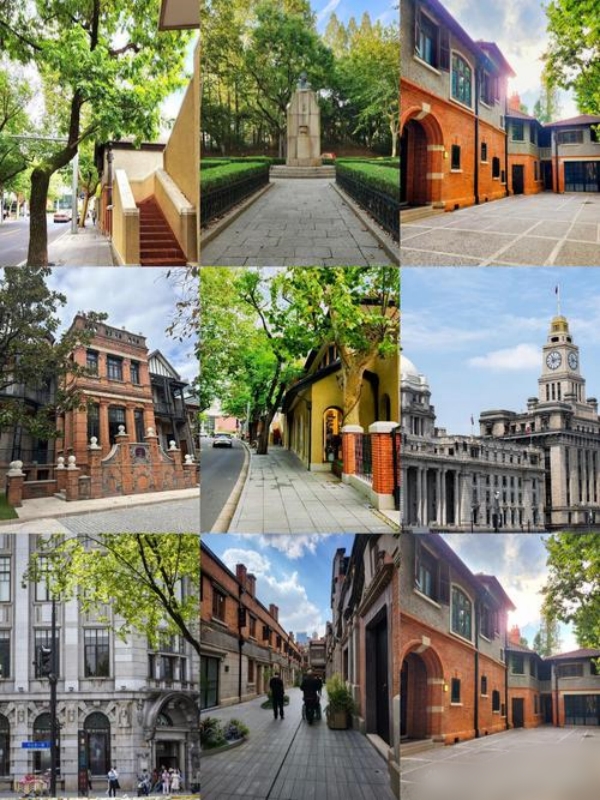
Wukang Road represents the apotheosis of the French Concession. French plane trees filter the light in a most cinematic way. Wukang Mansion — that bow-shaped edifice at the northern tip of the road — anchors the show. Turn off into almost any side lane down here and you’ll stumble into a garden longtang worth shooting.
The best route: Wukang Mansion → Hunan Road → West Fuxing Road → Wuyuan Road. Café hopping is built into the walk. The lanes are calm, photogenic, and still genuinely residential.
Getting there: Lines 10 / 11, Jiaotong University Station — Exit 7, then a 5–8 minute walk straight to Wukang Mansion. Alternatively, Line 10's Shanghai Library Station puts you at the southern end of Wukang Road in about 10 minutes. Best light: 3:00–5:30 PM, when the plane tree shadows cut deep into the lane floors.
📍 Full neighbourhood guide: exploring Wukang Road and the French Concession.
📋 Quick-reference: 4 Longtangs at a Glance
| Location | Metro | Best Time | Stay |
|---|---|---|---|
| Jing'an Villa | Lines 2/7 Jing'an Temple, 5 min | 7:30–9:00 AM | 45–60 min |
| Zhang Yuan | Lines 2/12/13 S. Nanjing Rd Exit 12, 3 min | Anytime | 1–1.5 hrs |
| City God Temple area | Line 10 Xiaonanmen, walk | Morning | 45 min |
| Wukang Road | Lines 10/11 Jiaotong Univ. Exit 7, 8 min | 3:00–5:30 PM | 1–2 hrs |
Daily Life Inside the Longtang Iron Gates
Step through the iron gate. That's where Shanghai changes.
What the Busy Alleys Look Like at Seven in the Morning
-
- Local Residents’ Morning Routines in Longtang
-
- Local Residents’ Morning Routines in Longtang
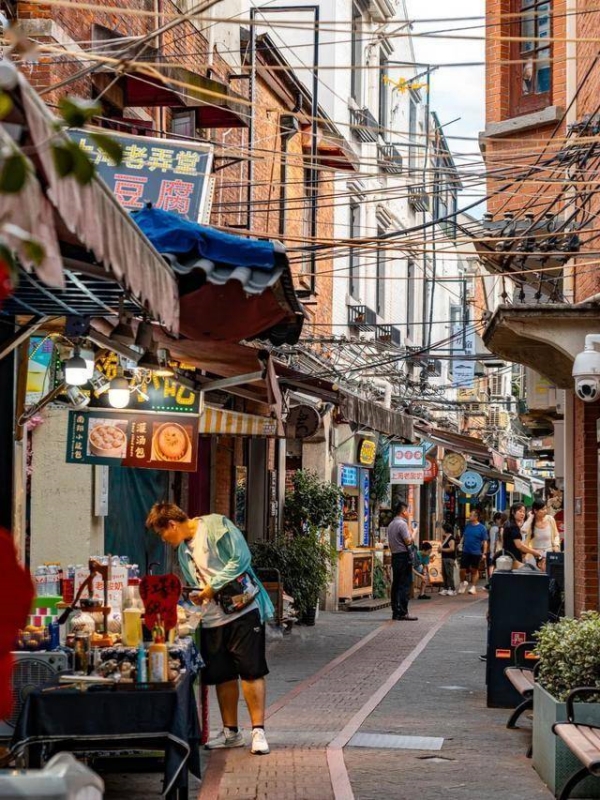
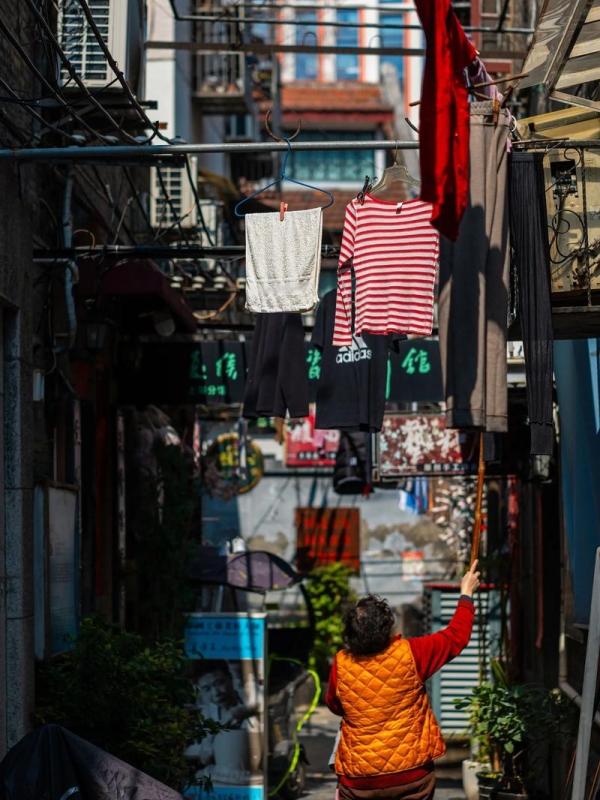
Seven in the morning is the longtang's peak hour. Miss it and you miss the point. By 9:00 AM, the lanes have already started to quiet down.
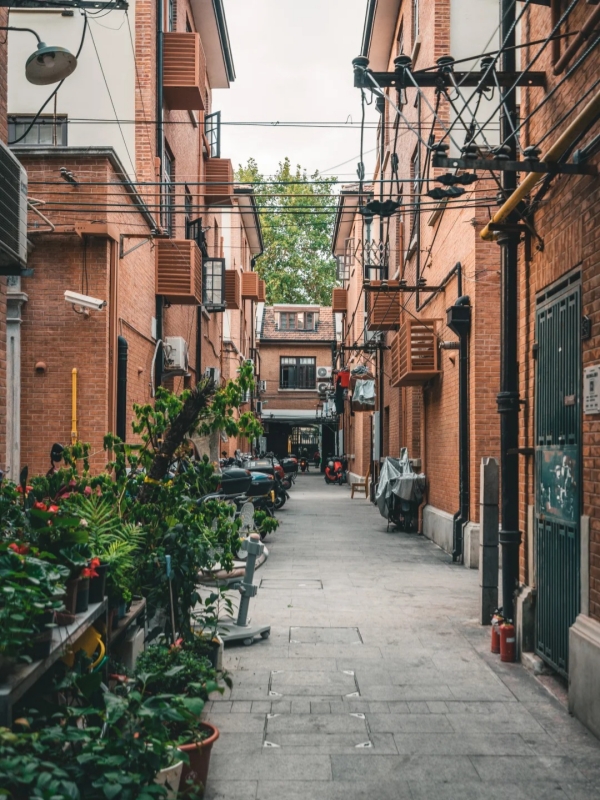
What you’ll actually see: grandmothers returning from the wet market with mesh bags bursting with vegetables; old men slumped over a folding table playing Chinese chess; someone brushing their teeth at the sink, flanked by cement walls, actively unperturbed. A tangle of power lines — dozens of cables strung out here and there between buildings — is perhaps the most photographed detail in any longtang. It’s everywhere. It’s very Shanghai.
Arrive at 7:00–7:30 AM for the best atmosphere. The morning market is in full swing, the breakfast stalls are steaming, and the light is soft. Don't come at 6:30 — the lanes are still dark and the sanitation crews are working. For photography, the golden hour hits between 4:00–5:30 PM, when the late afternoon light cuts through the tree canopy and into the alleys at a perfect angle.
Families Sharing Kitchens and Narrow Stairwells
Shared Alley Facilities in Old Shanghai Longtang
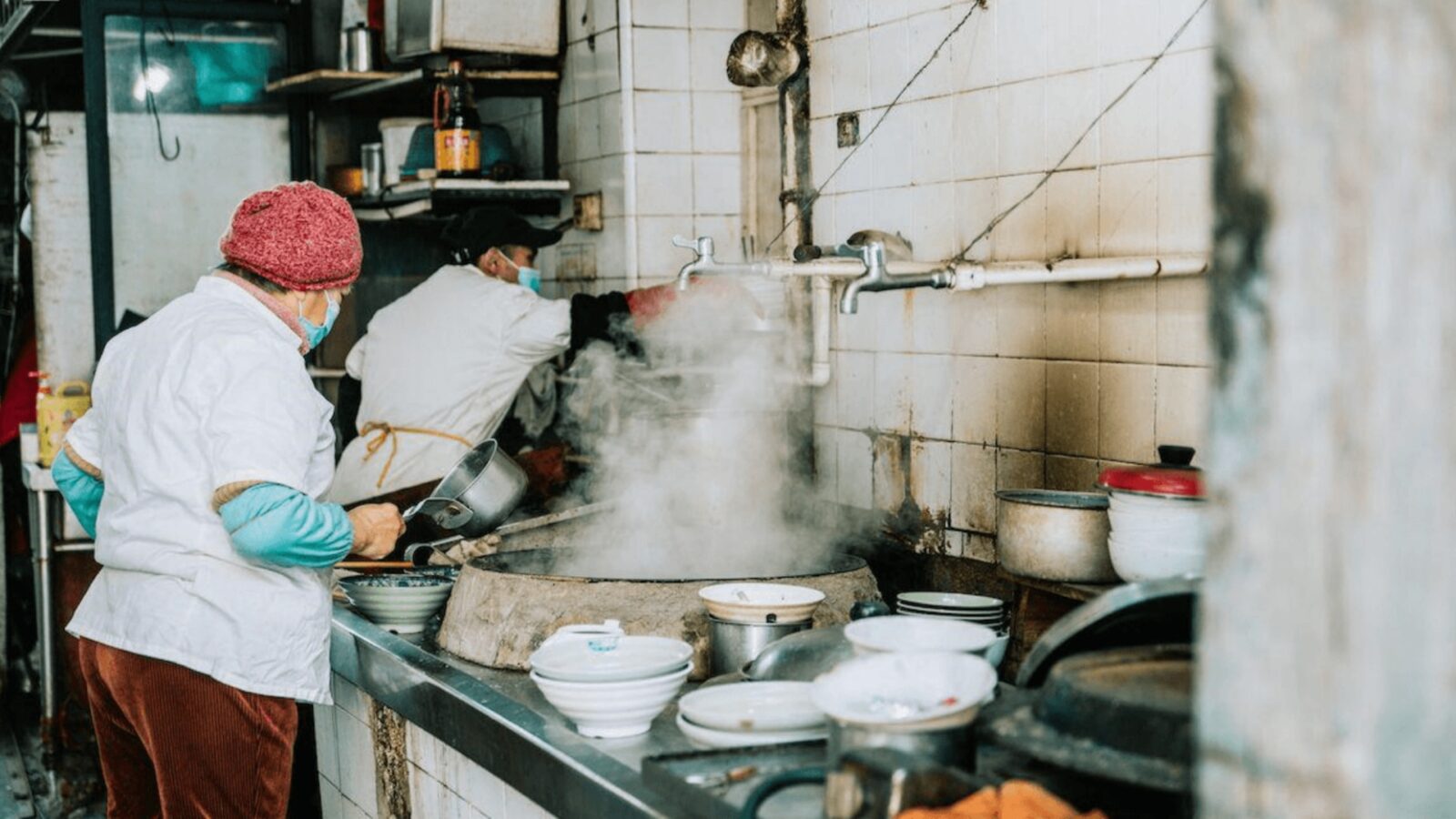
Imagine sharing a kitchen with two neighbours you've known for thirty years. You know their recipes by smell alone. You know when they've had a fight. That's longtang life.
Traditional lane houses were designed for communal living. Multiple families would share a single stairwell, a single corridor, sometimes a single kitchen. Many older shikumen units still have a communal sink situated in the outdoor trapezoidal sections. Three floors, three families, one building—that’s a typical arrangement. The staircases are narrow enough that two people have to turn sideways to pass one another. It’s physically close in a way that modern apartments are simply never going to be.
This is also what makes staying in a renovated longtang apartment so memorable — if you can find a properly licensed one (more on that in the FAQ section). The spatial logic of the building is unlike anything else in the city.
Decorating Window Ledges in Crowded Residential Spaces
Shanghai's most celebrated writers chose these lanes as their backdrop. Wang Anyi's novel Song of Everlasting Regret and Eileen Chang's essays both unfold inside longtangs — not because they're picturesque, but because they capture something true about how Shanghainese people live.
What surprised me the first time I walked through Jing'an Villa was how intentional everything looked despite the crowding. A rose on a window ledge, precisely placed. Printed curtains. An umbrella stand by the front door, organised. There's a phrase that comes up often in writing about these communities: "小资情调" — a certain bourgeois sensibility that locals maintained regardless of income. Longtang life was cramped. But it was never ungraceful.
Grandparents Raising Grandchildren in the Older Blocks
Elderly Local Residents Living in Traditional Longtang
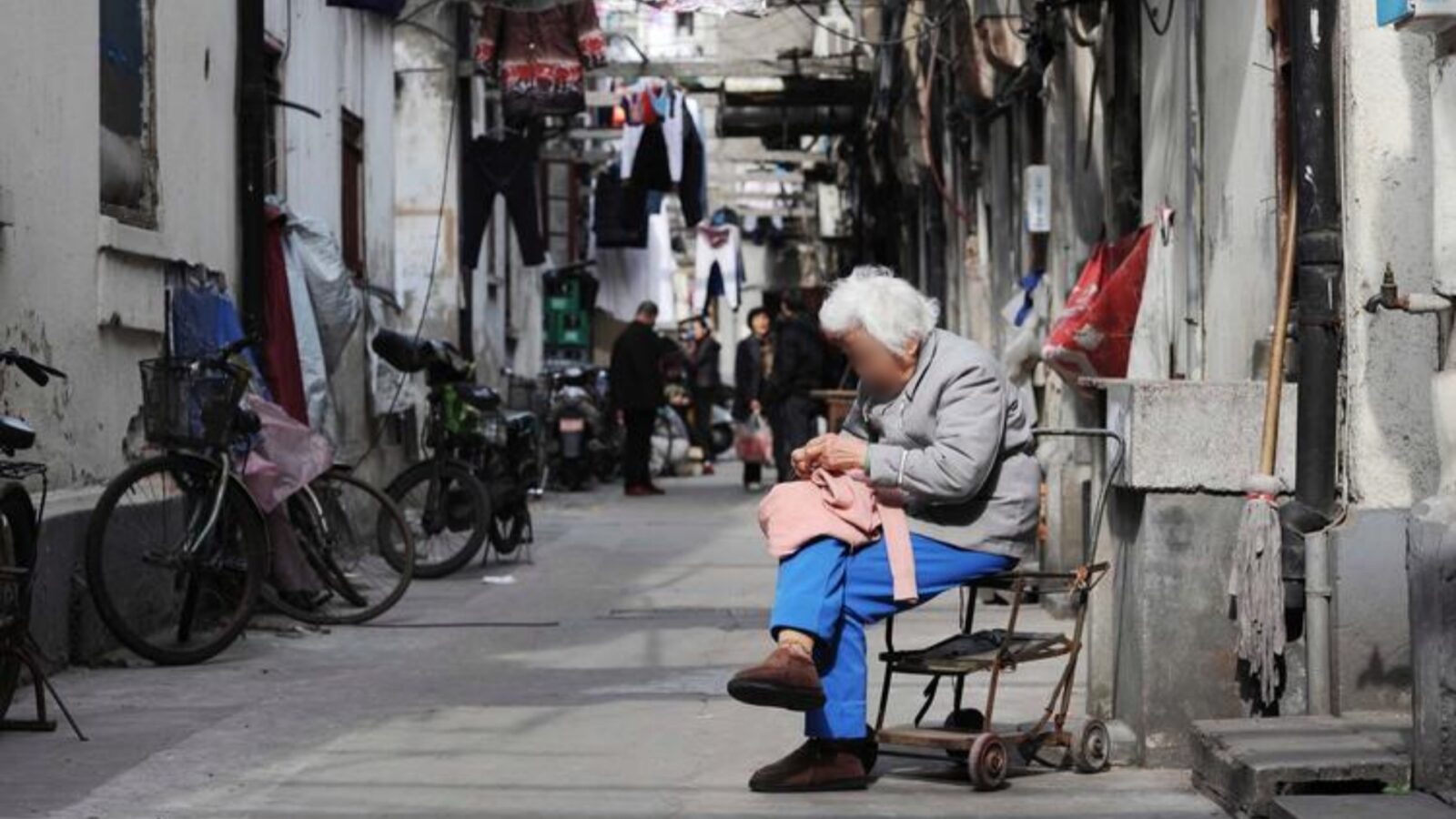
Walk through a longtang today and the demographic reality is clear. Most permanent residents are elderly. The younger generation has moved on — into modern apartments across the city, often out in the suburbs. Grandparents raising grandchildren is the most common household picture you'll see.
This doesn't mean the lanes are unwelcoming. Locals are often far more curious about foreign visitors than they let on. A smile and "你好" (nǐ hǎo) is usually all it takes to get a nod in return — sometimes a full conversation through a translation app. JohnnyIsaak put it well after his own visit: "They were just as curious about me as I was about them."
Street Markets and Food Near the Neighborhood Alleys
You haven't really seen a longtang until you've followed someone's grandmother into a wet market.
Finding Fresh Autumn River Crabs at the Wet Markets
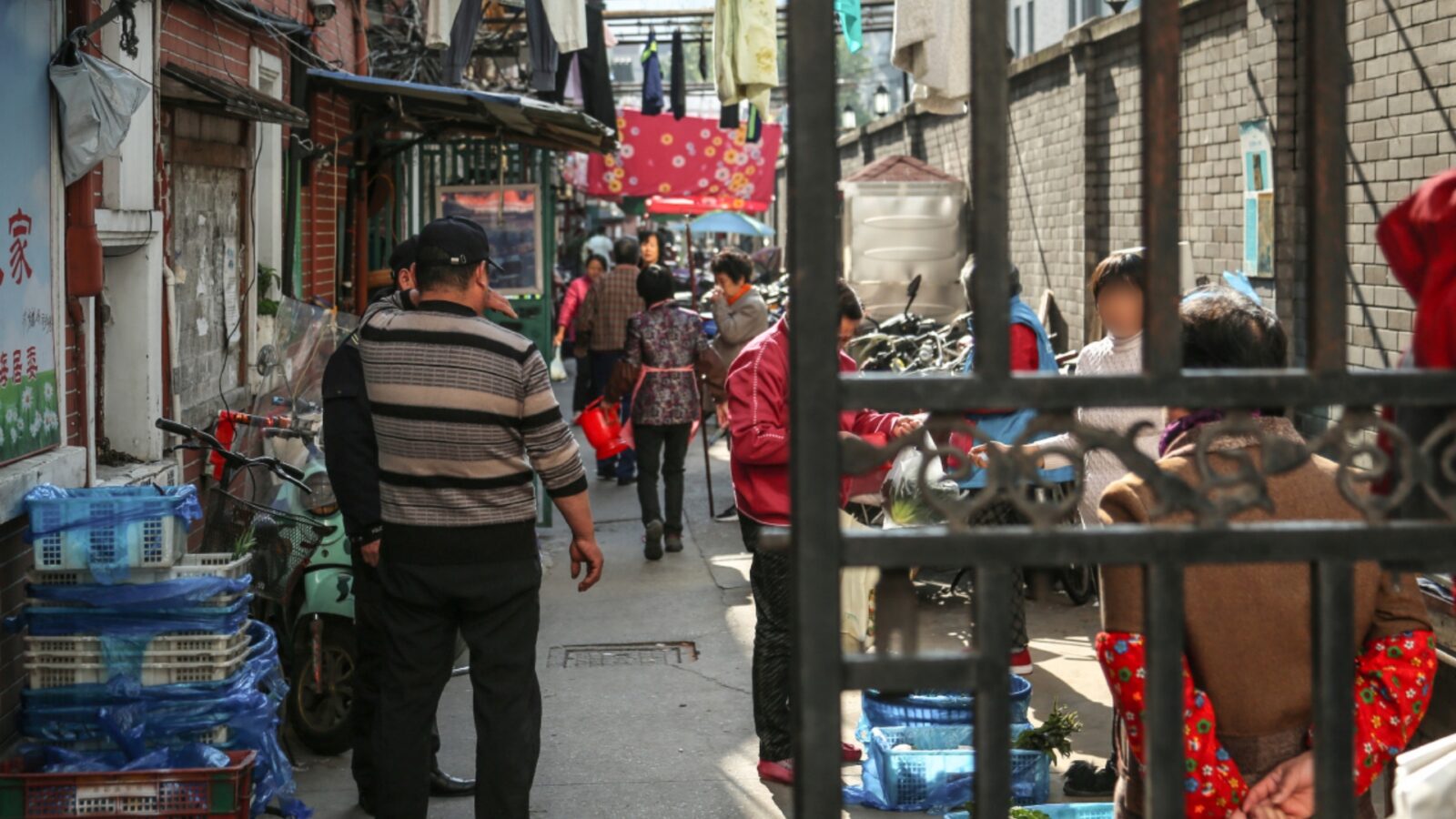
Local Wet Market Scenery in Shanghai Longtang
Almost every longtang has a small fresh market either inside or within a one-minute walk. Weekday mornings are calm. Weekends bring noticeably more energy — more stalls, more noise, more activity.
A quick note on what you’ll find: near longtangs, the wet markets carry every-day bulk goods, not premium branded goods. In autumn (September-November), you’ll see river crabs sold by the jin (half a kilo), heaped next to water chestnuts, wild rice stems and foxnut - these three together at that time of year are the true signal of a Shanghai autumn market. The famous Yangcheng Lake hairy crab? Specialty shop purchase, not market bin.
For a concrete reference point: the most accessible everyday market near Jing'an Villa is around the Shaanxi North Road / Weihai Road area. For something more raw and lively, the markets around Tanggu Road or Zhapu Road in old Hongkou are worth the trip if you're curious.
Buying Steamed Dumplings and Fried Dough at the Entrance
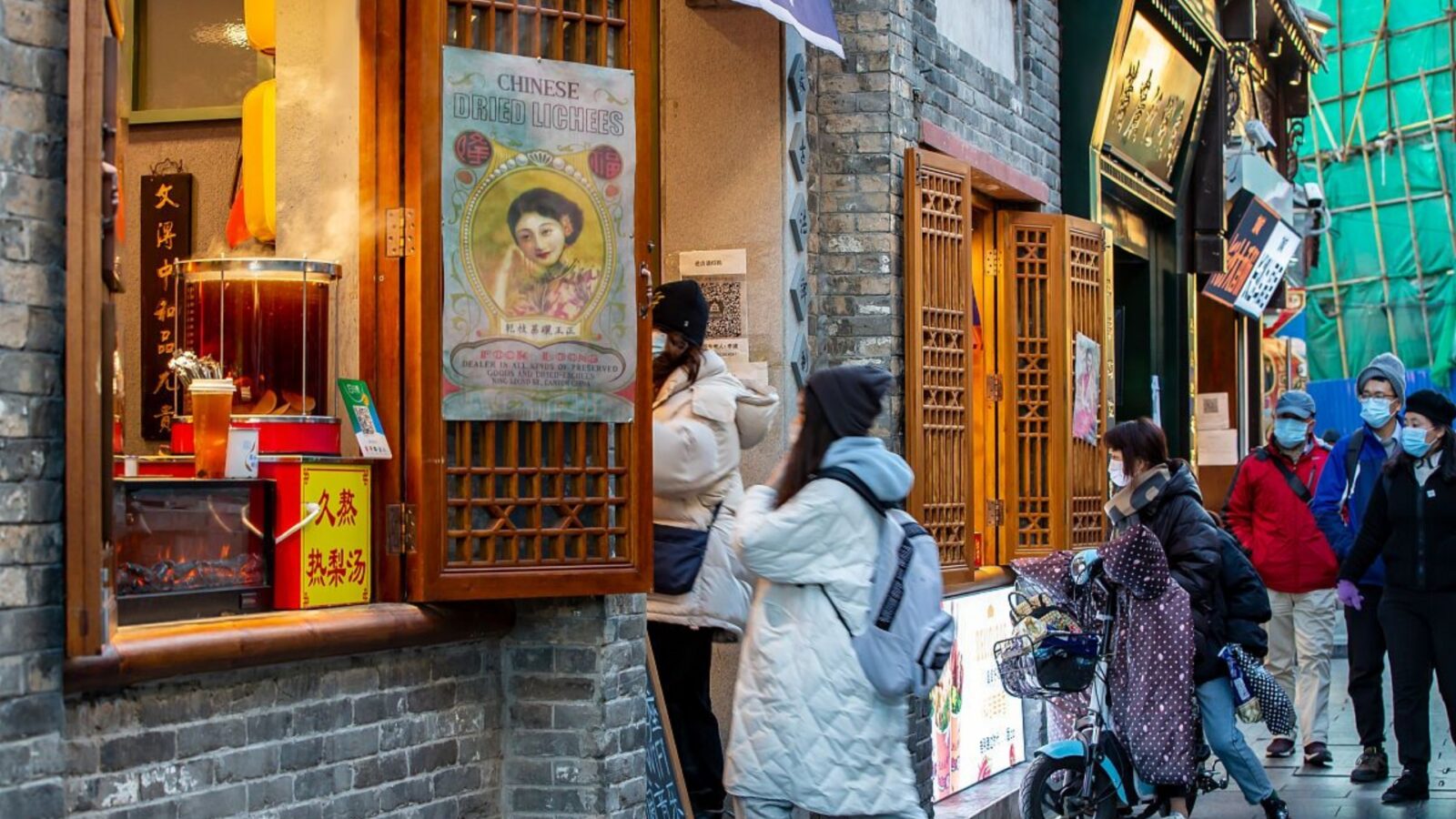
Classic Shanghai Breakfast Food in Longtang Alleys
The breakfast stalls near longtang market entrances are some of the best-value food in Shanghai. Look for smoke and a short queue — those are your two key indicators of quality.
The classics:
- You tiao (油条) — fried dough sticks, pulled fresh from the oil
- Xiao long bao (小笼包) — steamed soup dumplings, made to order
- Cong you bing (葱油饼) — scallion flatbread, crispy and fragrant
Ordering is easy. Point at what you want. Hold up fingers for quantity. Hand over cash or scan a QR code. You genuinely don't need a single word of Mandarin. Foreign faces often draw a few curious looks and sometimes a friendly attempt at conversation via a phone translation app — just go with it.
How Locals Negotiate Prices with Market Vendors

Local Stall Haggling in Shanghai Longtang
Market stalls near longtangs operate on negotiation. Not haggling is actually the odd behaviour. A 10–20% counter-offer is the normal range — don't go lower, because margins are already thin.
The simplest opening move: show the price on your phone calculator and shake your head slightly. If you want a verbal attempt, "tài guì le" (太贵了 — "too expensive") is universally understood and always gets a response. JohnnyIsaak described his own approach honestly: his wife handled all negotiations with a "take-no-prisoners" energy that he wisely never tried to replicate. Know your strengths.
The Demolition and Preservation of Shanghai Old Towns
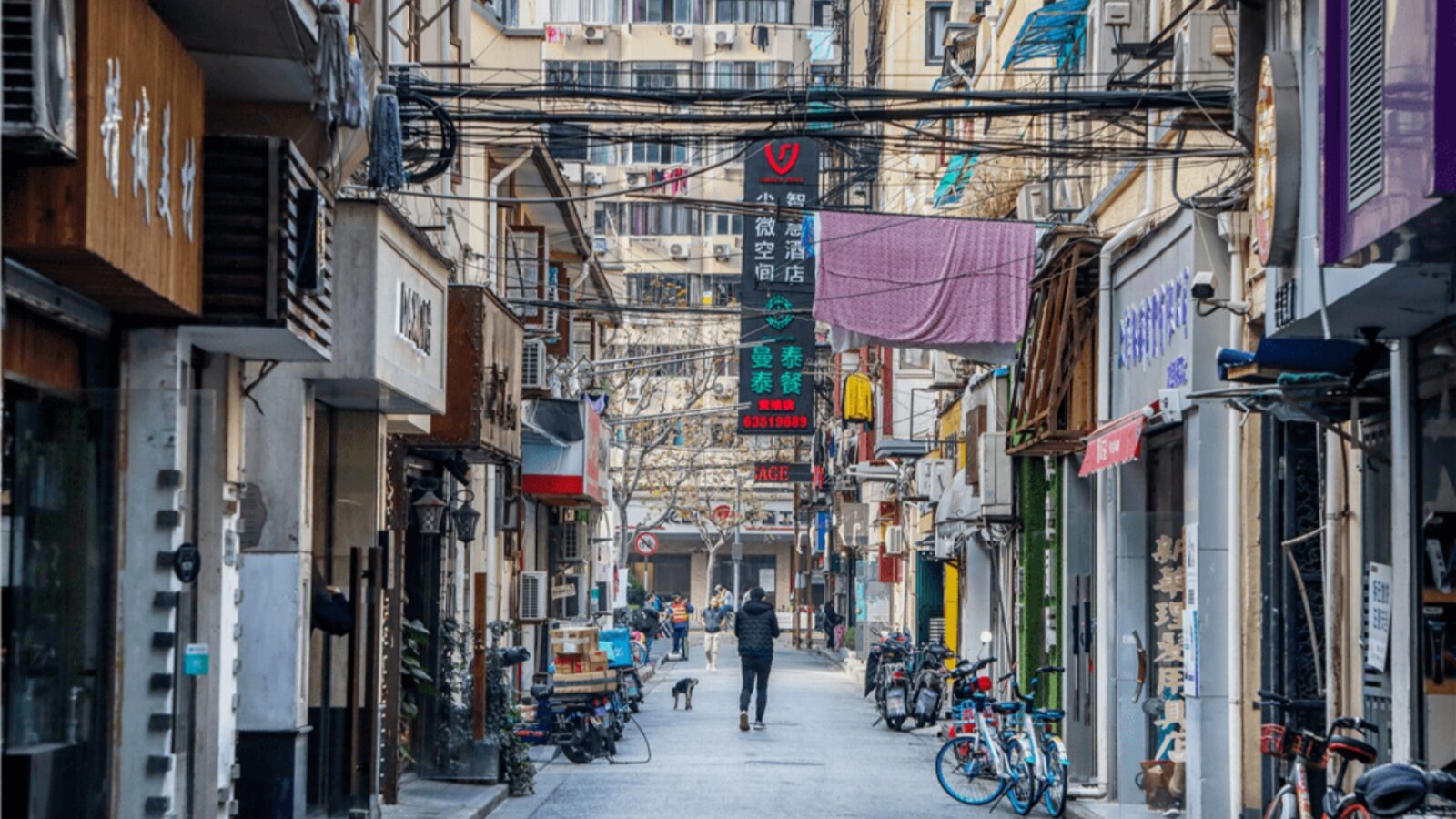
Vanishing Historic Longtang Alleys in Modern Shanghai
Walk into the right part of Old Town and you'll see it: a red painted character — 拆 — sprayed on a door. It means "demolish." It means this building is next.
How Relocation Policies Replaced Historic Neighborhood Demolition
For decades, the formula in Shanghai was simple: developers paid for the right to build on old housing; homeowners were compensated and relocated into new apartments on the city’s outskirts; the land was cleared and redeveloped—offices, mixed used, luxury homes.
2026 update: Shanghai's first major phase of mass-scale urban clearance is officially over. The city has formally shifted policy toward what planners call "保护优先、精细活化" — preservation first, careful revitalisation. Large-scale demolition of historical residential areas is now a policy of the past.
What this means for visitors is actually good news. The longtangs that survived the first wave are now protected. But the window between "still feels real" and "turned into a heritage shopping mall" is closing fast. The Three-City Weekly (三联生活周刊) put it starkly in their 2025 fieldwork: in parts of Old Town, the only long-term residents left are stray cats.
Opening Modern Coffee Shops in Preserved Stone Gate Houses
Zhang Yuan is the clearest example of what preservation looks like in practice. The exterior — stone gate frames, brick archways, tiled rooflines — was kept intact during restoration. The interior now holds independent coffee shops, design studios, and cultural exhibitions. Walk through it and you'll feel the paradox: the bones are from the 1880s, but the energy is entirely contemporary.
Xintiandi is the older, more famous case. It's polished, commercialised, and popular — which is both its success and its limitation. The more interesting preservation work is happening in smaller pockets: a lane here, a single block there, where the renovation hasn't quite steamrolled the texture out yet. Those are the places worth prioritising.
Why Former Residents Miss the Crowded Community Life
I've asked several long-time longtang residents the same question: do you miss it, now that you've moved out? The answers are always complicated. The honest version, which Mandarin Inn's Shanghai-born blogger put into words, is this — people got tired of sharing everything. They wanted their own space. They wanted modern bathrooms. And then they moved into a 22nd-floor apartment and realised they no longer knew their neighbours' names.
The longtang was cramped, noisy, and exhausting in the specific way that only constant proximity can be. It was also the opposite of lonely. That's the thing nobody quite prepares you for when you read about these communities in guidebooks.
Differences Between Shanghai Longtangs and Beijing Hutongs
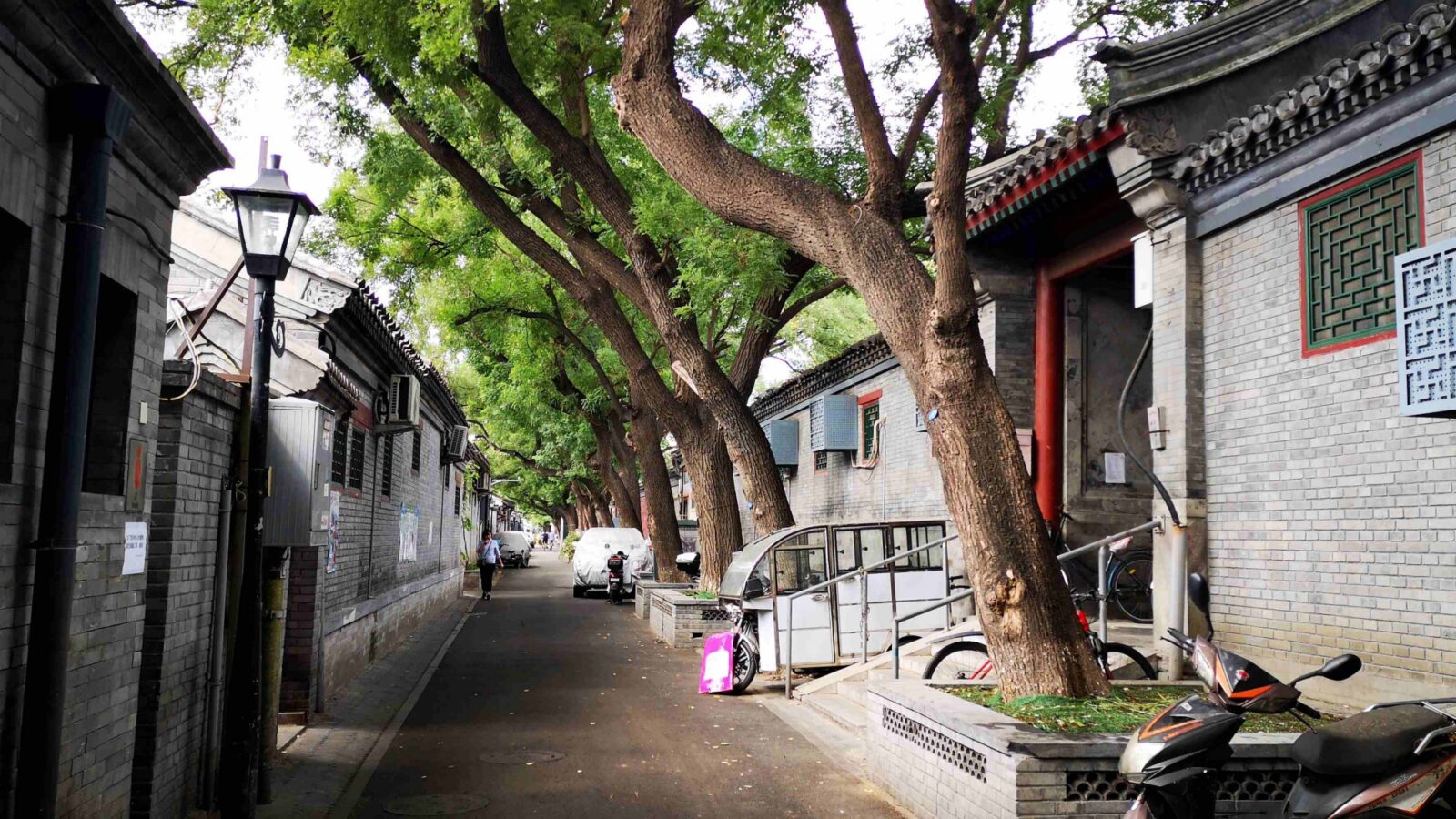
Classic Beijing Hutong Alley
The question comes up constantly. A longtang and a hutong aren't the same thing — and the difference tells you a lot about the two cities they belong to.
Both are historic residential lane systems. Both are disappearing. But step inside each and they feel utterly different. Shanghai’s longtangs are tight, vertical, and communal; Beijing’s hutongs lead to private courtyard compounds. The architecture speaks to each city’s character: Shanghai built for density and pragmatism; Beijing built for order and hierarchy.
📍 Planning a Beijing visit too? Our hutong tour guide covers everything you need.
Comparing Multi Story Terrace Houses to Private Courtyards
A longtang shikumen unit is a 2–3 storey terrace house. Multiple units share a stairwell, a corridor, and often a kitchen. There's no private outdoor space. Everything is vertical, stacked, and efficient — because Shanghai in the concession era had an extreme density problem and very limited land.
Beijing's siheyuan (四合院) is the opposite. Four buildings arranged around a central courtyard. One family, enclosed space, private sky above. The staircase in a longtang fits one person at a time — sideways. A siheyuan courtyard can fit a dining table and a garden.
Getting Lost in Winding Alleys Versus Walking a Straight Grid
Getting lost in a longtang is not just possible — it's likely. The lanes grow organically. There's no grid. One alley branches into three, and two of those dead-end at someone's front door. Beijing's hutongs, by contrast, follow a rough east-west grid laid down during the Ming and Yuan dynasties. You can usually tell which direction you're facing.
Practical tip: when you enter a longtang, note the name carved into the stone at the entrance — it's your anchor back out. Google Maps loses signal in some of the older, denser lanes. Offline maps help. And if you do get properly turned around, just keep walking — the lane has to end somewhere, and it usually ends on a major road within a few hundred metres.
How Cramped Spaces Built Shanghai Style and Beijing Order
Longtang architecture reflects Shanghai's particular genius: making very little space feel like enough. The "小资情调" (bourgeois sensibility) that writers like Eileen Chang observed wasn't despite the cramped conditions — it existed because of them. When you share walls with ten families, you develop an acute attention to aesthetics. A rose on a windowsill. A precisely folded curtain. These small gestures are forms of dignity.
Beijing's hutong culture is rooted in different values — deference to space, hierarchy, and structure. The siheyuan is designed around a central axis. The main room faces south. There's a logic to the layout that reflects Confucian order. Walk through both cities' historic residential districts in the same week and the contrast is impossible to miss.
Practical Tips for Visiting the Historic Lane Houses
A few things I wish someone had told me before the first time I walked into a Shanghai lane house. 🗺️
Walking Through Residential Areas Without Disturbing Locals
Yes — most longtangs don't have gates or security. The entrance is just an opening in the wall, and you walk through it. Renovated districts like Zhang Yuan have staff present, but they're not there to turn visitors away.
The right way to enter: follow someone who looks like they live there. Grandmothers heading to the market are ideal. Walk at their pace. Stop when something catches your eye, but don't plant yourself in a doorway. The lanes are narrow — blocking one is inconsiderate in a way that's immediately obvious.
Things that will get you noticed (not in a good way):
- Pointing a camera directly at someone's open window
- Blocking a stairwell landing for photos
- Speaking loudly on a phone call in the middle of a lane
Using Offline Translation Apps to Read Signs and Shop
In the renovated commercial sections of places like Zhang Yuan and Wukang Road, yes — young staff generally speak functional English. Inside a traditional residential longtang like Jing'an Villa? No. The permanent residents are mostly elderly and speak Shanghainese or Mandarin.
Four phrases that cover almost everything:
- 你好 (nǐ hǎo) — Hello
- 谢谢 (xiè xie) — Thank you
- 多少钱 (duōshao qián) — How much?
- 我迷路了 (wǒ mílù le) — I'm lost
Download Google Translate's offline Chinese language pack before you go. Camera translate mode is genuinely useful for reading market price tags and lane entrance signs.
Visiting in the Early Morning and Late Afternoon for Photography
Morning (7:00–9:00 AM): This is when longtang life peaks. The wet markets are open, the breakfast stalls are running, and residents are out. Arrive at 7:00 for peak energy. By 9:30, the lanes have quietened noticeably. Don't aim for 6:30 — the lighting is poor and the sanitation crew is still working.
Afternoon (4:00–5:30 PM): The photography window. Late light slices through the lane gaps at low angles. Plane tree shadows cross the pavement in long diagonals. This is when Wukang Road looks like a film still.
Midday: The quietest time. Good for looking at the architecture itself without navigating around people.
Riding Shared Bicycles Between the Different French Concession Lanes
Inside a longtang, you walk. Always. The lanes are too narrow for bikes — and bringing one in is inconsiderate to residents regardless of width.
Between longtangs, cycling is excellent. The best way to cover the French Concession route (Hengshan Road → Wukang Road → Anfu Road → Wuyuan Road) is by shared bike, hopping off at each lane entrance.
Currently the two most reliable shared bike apps in Shanghai's core districts:
- Meituan Bike (美团单车) — widest coverage, available via Meituan app or Alipay
- Qingju Bike (青桔单车) — DiDi-operated, WeChat or Alipay scan
Both accept international credit cards for deposit. Lock at the designated parking frames on the main street — never ride into a longtang lane. Hellobike (哈啰) has reduced its fleet significantly in central Jing'an, Huangpu, and Xuhui districts since 2024, so don't count on it.
✅️ Do:
- Enter from the main lane gate and stay in public areas
- Smile before raising your camera near residents
- Visit early — 7:00–9:00 AM is the sweet spot
- Download offline maps and Google Translate before going
❌️ Don't:
- Film through open windows or into private doorways
- Ride a bike inside the lanes
- Expect English from elderly residents
- Assume the City God Temple area still has a living community (it largely doesn't)
Frequently Asked Questions About Shanghai Lane Communities
Q: What is the difference between a longtang and a hutong?
A longtang is Shanghai's version of a historic residential lane community — rows of two to three-storey terrace houses sharing narrow alleys. A hutong is Beijing's equivalent, but it opens onto private courtyard compounds (siheyuan) and follows a strict east-west grid. Longtangs are vertical, shared, and organic; hutongs are horizontal, private, and ordered. Same era, completely different spatial logic, and two cities' worth of personality difference packed into those two words.
Q: What does "lilong" mean, and is it the same as longtang?
Lilong (里弄) and longtang (弄堂) refer to the same type of historic Shanghai neighbourhood. Longtang is the everyday spoken term; lilong tends to appear in academic or formal writing. Both describe the lane-house communities built during the concession era. Shikumen (石库门) is not a synonym — it's a specific architectural style found within these communities, identifiable by its stone-framed gate and arched lintel.
Q: Are Shanghai's longtangs open to the public?
Most longtangs don't have locked gates — you can walk into the main public lane freely. Restored districts like Zhang Yuan have staff present but are open to visitors without admission. Residential longtangs like Jing'an Villa are still lived in, so treat them accordingly: main lanes are accessible, but private stairwells and doorways are not for visitors.
Q: What is a shikumen?
Shikumen (石库门) is a building type specific to Shanghai's longtang communities. The name means "stone warehouse gate" — a literal description of the granite doorframe and arched lintel that marks the entrance to each unit. Built primarily between the 1860s and 1930s, shikumen design fuses Western terrace-house structure with Chinese courtyard sensibility. It's the signature architecture of the longtang, and the best surviving examples are in Jing'an and Huangpu districts.
Q: Where is the best longtang to visit in Shanghai for a first-timer?
For a first visit, Zhang Yuan is the most accessible — it's restored, publicly open, easy to navigate, and still feels genuinely atmospheric. For a more local, unpolished experience, Jing'an Villa is the better choice, but go early and read the etiquette notes carefully. If photography is the priority, base yourself on Wukang Road and explore the surrounding lanes.
Q: Why are Shanghai's longtangs disappearing?
Decades of urban redevelopment saw developers purchase longtang properties, relocate residents to suburban high-rises, and build new commercial or residential projects on the cleared land. Shanghai's large-scale clearance phase is now officially closed as of early 2026 — the city has shifted to preservation and adaptive reuse. But the longtangs that survive are now caught between genuine protection and commercial transformation. The window to see them before they're fully packaged for tourism is real, and it's not wide.
Q: Is it rude to take photos inside a longtang?
Photographing the architecture is fine. Pointing your lens directly at residents, their windows, or their doorways without any acknowledgment is not. A brief moment of eye contact and a smile before raising a camera goes a long way. If someone shakes their head, lower the camera. The longtang isn't a set — people live there, and that's exactly what makes it worth photographing in the first place.
Q: Can you stay overnight in a longtang in Shanghai?
Short-term residential rental platforms (Airbnb-style) now operate under strict regulations in Shanghai, and unlicensed informal rentals are not recommended. The legal route for a longtang-style overnight experience is to book a licensed boutique hotel or registered guesthouse in a renovated heritage building — particularly in the Hengfu Conservation Area (衡复风貌区). These properties retain the exterior shikumen architecture and spatial character while meeting official safety and registration requirements. Search for stays with "历史建筑" (heritage building) tags on booking platforms.
Q: How do longtangs compare to Shanghai's newer neighbourhoods?
Walking from a longtang into Pudong — or even into a standard Shanghai apartment complex — is a genuine culture shift. The new city is efficient, modern, and anonymous in the way that modern cities tend to be. A longtang is inefficient, impractical, and full of texture in all the ways that make a city feel alive. Shanghai contains both, and the contrast between them is part of what makes the city worth spending real time in.