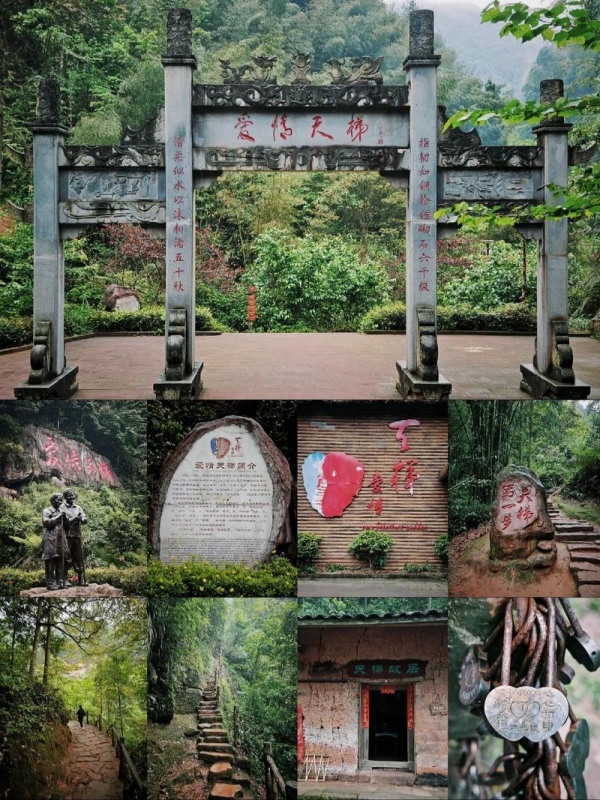
Ladder of Love, Chongqing, China
In the forested slopes of Simian Mountain, roughly 30 kilometers from Chongqing's urban core, a staircase unlike any other winds through the wilderness. Six thousand, two hundred and eight hand-carved stone steps climb from the valley floor to a modest former home — a trail built entirely by one man over more than five decades using nothing but rudimentary tools. The steps, known as the Ladder of Love China, were not constructed for tourism or commerce. They were carved, step by step, by Liu Guojiang so his wife Xu Chaoqing could descend the mountain safely each day. Today the route draws visitors from across China and beyond, not for its engineering grandeur but for what it represents: an extraordinary act of devotion preserved in stone.
This guide covers the full story behind the steps, what to expect on the hike itself, practical safety advice, how to reach Simian Mountain from Chongqing, and everything you need to know before booking your visit.
Quick Facts
The Love Story Behind the Ladder of Love in China

Ladder of Love
In 1956, a 19-year-old man named Liu Guojiang left his village in Jiangjin District with a 29-year-old widow named Xu Chaoqing, who had four children from a previous marriage. The couple fled social stigma by retreating into the forested wilderness of Simian Mountain, where they built a home far from the nearest road or settlement. For decades they lived largely isolated from the outside world, subsisting on what the mountain provided.
The problem was the terrain. The only path down the steep, rocky slopes was treacherous, especially for Xu as she aged. Liu resolved to change that. Over approximately 50 years, using only a hammer, steel rods, and hand tools, he carved and mortared 6,208 individual stone steps into the mountainside. He reportedly broke roughly 20 hammers and worn down 40 steel rods in the process. The work continued through all seasons, often in rain and humidity, until a complete ascent existed where only raw rock had been before. His motivation was simple and practical: he wanted his wife to be able to climb down safely.
A group of adventurers rediscovered the couple and their staircase in 2001. Word spread rapidly, and the site became a destination for hikers and romantics alike. The local government subsequently designated the area as a protected scenic site and restored elements of the trail. The Ladder of Love in China has since been listed among China's most notable love stories by Chinese Women Weekly. Xu Chaoqing passed away in 2022, but descendants of the couple continue to maintain the former residence at the summit, keeping the home and shop operational for visiting hikers.
The Hike: 6,208 Steps, Trail Route, and Scenery
The Ladder of Love forms the centerpiece of a marked 2.2-kilometer loop within the Simian Mountain scenic area. Visitors ascend via the original hand-carved steps and descend via a separate, park-built trail fitted with handrails — a smoother path designed for the return leg. The contrast between the two routes is immediately apparent: one raw and uneven, the other purpose-built and maintained. Both converge at the same trailhead parking area, so the loop closes cleanly.
Along the way, a sequence of numbered markers guides hikers through the site's key landmarks. The trail is generally well-signed, with restrooms at the main trailhead facilities and at several intermediate points. The ascent is steep throughout, with some sections approaching near-vertical, and the highest concentration of steps occurs in the humid mid-trail zone where moss and moisture persist year-round.
Route and Trail Markers
Ladder of Love
The official loop sequence passes through eleven named waypoints:
- Parking Lot: Trailhead entry point; parking fees apply here.
- Tourist Centre: First restroom stop and general information point.
- Mutual Guard Tomb: A heritage marker along the lower loop.
- Home of Liu Guojiang's Son: Descendant residence with restroom facilities.
- Story Museum: Exhibits recounting the couple's history and the carving effort.
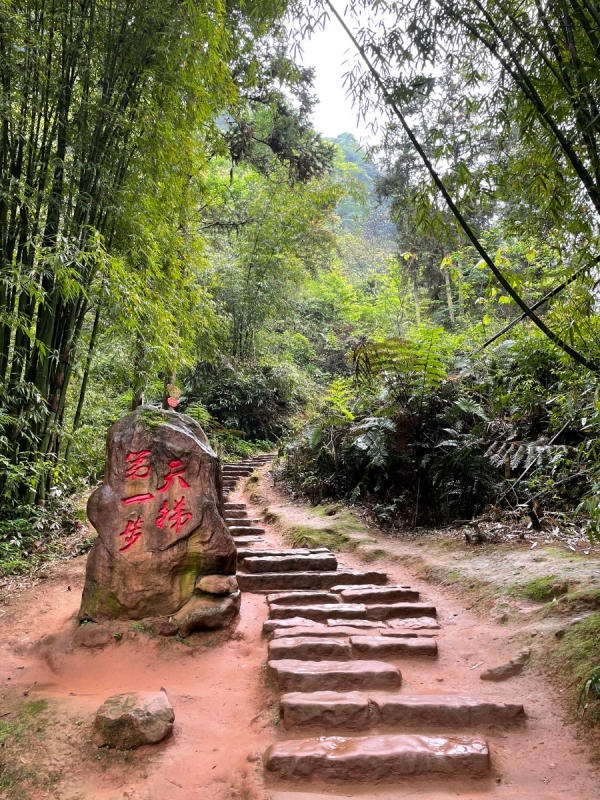
- First Step of the Celestial Ladder: The marked beginning of the hand-carved ascent; restroom available.
- Hiking Trail Ascent: The 6,208-step climb itself — narrow, uneven, moss-covered in places.
- Former Residence: The couple's original home, now maintained by descendants; summit shop on site.
- The Rock Shelter: The original overhang where Liu stored firewood and shelter; accessible via a short stair from the house.
- Mountain Waterfall: A natural feature visible from the upper trail section.
- Return to Story Museum, Tourist Centre, and Parking: Descent via the smoother park-built trail.
What the Ascent Feels Like
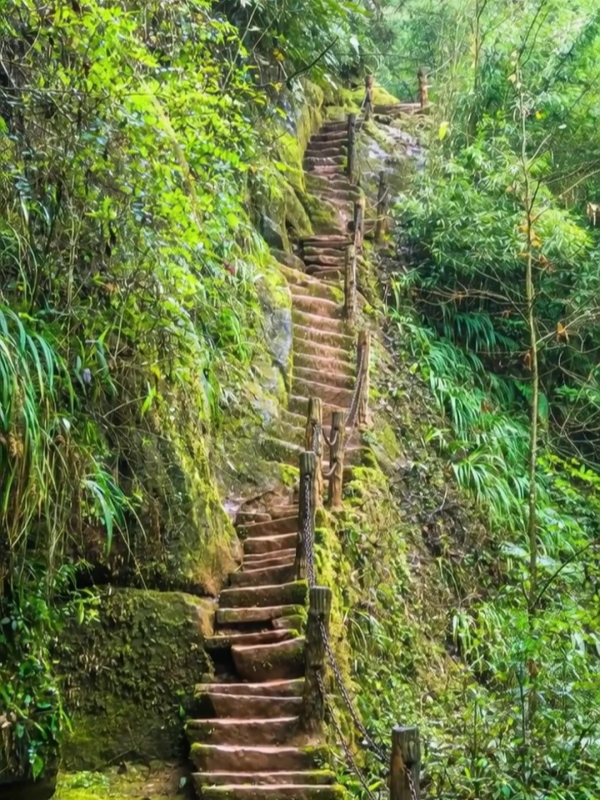
The steps themselves are narrow, made of local stone, and vary considerably in both height and tread width — a direct result of being individually carved over decades rather than engineered to uniform specification. Step risers in the steepest sections reach approximately 40 centimeters. The stones have been worn smooth in places by decades of use, and moss or sand accumulation after rain can make them slippery. Near-vertical sections are fitted with installed metal chains to assist balance; small handholds — sometimes described as "handkerchief grips" — protrude from the rock face at regular intervals. In some exposed sections, wooden beams prop the steps against the cliff edge.
The humid forest environment means mid-trail sections are shadier and more enclosed, with a corresponding increase in insect activity. Hikers should expect damp stone surfaces even on dry days in the forest canopy zones, and notably so after any rainfall. The physical demands are considerable: the climb is continuous with no vehicle-accessible shortcut, and the uneven surface requires constant attention to footing.
🏔️ Explore Chongqing’s Mountainous Terrain: Beyond the forested trails of Simian Mountain, the municipality is defined by dramatic karst peaks and river gorges. Discover the region's top summits in our guide to Chongqing Mountains.
The Summit: Former Residence and Rock Shelter
Ladder of Love
Reaching the top of the ascent, hikers arrive at the former residence of Liu Guojiang and Xu Chaoqing, now operated by their descendants. A small shop at the summit sells water, snacks, douhua fan — a rice and tofu pudding dish popular in the region — and Chongqing ice jelly, a refreshing gelatin dessert. The original rock overhang that served as the couple's firewood shelter sits to the left of the house, accessible by climbing a short stair set into the stone.
From the summit, the descent follows the separate park-built trail, which features smoother paving and handrails along the steeper sections. This return path is considerably easier on the knees and feet than the ascent, making the loop practical for most reasonably fit visitors within a half-day timeframe.
🧗 Discover Chongqing's Famous City Steps: Chongqing is known for its steep, dramatic staircases. Beyond mountain trails, explore the city's most famous historic walking street in our guide to 18 Steps Chongqing.
Safety and Deaths on the Ladder of Love in China
The Ladder of Love is a demanding natural trail, not a managed boardwalk. With proper preparation and awareness, it is navigable for most visitors of reasonable fitness, but it does carry real risks that are worth acknowledging plainly.
- Steep, near-vertical sections: Metal chains are installed at the steepest points to assist balance. Use them without hesitation.
- Slippery surfaces: Moss and sand accumulation, particularly after rain, make stones significantly more hazardous. Consider postponing the hike if heavy rain fell the night before.
- Uneven step heights: Step risers vary considerably; watch your footing continuously, especially in the mid-trail forest zone.
- Limited cell service: Mobile network coverage is unreliable along the ascent. A power bank and offline maps are advisable.
- Insect presence: The humid forest mid-trail has the highest insect activity. Apply repellent before starting the ascent.
- No-smoking policy: The trail and surrounding forest are subject to a year-round no-smoking restriction due to fire risk.
- Visitor registration: All hikers are typically required to register at a checkpoint before starting the ascent.
Regarding the questions that surface most frequently: no widely-documented fatal fall on the original hand-carved route is publicly recorded. The trail remains in active use, and the local management has installed practical mitigations — chains, handrails on the descent, checkpoint registration. Serious incidents concentrate on the steep, mossy sections after rain and on the near-vertical portions without guardrails. Visitors who respect the terrain, wear appropriate footwear, and avoid the trail in wet conditions generally complete the hike without incident.
Getting to the Ladder of Love in Chongqing
Chongqing serves as the primary hub for visiting the Ladder of Love. The trailhead sits within the Simian Mountain scenic area in Jiangjin District, roughly 30 kilometers by road from Zhongshan Ancient Town and approximately 30 kilometers from central Chongqing's nearest metro-accessible areas. Several transport options connect the city to the mountain, ranging from entirely public transit to private vehicle.
By Metro, Bus, and Taxi
From central Chongqing, take Chongqing Rail Transit Line 5 to a Jiangjin District station. The metro fare within the city is typically modest, around $0.55–1.10 (¥4–8) depending on distance. At the Jiangjin station, transfer to a local bus heading toward Zhongshan Ancient Town or the Simian Mountain area — local bus fares run roughly $0.55–1.40 (¥4–10). The final leg from Zhongshan to the Ladder of Love parking area covers approximately 30 kilometers and is typically covered by taxi or ride-hail, costing about $11–17 (¥80–120) one-way by taxi or DiDi, with pricing varying by demand. Total door-to-trailhead journey time is generally 2.5 to 3.5 hours. Confirm local bus schedules and last departures on site before your visit, as services may vary by day and season.
By Car and Driver
Driving from central Chongqing, the expressway route to the Zhongshan exit takes approximately 1.5 to 2 hours in normal traffic, longer during holiday peak periods. From the exit, continue on local roads to the Simian Mountain scenic area and the designated Ladder of Love Parking Lot — this destination is recognized by Amap and Gaode Maps. Parking at the trailhead costs approximately $1.40–2.80 (¥10–20) per vehicle per day. Visitors who prefer not to drive can arrange a private car and driver from central Chongqing, typically costing around $55–85 (¥400–600) round trip depending on vehicle type and waiting time. This option provides the most flexibility for setting your own schedule and starting the hike at a time that suits you.
Tickets, Booking, and the Simian Mountain Combo
The Ladder of Love is not a separately ticketed monument — it is a foot-access trail within the Simian Mountain scenic area. Once inside the main scenic gate, the 6,208-step ascent is included in your admission. The trail is reached on foot from the trailhead parking area inside the park, and no additional stamp or add-on ticket is required to use the steps themselves. Parking and any shuttle services within the scenic area are handled separately at the trailhead.
- Trip.com / Klook (foreign-card-friendly): Simian Mountain adult admission typically about $14–17 (¥100–120). These are the primary international-facing booking channels that accept foreign payment cards.
- Simian Mountain Combo tickets: Bundled tickets combining scenic area admission with access to related attractions in the park are available for approximately $17–28 (¥120–200), depending on which sites are included. Check current listings on Trip.com or Klook for the specific combo that matches your interests.
- Domestic-only channels: Meituan, Dianping, and WeChat mini-programs require a mainland Chinese phone number and WeChat Pay or Alipay — they are not usable for most foreign visitors and are not listed here.
- On-site purchase: Walk-up tickets at the Simian Mountain main gate are generally available, but booking in advance through Trip.com or Klook is advisable during weekends and holiday periods to secure entry and avoid queuing.
What to Bring and On-Trail Tips
The Ladder of Love is a natural mountain trail with no services along the ascent — no vendors, no shelters, and limited to no cell reception in the forest sections. Preparation matters.
- Sturdy non-slip hiking shoes: Sandals and flat-soled shoes are unsafe on the uneven, mossy stone steps. Hiking boots or trail shoes with aggressive tread are strongly recommended.
- Insect repellent: The humid mid-trail forest zone has elevated insect activity, particularly in warmer months.
- Rain jacket or quick-dry layer: Stone surfaces become slippery after rain, and light rain gear helps regardless of forecast — mountain weather can shift quickly.
- Refillable water and snacks: No water vendors exist along the ascent. Carry at least 1 liter of water per person and sufficient food for a 3–5 hour outing.
- Hat and sun protection: Open ridge sections are exposed. Sun protection is advisable in spring and autumn, essential in summer.
- Power bank: Cell service is unreliable along the trail. Keep your phone charged for emergencies and offline trail maps if downloaded.
- Small daypack only: A lightweight pack keeps your hands free. Metal chains are installed at steep sections specifically to support balance — having both hands available is genuinely useful.
Optional additions worth considering: lightweight gloves for a better grip on the chains, a compact first-aid kit, and — where permitted — collapsible trekking poles for added stability on the descent.
Frequently Asked Questions
Q: Has anyone fallen off the Ladder of Love in China?
No widely-documented fatal fall on the original hand-carved route is publicly recorded. The trail is in active use and has chains installed at steep sections. Serious slips tend to occur after rain on mossy or sandy stones and on near-vertical portions. An easier alternate descent path with handrails is available for those who want to reduce risk on the return leg.
Q: Is the Ladder of Love in China real?
Yes. The 6,208 hand-carved steps exist in Simian Mountain, Jiangjin District, Chongqing. The couple Liu Guojiang and Xu Chaoqing were rediscovered by a group of adventurers in 2001. The local government has preserved the site and the former residence, which now operates as a museum maintained by the couple's descendants.
Q: How many steps does the Ladder of Love in China have?
The ascent comprises 6,208 individual hand-carved stone steps. Liu Guojiang reportedly used roughly 20 hammers and 40 steel rods over approximately 50 years to complete the work.
Q: Is the Ladder of Love dangerous?
The trail is moderate-to-demanding rather than inherently dangerous, but it is not suitable for visitors with significant mobility limitations. Primary risks are slippery moss and sand after rain, near-vertical step sections, and limited cell service. Chains, an easier descent trail with handrails, and checkpoint visitor registration help mitigate the most serious hazards. Bring sturdy non-slip footwear, water, and a rain layer.
Q: Where is the Ladder of Love in China located?
The site is in Simian Mountain, Jiangjin District, Chongqing Municipality, China. It is approximately 30 kilometers by road from Zhongshan Ancient Town and roughly 30 kilometers from central Chongqing. The nearest major transport hub is Chongqing, accessible via Chongqing Rail Transit Line 5 to Jiangjin District.
Q: Can you visit the Ladder of Love without hiking all 6,208 steps?
No vehicle-accessible road reaches the summit. The hand-carved steps are the only direct route to the former residence. Visitors of limited fitness can hike partway up — for example to the Narration Pavilion or the Mutual Guard Tomb — and return via the same trail or the easier park-built descent path. Confirm turnaround points and route options on site before starting.