Dr Sun Yat-sen Mausoleum Nanjing
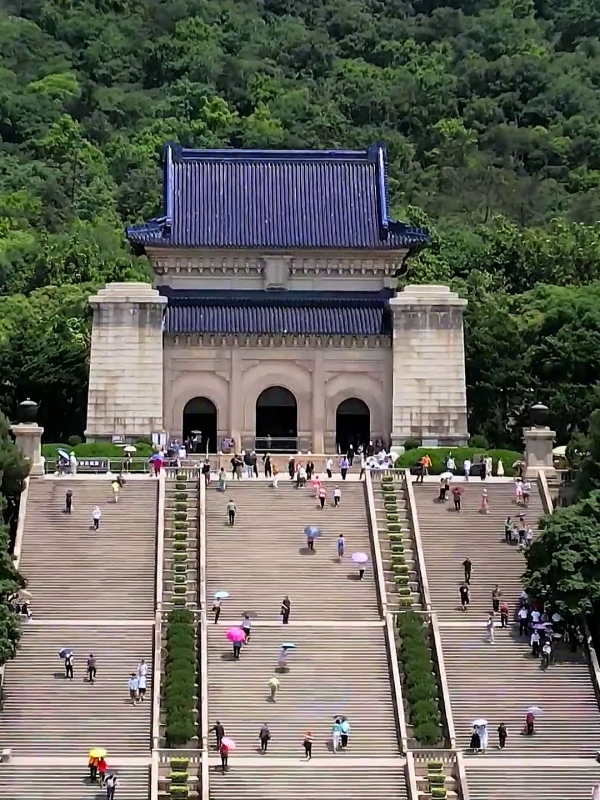
Dr Sun Yat-sen Mausoleum crowns the north slope of Purple Mountain in Nanjing, standing as the most visited Revolutionary-era memorial in China. The mausoleum honors Sun Yat-sen (1866–1925), the physician-turned-revolutionary who ended 2,000 years of imperial rule and founded the Republic of China. Construction ran from 1926 to 1929 under architect Lu Yanzhi, producing a structure that fuses traditional Chinese tomb symmetry with modern reinforced concrete. Visitors climb 392 stone steps through a pine-shaded corridor before reaching the summit Sacrificial Hall. The site sits within the vast AAAAA Zhongshan Mountain Scenic Area, making it a natural starting point for a full day exploring Nanjing's most celebrated outdoor attractions.
The mausoleum remains free to enter, a policy that draws hundreds of thousands of domestic and international visitors annually. Most travelers approach via Muxuoyuan Station on Nanjing Metro Line 2, then either walk roughly 10 minutes or catch the scenic-area shuttle. The surrounding Purple Mountain landscape changes dramatically across seasons — spring azaleas, summer canopy, autumn ginkgo gold, and winter quiet. A short walk from the main mausoleum leads to the Music Stage, an open-air amphitheater that ranks among the world's three great concert venues of its kind.
Quick Facts
Who Was Sun Yat-sen & Why This Mausoleum
Dr Sun Yat-sen Mausoleum Nanjing
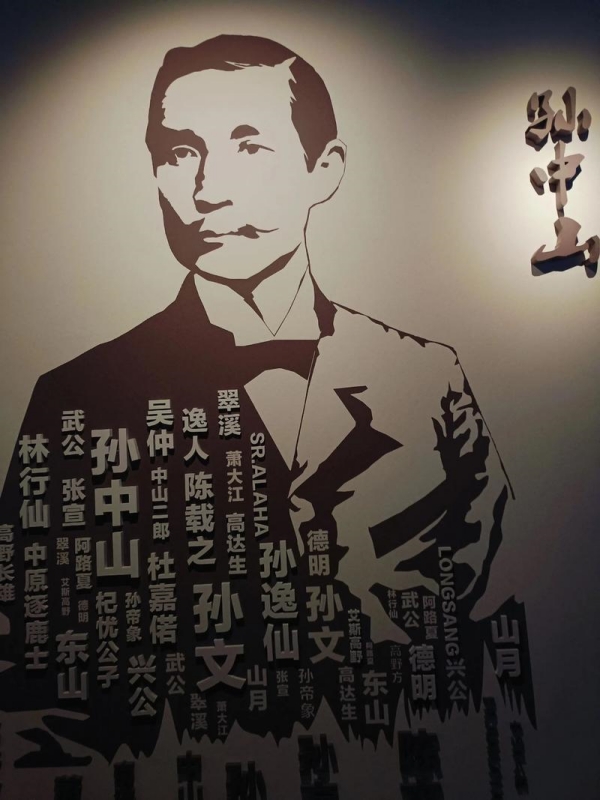
Sun Yat-sen (1866–1925) holds a unique position in modern Chinese history. Across the political spectrum, he is remembered as the "Father of Modern China" — a label acknowledged by both the ruling Communist Party and the opposition Kuomintang. His 1911 Revolution toppled the Qing monarchy and established the Republic of China, ending over two thousand years of imperial rule. Sun framed his program around the Three Principles of the People: Nationalism (民族), Democracy (民权), and Livelihood (民生). He died in Beijing on March 12, 1925, after years of exile, armed uprisings, and political organizing across China and overseas.
The choice of Nanjing for his final resting place was deliberate. His coffin rested temporarily at Biyun Temple on Fragrant Hill before being moved to Nanjing on June 1, 1929. The north slope of Purple Mountain was selected so that visitors ascending toward the Sacrificial Hall look south — toward the city Sun Yat-sen helped create. Architect Lu Yanzhi designed the mausoleum between January 1926 and spring 1929, producing a structure that blends traditional Chinese imperial-tomb geometry with modern construction. The overall plan was laid out as a "freedom clock," a metaphor for Sun's lifelong insistence that China take the democratic road. He remains one of the very few figures in modern Chinese history to receive consistent tributes from both the CCP and the KMT, a testament to his foundational role in the nation's political transformation.
🌸 Experience Nanjing’s Spring Season: Spring is one of the best times to visit Purple Mountain when azaleas, plum blossoms, and cherry trees bloom across the city. Read our complete seasonal travel guide on how to Visit Nanjing in Spring.
Architecture & the 392-Step Ascent
The mausoleum occupies the summit of Purple Mountain along a central axis that stretches roughly 700 meters from the entrance Paifang to the Sacrificial Hall. The elevation gain is approximately 70 meters. When viewed from above, the structure reads as a "freedom clock" — buildings and pathways arranged as hour, minute, and second hands radiating from the summit dial. Lu Yanzhi fused traditional imperial-tomb symmetry with modern reinforced-concrete construction, creating something visually Chinese yet structurally of its era. The complex forms part of the AAAAA Zhongshan Mountain Scenic Area, which protects the entire mountain ridge and its associated monuments.
The Bo Ai Paifang & Marble Gate
Dr Sun Yat-sen Mausoleum Nanjing
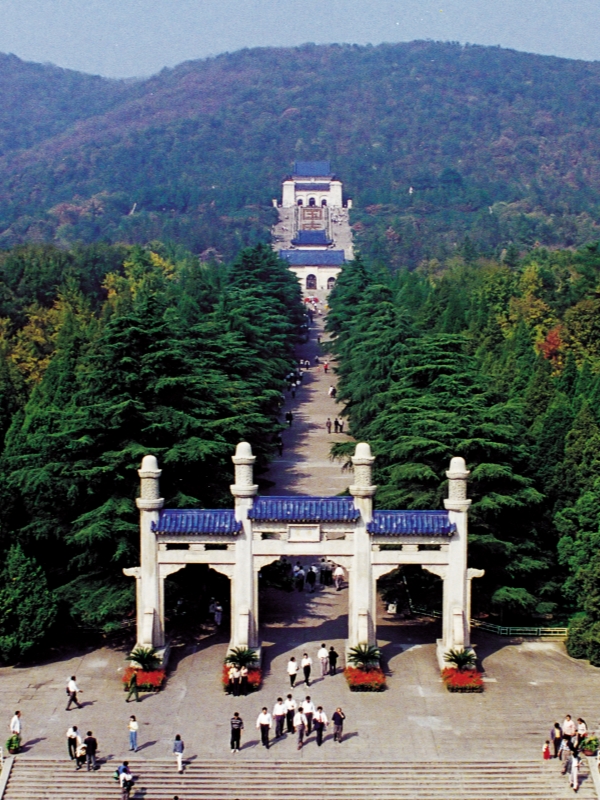
The granite memorial archway at the entrance bears the characters 博爱 (Bó Ài — Universal Love) in Sun Yat-sen's own calligraphy. This inscription sets the philosophical tone for the entire site. Immediately behind the Paifang stands the marble gate, 16 meters high and 27 meters wide, inscribed with 天下为公 (Tiān Xià Wéi Gōng — "All under heaven is for all") — also in Sun's own hand. From this gate, the central axis begins its steady northward climb toward the summit Sacrificial Hall. Both inscriptions are original to the design and serve as the site's most photographed details.
Climbing the 392 Stairs
Dr Sun Yat-sen Mausoleum Nanjing
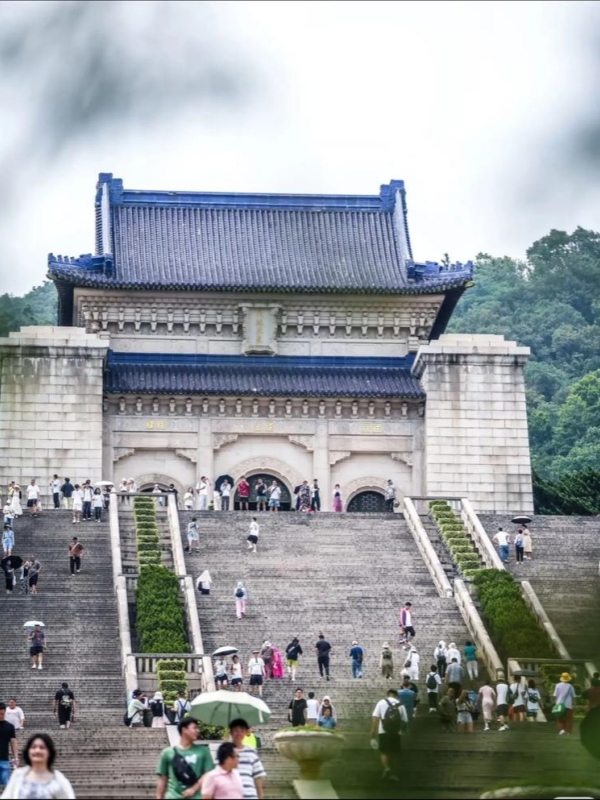
The 392 stone steps are lined by pine, cypress, and ginkgo trees that provide shade and seasonal color. Lu Yanzhi employed a deliberate perspectival trick: from the bottom, the stairway appears as a continuous slope, but from the summit the steps vanish, leaving only flat landings visible. The climb covers approximately 700 meters with a roughly 70-meter elevation gain (some sources record 73 meters — the 70-meter figure is the standard measurement). Intermittent flat platforms offer places to catch your breath. A comfortable pace takes 15 to 25 minutes to reach the top.
- Step count: 392 stone steps from Paifaw to the Sacrificial Hall.
- Tree species: Pine, cypress and ginkgo line the stairway corridor.
- Perspectival device: Steps appear continuous from below, invisible from above.
- Resting platforms: Flat landings spaced along the climb for pacing.
The Sacrificial Hall & Burial Chamber
Dr Sun Yat-sen Mausoleum Nanjing
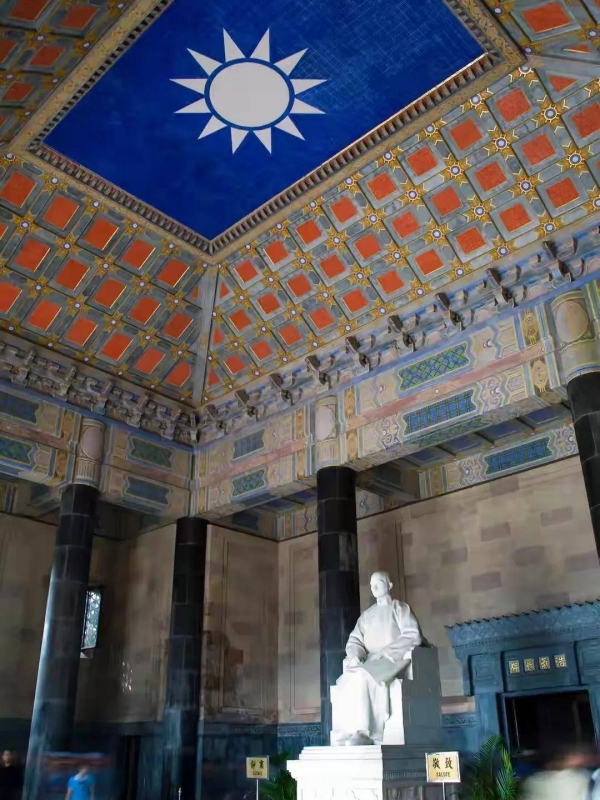
The Sacrificial Hall at the summit measures approximately 30 meters long by 25 meters wide by 29 meters high, built in a palace-imitation style with three arched doors inscribed with the characters of the Three Principles — 民主 (Democracy), 民权 (Rights of the People), and 民生 (Livelihood). Inside stands a seated statue of Sun Yat-sen carved from Italian white marble, with six relief panels on the pedestal depicting his revolutionary activities. Behind the seated figure, bronze double doors open to a circular burial chamber containing a marble sarcophagus. A recumbent statue of Dr. Sun sculpted by Czech artist Bohuslav J. Koci rests above the coffin, which holds Dr. Sun's actual remains. Photography is strictly forbidden inside the Sacrificial Hall and the burial chamber.
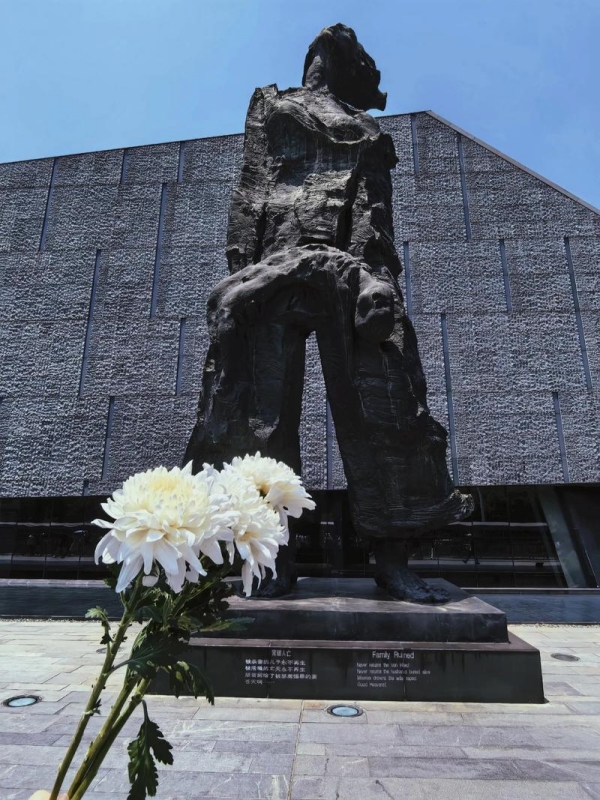
🏛️ Explore Nanjing’s Modern History: To gain a deeper understanding of Nanjing's 20th-century history and wartime legacy, consider visiting the nearby Nanjing Memorial Hall.
Sun Yat-sen Mausoleum Music Stage
Dr Sun Yat-sen Mausoleum Nanjing
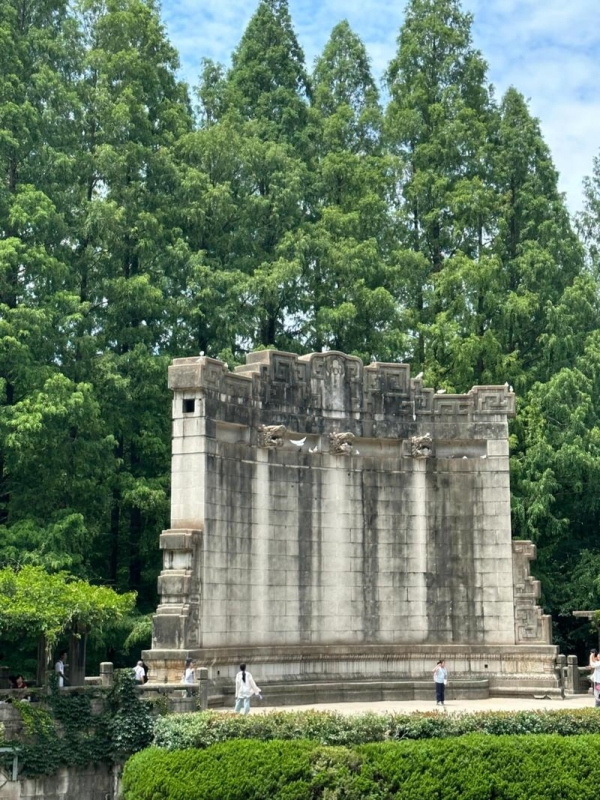
The Music Stage sits within the same Zhongshan Mountain Scenic Area, a short walk from the main mausoleum. Built in the early 1930s, the open-air amphitheater was designed by Henry K. Murphy, an American architect who incorporated traditional Chinese rooflines into a semicircular reinforced-concrete structure. The venue can seat thousands and hosts seasonal concerts throughout the year. It ranks among the world's three great open-air music venues alongside the Hollywood Bowl and a German counterpart — a long-standing local comparison that reflects the venue's acoustic design and cultural prestige. Sunset photography from the amphitheater is particularly popular, with the Purple Mountain ridge as a backdrop. Admission costs $1 (¥10) on the door. Note that the Music Stage closes earlier than the mausoleum in some seasons — verify current hours locally before planning your visit.
- Architect: Henry K. Murphy, early 1930s.
- Design: Semicircular open-air amphitheater with Chinese-style roof.
- Events: Seasonal concerts and public performances.
- Photography: Popular sunset spot overlooking Purple Mountain.
Tickets, Opening Hours & 2026 Visiting Tips
Entrance to Dr Sun Yat-sen Mausoleum itself is free ($0), one of Nanjing's most generous policies for international visitors. The Music Stage charges $1 (¥10) at the door. Within the same scenic area, neighboring attractions carry separate fees: Ming Xiaoling Mausoleum costs $10 (¥70) and Linggu Temple costs $5 (¥35). A free internal shuttle runs between Dr Sun Yat-sen Mausoleum and Ming Xiaoling — present your entrance ticket for the ride. Standard opening hours are 8:30–17:00, with the mausoleum traditionally closed on Mondays; confirm the current 2026 schedule on the official scenic-area site before traveling, as AAAAA sites have gradually expanded Monday openings in recent years.
- Booking: Real-name registration is required; Trip.com accepts foreign passports. The domestic WeChat mini-program requires a mainland phone number and WeChat Pay account.
- What to bring: Passport (for registration), water, and comfortable shoes — the 392-step climb is unavoidable on foot.
- Photography rules: No phones, cameras, or flash inside the Sacrificial Hall. No tripods anywhere in the mausoleum complex.
- Best timing: Weekday mornings draw the fewest crowds. March–May and September–early November offer the most comfortable weather and strongest seasonal colors.
- Mobile payments: Most scenic-area shops and the shuttle accept Alipay+ via international card. Small vendors near the Music Stage may still require cash or a mainland WeChat Pay account — carry a small reserve of RMB as backup.
- English signage: Bilingual signs, audio guides, and exhibit panels are available at the main mausoleum. English is thinner at the Music Stage and smaller sub-attractions.
Getting to Sun Yat-sen Mausoleum from Nanjing
Muxuoyuan (苜蓿园) Station on Metro Line 2 is the standard gateway, with several alternatives depending on your starting point and tolerance for walking. The table below lists every practical transport option for foreign travelers.
Nearby Attractions in the Zhongshan Scenic Area
Dr Sun Yat-sen Mausoleum sits at the heart of the AAAAA Zhongshan Mountain (Purple Mountain) Scenic Area, a protected landscape covering roughly 31 square kilometers. The area packs several major monuments within a single 5–8 kilometer loop. Most attractions are connected by the free internal shuttle or a well-marked walking trail, making same-day combination visits entirely practical for visitors with a full morning and afternoon available.
- Ming Xiaoling Mausoleum: Tomb of the Hongwu Emperor, the founder of the Ming Dynasty. A UNESCO World Heritage component. Admission $10 (¥70).
- Linggu Temple: Buddhist temple set in a wooded valley with the famous Beamless Hall and cave inscriptions. Admission $5 (¥35).
- Meiling Palace: Former residence of Chiang Kai-shek, famous for its autumn plane trees and colonial-style architecture. Admission varies — confirm on site.
- Purple Mountain Observatory: China's first modern astronomical observatory, perched on the ridge with panoramic views over Nanjing. Included with the scenic-area ticket.
- Zhongshan Botanical Garden: Expansive green space with native and imported plant collections. Free with the scenic-area ticket.
Frequently Asked Questions
Q: Is Dr. Sun Yat-sen Mausoleum in Nanjing free to enter?
Yes — entrance to the mausoleum itself is free ($0). Only the Music Stage ($1 / ¥10) and neighboring Ming Xiaoling ($10 / ¥70) and Linggu Temple ($5 / ¥35) charge admission.
Q: What are the opening hours of Dr Sun Yat-sen Mausoleum?
8:30–17:00 is the standard posted window. The mausoleum is traditionally closed on Mondays — confirm the current 2026 schedule on the official scenic-area site before traveling, as AAAAA sites in China have gradually expanded Monday openings in recent years.
Q: How long does a visit to Dr Sun Yat-sen Mausoleum take?
2–3 hours for the mausoleum alone. Add 1–2 hours if you include the Music Stage. Allow a full day if combining with Ming Xiaoling and Linggu Temple via the free internal shuttle.
Q: Is Dr Sun Yat-sen Mausoleum wheelchair accessible?
The Paifang, lower terraces, and Sacrificial Hall exterior are accessible. The 392-step central stairway is not. Visitors with mobility needs can use the $1 (¥5) electric car from Muxuoyuan Station and request assistance at the gate — confirm exact accessibility arrangements on arrival.
Q: Can I take photos inside the Sacrificial Hall?
No — photography (including phones) is forbidden inside the Sacrificial Hall and the burial chamber. Photos of the exterior, the stairway, the Paifang, and the Music Stage are all permitted.
Q: What is the nearest subway station to Dr Sun Yat-sen Mausoleum?
Muxuoyuan (苜蓿园) Station on Line 2 is the closest, roughly a 10-minute walk or a short shuttle ride from the mausoleum entrance.
Q: Is English signage available at Dr Sun Yat-sen Mausoleum?
Yes at the main mausoleum site — signs, audio guides, and exhibit panels are bilingual. English is thinner at the Music Stage and at smaller sub-attractions in the broader scenic area.