Nanjing Massacre Memorial Hall
The Memorial Hall of the Victims in Nanjing Massacre by Japanese Invaders stands as China's most significant commemorative site for the atrocities committed when Japanese forces captured Nanjing on December 13, 1937. Located at 418 Shuiximen Dajie in Jianye District, the memorial occupies the actual mass grave site and has grown into a vast complex of underground exhibition halls, outdoor sculpture gardens, and solemn public squares since its founding in 1985. Visitors come not as tourists seeking entertainment but as witnesses seeking to understand — a distinction that shapes every aspect of the experience from the moment you pass through the entrance plaza.
The memorial draws hundreds of thousands annually, including many Japanese and international visitors who walk the same underground corridors where recovered artifacts, photographs, and documented testimonies reconstruct the six weeks of devastation. Free admission removes any barrier to entry, though the emotional weight of what awaits inside makes preparation essential. This guide covers everything needed to visit respectfully and thoroughly: getting there by metro, ticket procedures, opening hours, what lies within each gallery, and the specific conduct the memorial expects from its visitors.
Quick Facts
What to See Inside the Memorial
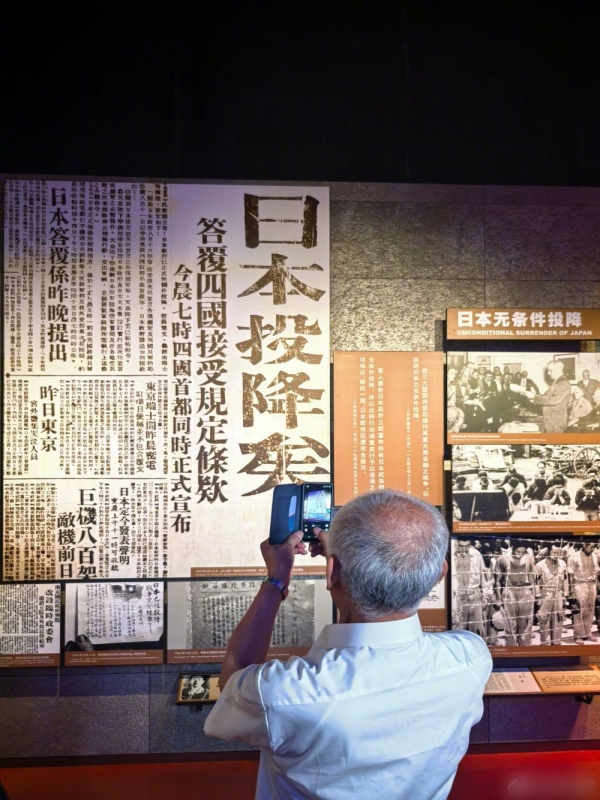
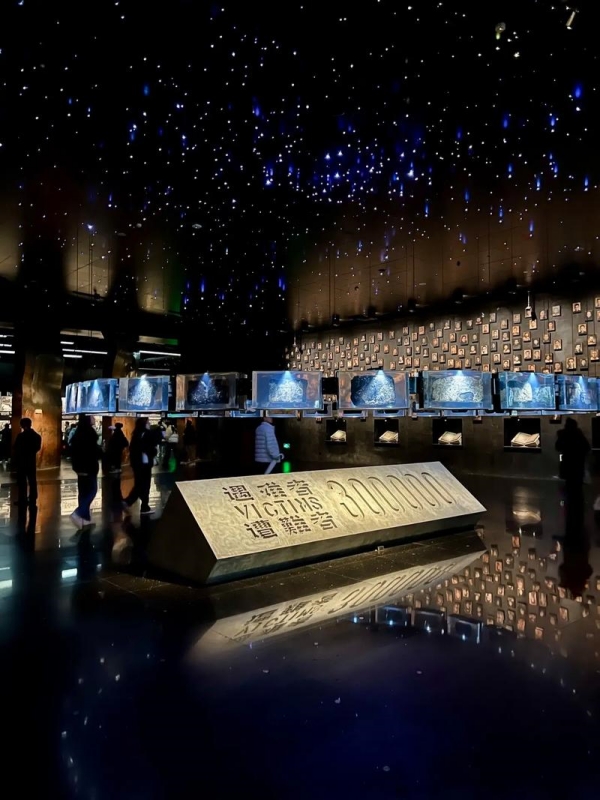
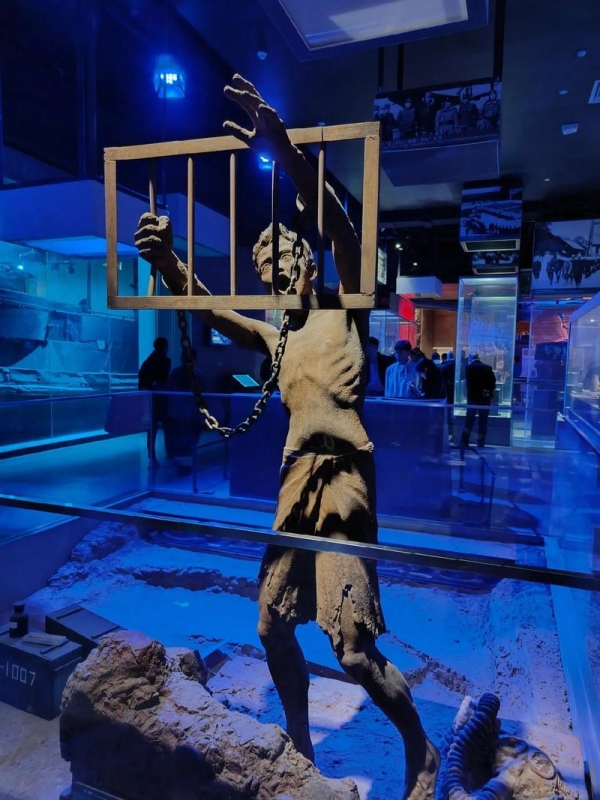
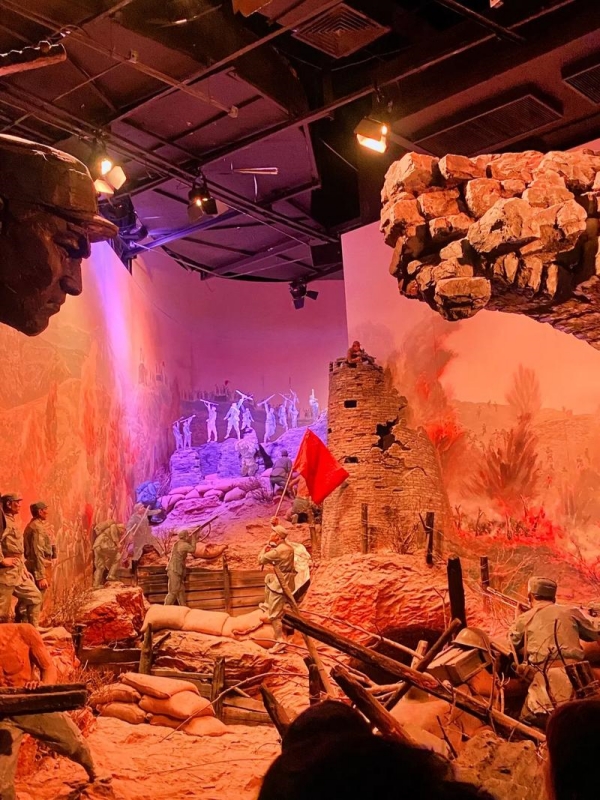
The memorial is organized as a roughly linear circuit. Visitors descend from the entrance plaza into the underground Exhibition Hall, move through successive galleries that build the historical narrative, encounter the most solemn spaces at the lowest level, then gradually rise back to ground level where the outdoor memorial square and sculpture gardens await. The route is designed to guide visitors from open air into enclosed, dimly lit underground chambers before releasing them into the expansive plaza — an intentional architectural descent into darkness and return to light.
Exhibition Hall & Historical Documents
The underground Exhibition Hall forms the memorial's core. Here, trilingual captions in English, Japanese, and Chinese appear throughout the main galleries, making the material accessible to a genuinely international audience. The collections include primary historical documents, contemporary photographs taken by Japanese military photographers themselves, handwritten eyewitness diaries, and artifacts recovered from the massacre period. These materials have been augmented over decades through donations, archaeological excavation, and archival research.
Documentary evidence from the International Military Tribunal for the Far East (1946–48) and the Nanjing War Crimes Tribunal forms part of the institutional foundation here — the memorial does not present a narrative based on memory alone but anchors its account in courtroom-admitted evidence. The galleries trace the timeline from the fall of Shanghai in November 1937 through the six-week siege of Nanjing and its aftermath, using original source material rather than summary retellings.
🏛️ Explore China's Cultural Heritage Sites: For travelers interested in understanding the broader tapestry of Chinese history, transitioning from modern historical memorials to traditional spaces dedicated to family lineage, classical architecture, and intricate woodcarvings is highly rewarding. Discover another of South China's preserved historic complexes in our guide to the Chen Clan Ancestral Hall, Guangzhou.
Mass Grave Site, Memorial Square & Outdoor Sculptures
The most solemn interior space is the viewing pavilion over the excavated mass grave. Within this chamber, skeletal remains of massacre victims recovered from the burial pit are displayed — the most direct physical evidence of what occurred on this specific ground. Photography in this pavilion is typically prohibited, and visitors are expected to pause with appropriate gravity.
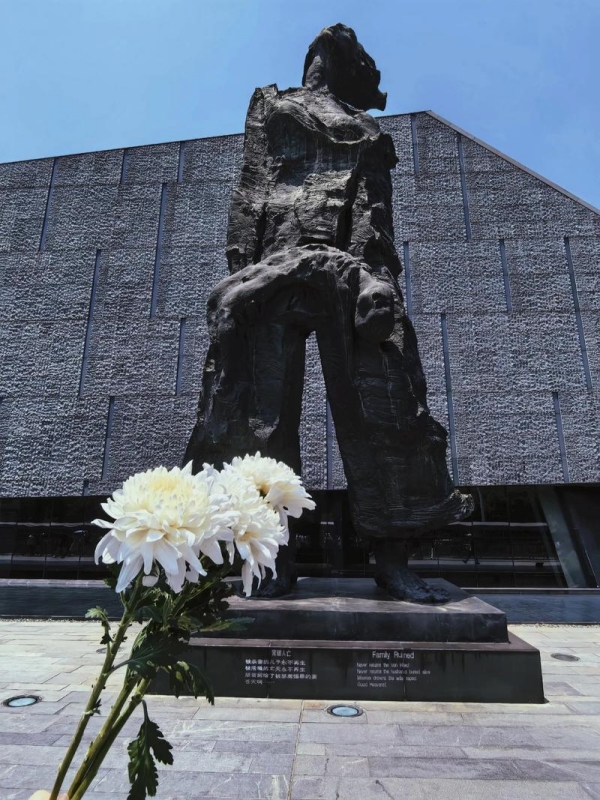
Above ground, the Memorial Square opens into a vast stone plaza anchored by monumental sculptures. A long procession of figures by sculptor Wu Weishan stretches across the public grounds, depicting civilians and soldiers caught in the catastrophe. Nearby, the "Statue of a Mother" stands as a central symbolic piece. The entire outdoor landscape is deliberately austere — paved stone, minimal vegetation, water features that reflect grey skies rather than soften them. The architecture throughout the complex was designed by Qi Kang of Southeast University, a member of the Chinese Academy of Engineering, whose low, swooping, slab-like buildings sit partly below grade to keep visitors oriented inward rather than toward the surrounding city.
🌸 Reflect During a Seasonal Visit: While this memorial is a deeply solemn site to experience at any time of year, many travelers choose to visit during the seasonal transitions when the city's peaceful surrounding plum blossoms and greenery offer a quiet space for reflection. Plan your seasonal travel itinerary with our guide to Visit Nanjing in Spring.
Historical Background & Significance
The Nanjing Massacre began when Japanese Imperial Army forces captured the city on December 13, 1937, following the brutal suppression of Shanghai the previous month. Over roughly six weeks, organized and indiscriminate killings, systematic sexual violence, and widespread arson devastated the civilian population and disarmed combatants who had surrendered. The city that had served as the Nationalist capital was reduced to chaos and destruction on a scale that shocked the international community.
The Memorial Hall itself opened in 1985 on the site of a major mass grave, expanded significantly in 2007 to accommodate the growing collection and visitor numbers, and was designed throughout by architect Qi Kang (齐康) of Southeast University. The site was formally designated as a national memorial institution, reflecting its role not merely as a local museum but as an official voice of the Chinese state on this historical question. In 2015, UNESCO inscribed "Documents of the Nanjing Massacre" into its Memory of the World Register, recognizing the archival significance of the materials held here.
December 13 was designated National Memorial Day by the Standing Committee of the National People's Congress in 2014, formalizing what had been a commemorative practice into a national observance. The city marks the day with a 10:01 a.m. ceremony involving sirens and bells broadcast across Nanjing, observed at the memorial and at other relevant sites throughout the city.
Regarding the death toll, the Memorial's own figures cite approximately 300,000 killed in and around Nanjing during the six-week period. International scholarly estimates range from roughly 200,000 to more than 300,000 — this range reflects ongoing historical debate rather than any single settled figure, and both the Memorial's cited number and the broader scholarly range appear in serious historical literature.
Getting There & Location
The memorial sits at 418 Shuiximen Dajie in Nanjing's Jianye District, a short walk from the metro. Visitors arriving by subway will find the most reliable route drops them within a few minutes of the entrance plaza. Those coming from further afield — whether the main railway station, the high-speed hub, or the international airport — should plan for a combination of metro lines or a taxi depending on budget and time constraints.
Address & Metro Access
The memorial's address is 418 Shuiximen Dajie (水西门大街418号). The closest metro station is Line 2 Yunjin Lu (云锦路站), and Exit 2 deposits you directly onto the pedestrian approach. From there, the entrance plaza lies roughly five minutes ahead on flat ground. A multilingual orientation panel stands beside the main gate, and free printed site maps are available from the visitor center near the entrance. Offline navigation apps including AMap and Baidu Maps recognize the Chinese name 侵华日军南京大屠杀遇难同胞纪念馆 for those who prefer not to rely on data roaming.
From the Train Station and Airport
Three primary arrival points serve Nanjing visitors, each with distinct transit options and cost profiles.
Tickets, Opening Hours & Booking
One of the most welcoming aspects of the memorial is its zero-cost admission policy. The site operates as a public institution, not a commercial attraction, meaning visitors are never turned away for inability to pay. However, this free entry comes with specific requirements at the checkpoint and a different rhythm than ticketed venues — knowing what to expect before arrival prevents confusion.
Admission & What It Costs
General admission is completely free for all visitors. No ticket platform exists because none is needed — the memorial processes entry on a walk-up basis. However, a valid passport is required at the entry checkpoint for identification registration. Foreign nationals and domestic visitors alike present their travel documents to staff stationed at the entrance gates before proceeding inside.
Beyond free entry, the memorial offers optional paid services for those who want additional context. Audio guides are available in English, Japanese, and Chinese, rentable from the visitor center for about $3–5 (¥20–30). These handheld devices walk listeners through each gallery with narrated commentary and are worthwhile for visitors who want deeper historical context than the wall captions provide. Guided tours in English exist but are limited in availability — those interested should contact the memorial's official email in advance or arrange one through a licensed Nanjing tour operator. Trip.com lists several English-language tour packages that combine memorial visits with other Nanjing sites, though the memorial itself does not transact through that platform.
Hours, Closures & Best Time to Visit
The memorial opens Tuesday through Sunday from 8:30 to 17:30, with last entry at 16:30. Mondays are reserved for administrative closure — a weekly rest day that affects every week of the year. Public holiday hours can deviate from this schedule, particularly around Chinese New Year, National Day in October, and other major holidays. The official English website posts closure announcements ahead of time, so visitors with tight itineraries should verify before arrival.
Visit Etiquette & Rules
This is a national memorial and a site of mass grave — not a theme park, not a museum in the casual sense. The memorial has established clear conduct expectations that visitors are expected to follow as a matter of respect, not bureaucratic enforcement. These norms reflect the site's dual function as a place of remembrance and as an educational institution.
Important Rules for Visiting the Memorial
Photography: Non-flash photography is permitted in most exhibition halls. Flash units, tripods, and selfie sticks are prohibited throughout the indoor galleries. The mass grave viewing pavilion typically bans photography entirely — posted signs at the entrance to that space take precedence and must be followed. Video recording inside exhibition spaces is restricted.
Sound and silence: Phone calls should be taken outside the exhibition halls. Devices should be switched to silent mode before entering indoor spaces. Voices should be kept low throughout, particularly near the mass grave viewing pavilion. Visitors who arrive on December 13 should be aware that citywide sirens and bells sound at 10:01 a.m. as part of the National Memorial Day observance — those inside the memorial at that moment are expected to observe a moment of silence.
Food, drink, and smoking: No food or drink is permitted inside exhibition spaces. Water bottles can be refilled at drinking fountains within the complex. Smoking is prohibited on the entire memorial grounds.
Dress code: Visitors are expected to dress respectfully. Sleeveless tops, beachwear, and costume clothing are not appropriate. The memorial is a civic space and visitors should dress as they would for a formal government building or religious site.
Flowers and wreaths: On National Memorial Day (December 13), visitors commonly lay flowers at designated spots. Outside that date, formal wreath-laying requires prior coordination with memorial staff. Optional donation boxes are available at the visitor center.
Children: Visitors under 12 are welcome, but the skeletal displays and graphic photographs in certain galleries are emotionally heavy content. Guardians should exercise discretion based on their child's maturity and sensitivity. No age-based entry ban exists.
Practical Tips for Visitors
Allow 2–3 hours for a complete visit that includes the underground Exhibition Hall, the mass grave viewing pavilion, and the outdoor memorial square with its sculpture gardens. The site is larger than it appears from the entrance — the outdoor plaza alone extends further than many visitors expect, and the galleries below contain more material than a cursory walk-through reveals.
Bring your passport for the entry checkpoint. Wear comfortable walking shoes, as the route involves both indoor corridors and outdoor paved areas. The indoor halls are climate-controlled, making them bearable during Nanjing's hot summers and cold winters. During the May-to-August monsoon season, rain gear is advisable for the outdoor portions — the sculpture plaza offers little shelter. Bring a refillable water bottle to use at the fountains inside.
English signage is concentrated in the main Exhibition Halls. The outdoor grounds and some secondary galleries may have limited English-language captions. Audio guides improve accessibility significantly for non-Chinese speakers. The official English portal at 19371213.com.cn/en covers logistics, holiday schedules, and contact information. Elevators in the main buildings make the route largely step-free for visitors with mobility considerations.
Nanjing offers several other significant cultural sites within reasonable distance of the memorial. The Sun Yat-sen Mausoleum on Purple Mountain, the Nanjing Museum, and the Confucius Temple area can be combined with a memorial visit for a full day of Nanjing's historical sites. And a small cluster of noodle shops and casual eateries sits within ten minutes' walk of Yunjin Lu metro station. It makes the transition to lunch or dinner straightforward after a visit.
Frequently Asked Questions
Q: Do I need to book tickets in advance?
No. Admission is free and walk-up entry is standard practice. You will need your passport for identification at the checkpoint. Third-party platforms like Trip.com and Klook list guided-tour packages but do not transact a separate "ticket" for memorial entry — the memorial itself has no ticketing platform.
Q: How long should I plan for a visit?
Plan for 2–3 hours to walk the full circuit: underground Exhibition Hall, mass grave viewing pavilion, and the outdoor memorial square with its sculpture gardens. Visitors who rush through in under an hour typically miss the deeper galleries.
Q: Is English signage or audio guide available?
Yes to both. Trilingual captions in English, Japanese, and Chinese appear throughout the main Exhibition Halls. Audio guides are available for rental at the visitor center for about $3–5 (¥20–30) in English, Japanese, and Chinese.
Q: When is the National Memorial Day?
December 13, designated as the official National Memorial Day in 2014. The city sounds sirens and bells at 10:01 a.m. Visitors inside the memorial observe a moment of silence. The site is extremely crowded that day and is best avoided unless you specifically want to attend the ceremony.
Q: Is the memorial appropriate for children?
Children under 12 are allowed, but the skeletal displays in the mass grave viewing pavilion and certain execution photographs in the galleries are emotionally heavy. Guardian discretion based on the child's maturity is strongly advised. No age-based entry ban exists.
Q: Can I take photos inside?
Non-flash photography is permitted in most halls. Flash units, tripods, and selfie sticks are prohibited throughout indoor spaces. The mass grave viewing pavilion typically bans photography entirely — posted signs at that pavilion must be followed. Video recording inside exhibition halls is restricted.
Q: Are guided tours in English available?
Official English-language guided tours are limited and should be pre-arranged through the memorial's official email or a licensed Nanjing tour operator. Trip.com lists a small number of English-guided tour options that include the memorial, but the memorial itself does not operate these tours directly.
Q: What's the nearest metro station?
Line 2 Yunjin Lu Station (云锦路站), Exit 2. The entrance plaza is roughly five minutes' flat walk from the exit. No transfer or bus is required.