JINS in China
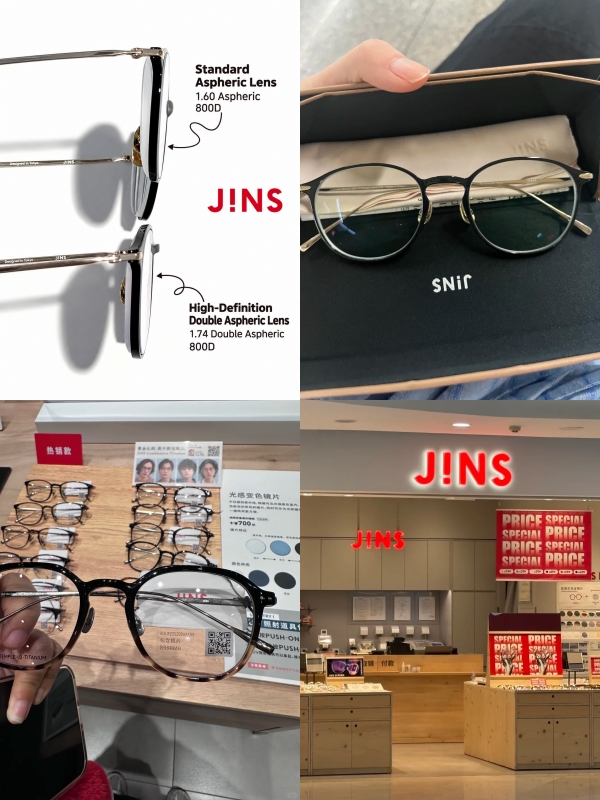
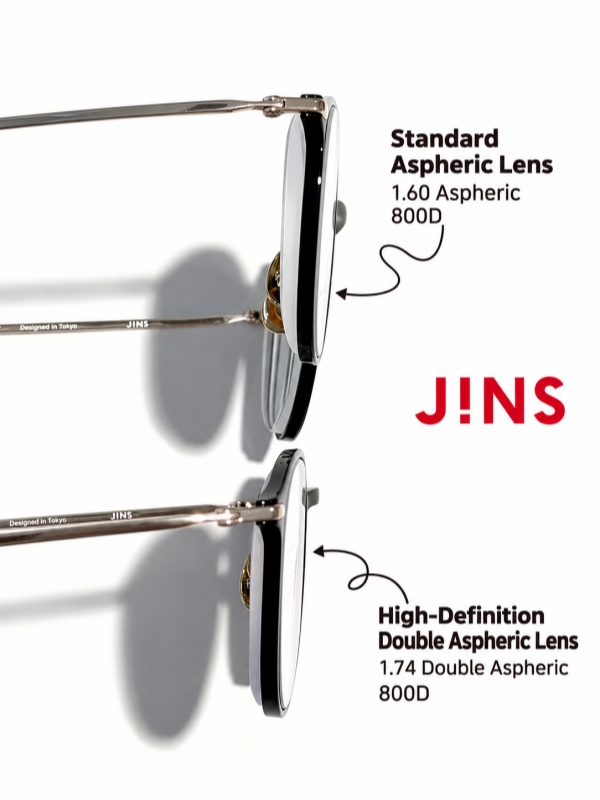
JINS in mainland China includes standard 1.60 aspheric lenses in its optical-glasses package; its lens menu lists CNY300 extra for 1.67 clear lenses and CNY500 for 1.74. Those amounts cover a pair, rather than the whole purchase. When comparing JINS China lens upgrade prices, start with your selected frame package, then choose the exact lens product. Clear, SCREEN, photochromic and progressive options have separate prices, and their features do not form a simple stack of surcharges. Before paying, match the prescription and collection date to your remaining time in China, because an affordable upgrade offers little help if your glasses arrive after you leave.
Quick Facts
These are amounts displayed on JINS's mainland lens menu, which carries no stated effective date. They provide a comparison baseline, rather than a dated receipt or a promise about a particular store's stock. A frame purchase and any confirmed replacement service remain separate parts of your bill.
Clear Lenses: CNY0–800 Extra
JINS in China
Start with standard clear lenses when you want everyday prescription glasses without an additional screen or sun feature. The first distinction in JINS China lens upgrade prices is between changing the refractive index and changing the lens design. Both appear in the menu, but they buy different specifications.
CNY0 Standard Clear Lenses
The standard option is 1.60 thin aspheric, listed at CNY0. That zero belongs to the lens upgrade within an eligible optical-glasses package. It does not mean you can enter with any frame and receive free replacement lenses.
For a straightforward replacement pair during a trip, begin by asking whether the standard option can be made for your prescription. This gives you a useful baseline before choosing extras. The menu leaves the manufacturable prescription range to staff, so an index alone does not establish eligibility.
CNY300–800 Double-Aspheric Lenses
JINS calls its double-aspheric clear range 「轻晰真视」 (an editorial translation: clear, true vision). The brand describes a design intended to reduce visual distortion, particularly for higher prescriptions or astigmatism. Treat that as a product description, rather than a guarantee about your own experience.
At each shared index in the table, double-aspheric clear lenses cost CNY300 more than the ordinary clear option. That comparison separates the design premium from the index premium. It also gives you a specific question to ask: what would the different design change in your selected frame and prescription?
Choice check: A higher number is not an automatic reason to spend more. Ask staff to compare the actual configurations available for your prescription. Choose a specification after that discussion, rather than treating the most expensive row as a default travel purchase.
Compare the Same Lens Index
At 1.67, the ordinary clear pair adds CNY300, while the double-aspheric clear pair adds CNY600. You select one of those products. The CNY600 is not an instruction to add CNY300 for thinning and another CNY600 for the design.
Use the same frame package when comparing totals. Otherwise, a more expensive frame can make a lens upgrade seem responsible for a difference it did not create. Request a quotation with the frame/package line and the selected lens line shown separately.
👁️ Buying Contact Lenses in China:Prefer wearing contacts during your trip or want to compare local optical shop rules and prescription requirements? Check out our practical guide to Contact Lenses in China.
SCREEN Lenses: CNY300–1,200 Extra
JINS in China
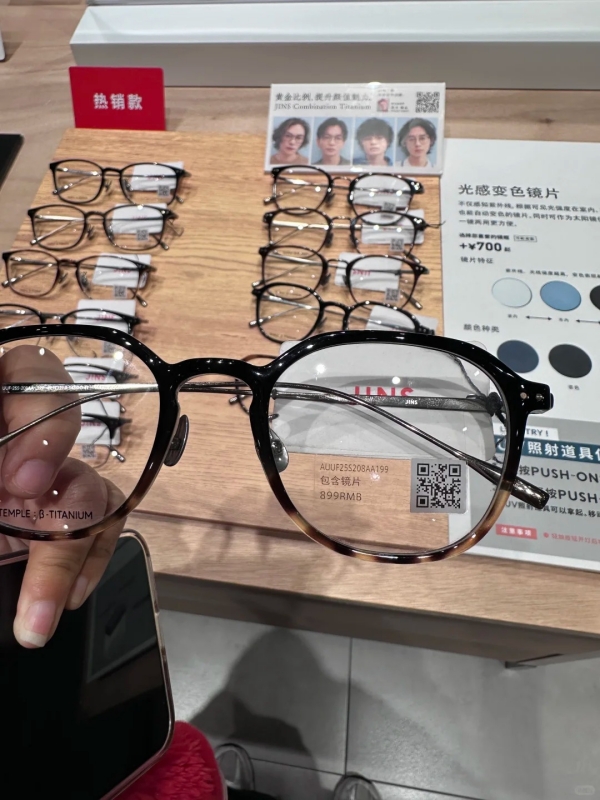
Compare SCREEN products by their full names and indices before accepting a single “blue-light lens” price. JINS China lens upgrade prices distinguish DAILY, NIGHT and double-aspheric SCREEN products. Each has its own listed charge; a familiar feature name does not make the products interchangeable.
CNY300–1,000 SCREEN DAILY
SCREEN DAILY USE lists CNY300 at 1.60, CNY600 at 1.67 and CNY1,000 at 1.74, per pair. JINS describes these lenses as reducing blue light from electronic screens. The price comparison here concerns that specified feature, without making a medical or sleep-benefit claim.
- Same index, different feature: At 1.67, DAILY costs CNY300 more than ordinary clear aspheric lenses.
- Same feature, different index: Moving from DAILY 1.60 to DAILY 1.67 changes the listed charge by CNY300.
- Complete product: The DAILY 1.67 amount is CNY600, rather than CNY300 for clear 1.67 plus CNY600 for DAILY.
If your main travel need is simply a spare pair, the standard clear option remains a comparison worth keeping. A screen feature should answer a preference you actually have, rather than arrive as an unexplained addition to the bill.
CNY500 SCREEN NIGHT
SCREEN NIGHT USE is listed at CNY500 for 1.60 aspheric lenses. JINS describes it for evening and bedtime screen use. Its name does not identify a night-driving lens: the mainland menu lists driving products separately.
Name matters: Tell the store whether you mean using a phone at night or driving at night. Ordering by the word “NIGHT” alone leaves room for a costly misunderstanding. Ask for the full product name on the quotation.
CNY800–1,200 Double-Aspheric SCREEN
The combined double-aspheric SCREEN range lists CNY800 at 1.67 and CNY1,200 at 1.74. At 1.67, that is CNY200 above double-aspheric clear and CNY200 above ordinary SCREEN DAILY. It is a separate combined product, not the sum of both upgrades.
This is the useful comparison when you want both features. Discuss the lens design first, then compare the combined SKU with its clear counterpart. That keeps the conversation about what you are buying, instead of a string of individually priced features.
🏥 Comprehensive Eye Care in Beijing:Need an English-friendly eye exam, prescription check, or specialized vision consultation before ordering new lenses? Learn what services are offered at Beijing New Vision Eye Hospital.
Sun Lenses: CNY300–1,600 Extra
JINS in China
Choose the outdoor function before choosing a price tier. Photochromic, light-responsive, polarized and fixed-tint lenses do different jobs. Among JINS China lens upgrade prices, similar amounts can describe different products, so a CNY700 quotation needs a full name beside it.
CNY400–1,600 Photochromic Options
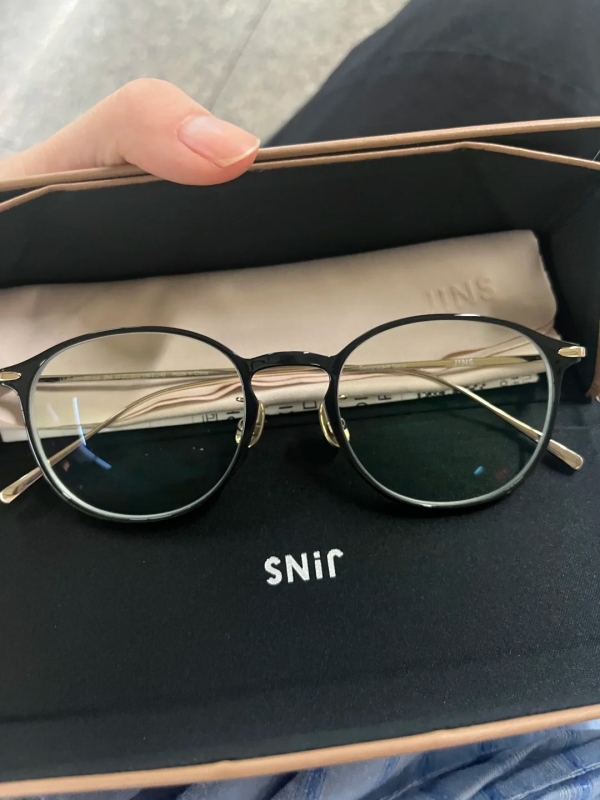
Ordinary photochromic lenses respond to ultraviolet conditions: JINS describes them as darkening in stronger UV and becoming clear in weaker-UV indoor conditions. The menu lists gray and brown. Its light-responsive product has a separate description and adds green as a color choice.
JINS specifically describes the light-responsive version as capable of some darkening inside a car. That statement does not promise a particular darkness or response time. It also should not migrate to the ordinary photochromic row, whose description makes a different claim.
At 1.60, light-responsive and SCREEN photochromic both list CNY700, but the descriptions emphasize different features. The first emphasizes enhanced light response, including some in-car response. The second combines screen-related blue-light filtering with UV-responsive color change.
- For indoor/outdoor changes: Compare ordinary photochromic with the light-responsive option at the same index.
- For a combined screen and sun feature: Compare SCREEN photochromic with the separate clear SCREEN product.
- For a specific color: Match the actual product's color list; green does not appear in every photochromic range.
Avoid double counting: SCREEN photochromic 1.60 is listed as a CNY700 product. Do not build its price by adding ordinary photochromic CNY600 to SCREEN DAILY CNY300. Ask about an explicitly offered combined product whenever you want multiple features.
CNY300–600 Tinted and Polarized Options
Fixed-color and polarized choices sit outside that automatic color-change comparison. The menu lists tinted lenses at CNY300 for 1.60 aspheric and CNY600 for 1.67 aspheric. Polarized lenses list CNY400 for 1.50 back-surface aspheric or CNY500 for 1.60 spherical.
Those specifications matter. The CNY500 polarized 1.60 product is described as spherical, while several other 1.60 products are aspheric. Comparing only the index and price would conceal that difference. Ask for the actual design as well as the intended outdoor function.
- Mirror finish: CNY300 at 1.50 spherical or CNY500 at 1.60 aspheric; select it for the specified finish, without assuming automatic color change.
- Blush-effect color: CNY300 at 1.60 or CNY600 at 1.67; the stated purpose is a cosmetic color effect.
- Driving products: The menu lists dedicated day and night options at CNY600 for 1.60 aspheric. It explicitly excludes the daytime version from night driving.
For a walking-heavy holiday, start by identifying whether you want changing tint, fixed color or the polarized feature. Then compare the exact products that meet that preference. A driving-specific purchase requires its own product discussion; SCREEN NIGHT does not substitute for it.
🔬 Vision Correction Procedures:Considering long-term laser vision correction options instead of upgrading high-index glasses? Explore clinical facilities and treatment basics in our Eye Laser Center in China Guide.
Progressives: CNY300–3,000 Extra
JINS in China
Compare progressive lenses within the progressive product family. JINS describes them as combining distance and near viewing needs. Their prices cannot be read as an extra layer placed on top of a single-focus lens quotation, and choosing a more expensive version requires an individual fitting discussion.
CNY300–2,100 Clear Progressives
The ordinary clear progressive range lists four indices, while the imported double-aspheric progressive range lists two. Keep the exact index attached to every amount, particularly the higher-index double-aspheric entry: the mainland page prints 1.70, rather than 1.67.
At the shared 1.60 index, the double-aspheric progressive costs CNY1,000 more than the ordinary progressive. JINS describes differences in design and visual distortion. Those descriptions support a comparison conversation, rather than a promise that every wearer should pay the premium.
Keep the decision personal: Use your prescription and intended use to discuss the available progressive designs with the optical staff. This price guide lets you check the bill; it cannot choose a prescription or establish which design suits your vision.
CNY600–3,000 Combined Progressive Options
The combined ranges add screen filtering or photochromic functions within a progressive product. For JINS China lens upgrade prices, this is another place where complete product names prevent double counting. Select the combined lens line rather than adding two independent menu entries together.
For example, ordinary progressive 1.60 lists CNY600, while progressive SCREEN 1.60 lists CNY800. The CNY200 difference is the relevant comparison between those two complete products. The SCREEN progressive amount is not CNY600 plus another CNY800.
Other specialist options include accommodation-support lenses at CNY800 for 1.60, or CNY1,000 with SCREEN, and a toughness-focused 1.60 product at CNY300, or CNY500 with SCREEN. These serve different product discussions; their names do not establish a treatment benefit or personal suitability.
Extra Fees and Collection Deadlines
Ask for the whole quotation before authorizing the order. JINS China lens upgrade prices are useful only when you keep the package price, chosen lens charge and any applicable service fee separate. Collection timing belongs in that conversation too, especially when your next stop is another city.
Add the Correct Lens Charge
Use this structure for a new eligible optical-glasses package: selected package price + selected lens upgrade + any separately confirmed service charge. The included 1.60 option is the starting point, not an additional CNY300 lens purchase that automatically appears on every order.
Let P stand for the actual package price quoted for your selected frame. At 1.67, ordinary clear gives P + CNY300, double-aspheric clear gives P + CNY600, and double-aspheric SCREEN gives P + CNY800, before any separately confirmed service. These are illustrative formulas, not customer receipts.
For a single 1.74 ordinary clear replacement lens, half the CNY500 menu amount is CNY250. That calculation concerns the lens line alone. It does not establish that your final replacement order costs CNY250, or that a separate replacement fee must be halved.
Old-frame boundary: The CNY300 footnote limits its charge to eligible products that can have lenses replaced. It does not clearly establish acceptance or a universal tariff for every old JINS or other-brand frame. Have the actual frame assessed before using that amount in a budget.
Allow for Special-Order Working Days
The mainland menu gives 7–14 working days for out-of-stock or outside-stock-range special-order lenses. Meanwhile, JINS's service commitments say waiting depends on the store and some lenses take several days. Neither statement gives every traveler a guaranteed same-day collection slot.
If your remaining stay is shorter than the quoted working-day lead time, treat that configuration as unsuitable for collection during this visit. Ask whether another appropriate configuration is available sooner. Do not assume that paying for a premium lens makes manufacturing faster.
Agree on Collection Before Payment
Use the quotation discussion to settle the fields that determine your actual purchase. You can show the store a written checklist rather than depend on remembering several similar product names across a language barrier.
- Product: Full lens name, index, design and color for both eyes.
- Money: Package price, lens charge, any service charge and the final amount payable.
- Timing: Stock status, expected ready date and collection branch, compared with your departure.
- Contact and aftercare: A usable notification method and the order's adjustment, remake and warranty terms.
The mainland support listing gives 400-920-7756 and [email protected], with service hours of 9:00–12:30 and 13:30–18:00, excluding weekends and holidays. Keep your quotation and order number when asking about a specific charge or collection date. English service and international delivery are arrangements to establish, rather than benefits to assume.
Frequently Asked Questions
Q: Does the frame price include prescription lenses?
For an eligible mainland JINS optical-glasses package, standard 1.60 aspheric lenses are included. Higher-index or functional lenses carry their selected menu charge. That inclusion does not establish free replacement lenses for an existing frame. Ask the store to identify the package and lens specification together, especially when comparing a promotion or a nonstandard product.
Q: Do I add thinning and SCREEN charges together?
Choose the complete lens product listed for your index and features. For example, SCREEN DAILY 1.67 lists CNY600 per pair; adding the ordinary clear 1.67 charge would count another product unnecessarily. The double-aspheric SCREEN 1.67 option has its own CNY800 amount. Request that exact product name and price on your quotation before paying.
Q: Is the listed price for one lens?
No. The mainland menu states that its lens prices cover a pair of two lenses. Replacing one lens uses half the listed lens amount. However, that rule does not halve a frame purchase or define a reduction in separate service fees. Compare JINS China lens upgrade prices using the same two-lens unit throughout.
Q: Can I collect upgraded glasses the same day?
There is no universal same-day promise for every prescription and lens product. JINS says waiting depends on the store, while special orders outside stock require 7–14 working days. Ask for availability and a ready date for your exact configuration before ordering. Match that date to your departure rather than relying on another customer's faster experience.
Q: Can I bring an old or non-JINS frame?
Bring it for assessment before treating replacement as an available service. The mainland lens page mentions an additional CNY300 replacement charge for its specified eligible category, but does not clearly establish a universal acceptance rule for old or other-brand frames. Obtain the frame decision, lens charge, any service fee and collection date together first.
Q: Are light-responsive and SCREEN photochromic lenses identical?
No. At 1.60, both list CNY700, but their descriptions emphasize different functions. JINS describes light-responsive lenses as offering enhanced darkening, including some response inside cars. SCREEN photochromic combines screen-related filtering with UV-responsive color change. Match the full product to your intended use; equal prices do not establish identical features, colors or performance in practice.