China Visa 'ID Number in Country of Nationality'
When you sit down to complete the China visa application, most fields feel straightforward. Then you hit one that stops you cold: "ID Number in the Country of Nationality." The question assumes you have one. If you are a US, UK, Canadian, or Australian citizen, you probably do not — at least not in the way the form intends. This single field sends applicants into forums, chatbots, and guesswork. The answer depends entirely on which country issued your passport. This guide walks through the 2025 form, explains where the field lives, and gives you a clear rule for every major nationality.
Quick Facts
What the Field Asks and Why It Confuses Applicants
China Visa 'ID Number in Country of Nationality'
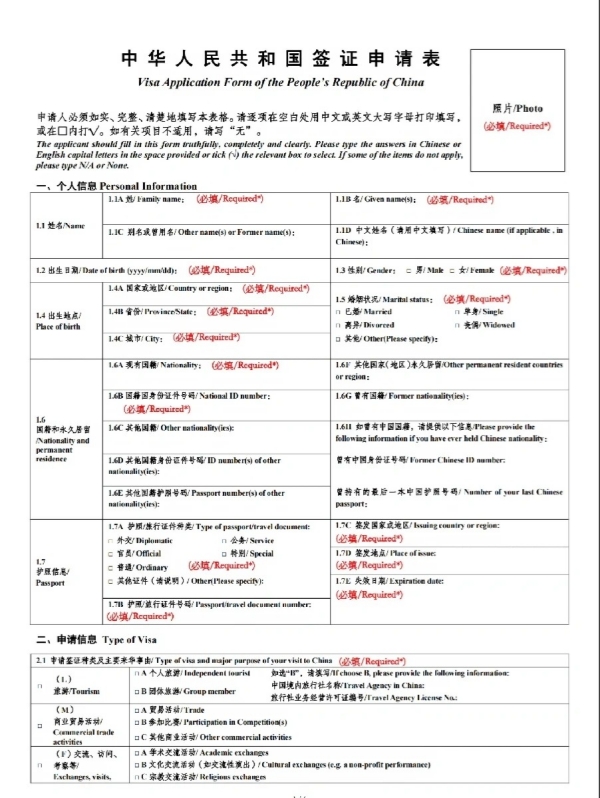
The field requests your government-issued civil ID number from your country of nationality. It sits in the personal-information block alongside your name, sex, date of birth, and passport number. This is not your passport number, tax ID, or driver's license — it is the number on a dedicated national identity document, if your country issues one.
The confusion arises because several major nationalities have no such system. The United States does not issue a universal civil ID number. The Social Security Number is a tax identifier, not an identity card. When US applicants read the prompt literally, they freeze. Community forums are full of the same three wrong answers: passport number, driver's license, or "none." All three have specific safe alternatives, which this guide covers below.
Where It Sits on the 2025 Form
In the COVA online portal (cova.mfa.gov.cn) the field is labelled "National ID Number." It appears on page 1 of the application, immediately after the passport-number entry and before the Purpose of Visit page. On the legacy PDF — still handed out by some embassies and visa centers — it is Section 1.6b under Part 1: Personal Information. Both versions serve the same purpose.
Why Foreign Applicants Get Stuck Here
The field assumes your country of nationality issues a universal civil-ID number. When it does not, applicants read the prompt and stop. This is not a flaw in the form — it is a genuine requirement for applicants from countries that do have such systems. For everyone else, the form has a built-in fallback: enter "N/A." The three most common wrong entries are the passport number (already entered in the field above), the driver's license (not a national ID), and nothing at all. The correct approach depends on which country issued your passport.
📄 Visa Categories: If you are unsure which travel category fits your trip before filling out the form, explore our breakdown of Chinese Visa Types.
2025 Form Walkthrough: Filling the ID Number Field
Here is the step-by-step path through both the COVA portal and the legacy PDF.
Locating the Field in the Online Portal
The COVA portal hosts the current standard form. However, the older visaforchina.cn site still functions at some locations. Both portals accept the field.
- COVA portal (cova.mfa.gov.cn): Look for "National ID Number" on the first application page, directly beneath the passport-number entry.
- Legacy portal (visaforchina.cn): The field is labelled "ID Number in the Country of Nationality" in the personal-information block.
- Both portals: Accept alphanumeric entry. Use the format printed on your national ID card if you have one.
What "1.6b" Means on the Older PDF Form
If you see "1.6b" referenced online, you are looking at the legacy PDF version of the Visa Application Form of the People's Republic of China. Section 1.6 is the personal-ID block, with sub-fields (a) ID type and (b) ID number. This older PDF is still distributed by some embassies and visa centers in 2025, even though the online portal is now the standard route. Users searching "6b id number" are typically trying to fill in this older form.
What to Write If Your Country Has No National ID
Not all countries issue a national ID number. If yours does not, enter "N/A" in the field.
- Do not enter: your passport number (it goes in the separate field above), your driver's license, or any tax identifier.
- US citizens: Enter "N/A" or "None" where the portal requires input. Do not enter your Social Security Number.
- Other countries without national IDs: The same rule applies — enter "N/A." The visa officer reviews the field but does not require a value where the issuing state issues no such document.
- Double-check before submission: Remove spaces, dashes, or special characters that do not appear on your official ID document.
⏱️ Processing Timelines: Need to know when your passport will be returned after submission? See our timeline guide on How Long Does It Take to Get China Visa.
What to Enter by Country
The table below summarises the rule for each major nationality. If your country issues a national ID, enter the number exactly as printed on the card. If it does not, enter "N/A."
United States
The United States does not issue a universal national ID number. The Social Security Number (SSN, format XXX-XX-XXXX) is a tax identifier. It is not a civil ID card and should not be entered on this form. The safest and most widely accepted entry on the 2025 form is "N/A." Where the portal refuses a blank field, enter "None." Some embassy guidance explicitly warns against sharing the SSN with foreign visa authorities unless required.
United Kingdom and Ireland
The UK National Insurance Number (NIN, format AB123456C) is the closest functional equivalent to a national ID, though the UK does not issue a compulsory ID card. Enter your NIN if you have one. If you do not have a NIN, enter "N/A." The NHS number and the UK driving licence number are not national IDs. Ireland's Personal Public Service Number (PPSN) serves the same purpose and may be entered if you hold one.
Canada, Australia and New Zealand
Canada has no federal ID card. Provincial health cards are not civil IDs and should not be entered — use "N/A." Australia has no national ID system — use "N/A." New Zealand likewise has no compulsory national ID number — use "N/A." For all three countries, leaving the field blank or entering "N/A" is consistently reported as accepted at visa centers.
Schengen Area and Countries With Mandatory National IDs
Most EU and Schengen member states issue a compulsory national ID card with a unique alphanumeric number. This field is genuinely required for these applicants. Here is a quick reference for the most common:
- Germany: Personalausweis number — enter exactly as printed on the front of the card.
- France: Carte nationale d'identité (CNI) number — 12-digit number on the back of the card.
- Italy: Carta d'identità number — appears on the front of the card.
- Spain: DNI number — 8 digits followed by a letter.
- Netherlands: BSN number printed on the ID-kaart.
- South Korea: Resident Registration Number (Jumin Beonho) — 13 digits.
- Japan: My Number (Mā Nanbā) — 12 digits.
- Brazil: CPF number — 11 digits.
- Argentina: DNI number — 8 digits.
🌍 Visa Exemption Rules: Planning a short trip and wondering if you even need an entry permit? Check the updated list of China Visa Free Countries.
Common Mistakes That Delay or Reject Applications
The following errors appear most frequently in reported application problems. Avoid them to keep your submission clean.
- Entering the passport number: The passport number has its own field directly above. Entering it here as well creates a mismatch and can trigger a resubmission request.
- Entering a US SSN: The Social Security Number is not a national ID. Visa authorities do not request it, and sharing it is unnecessary. Use "N/A" instead.
- Fabricating a number: Inventing an ID number where none exists is a refusal ground under the standard completeness and truthfulness review. If you have no national ID, say so with "N/A."
- Using a driver's license: A driving licence is not a national ID, even if it carries a number. It does not belong in this field.
- Mismatched nationality: Writing "USA" in one field and "United States of America" inconsistently elsewhere creates a data mismatch. The ID-issuing country must align with the declared nationality on your passport.
- Leaving the field blank when you have a national ID: If your country issues a national ID number and the portal permits entry, provide it. Omission can trigger a request for resubmission.
- Inconsistent dashes and spaces: Your national ID may include hyphens or spaces on the physical card. Enter it exactly as printed — no added or removed punctuation.
🔬 Specialized Visas: Traveling for science, technology, or academic exchanges? Learn more about the specific requirements for the China K Visa.
Frequently Asked Questions
Q: What is the "ID number in the country of nationality" on a China visa form?
It is the government-issued civil identification number from your country of nationality — separate from your passport number. The field is on page 1 of the form, after passport number, labelled "National ID Number" on the COVA portal and Section 1.6b on the older PDF.
Q: I'm a US citizen and I don't have a national ID number — what do I enter?
The US does not issue a universal national ID. Enter "N/A" on the form, or leave blank if the portal permits. Do not enter your SSN, driver's license number, or passport number in this field. The field accepts "N/A" for countries without such an ID system.
Q: What does "1.6b" or "6b" refer to on the China visa application form?
It is the sub-section number on the older PDF version of the Visa Application Form of the People's Republic of China. Section 1.6 is the personal-ID block, with (a) ID type and (b) ID number. This older PDF is still distributed by some embassies and visa centers.
Q: Can I leave the ID number field blank?
Yes, if your country does not issue a national ID number. If your country does issue one, leaving it blank may trigger a request to resubmit. The safest practice is to enter "N/A" only when your country situation supports it, and the actual national ID number when it exists.
Q: Should I enter my driver's license or passport number instead?
No. The passport number goes in the separate field directly above this one. The driver's license is not a national ID and should not be used. For US applicants, neither is required.
Q: Has the field changed on the 2025 version of the form?
No. The label, location, and purpose of the field have remained stable across the 2023, 2024, and 2025 form versions. Only the portal interface has shifted slightly, moving from the legacy visaforchina.cn form to the current COVA portal.
Q: What happens if I enter the wrong ID number?
Minor typos in a genuine national ID (Schengen, Korea, Japan) can be corrected at the visa-center counter on submission day if caught early. Entering a fabricated or non-existent ID number can lead to refusal under the standard completeness and truthfulness review. For "N/A" entries, no penalty applies when your country genuinely has no such number.
Q: Do Chinese passport holders also fill in this field?
Chinese nationals applying from outside China use the same field and enter their 18-digit Resident Identity Card number (居民身份证). Overseas Chinese using a foreign passport should follow the same rules as other foreign applicants based on the issuing country of that foreign passport.