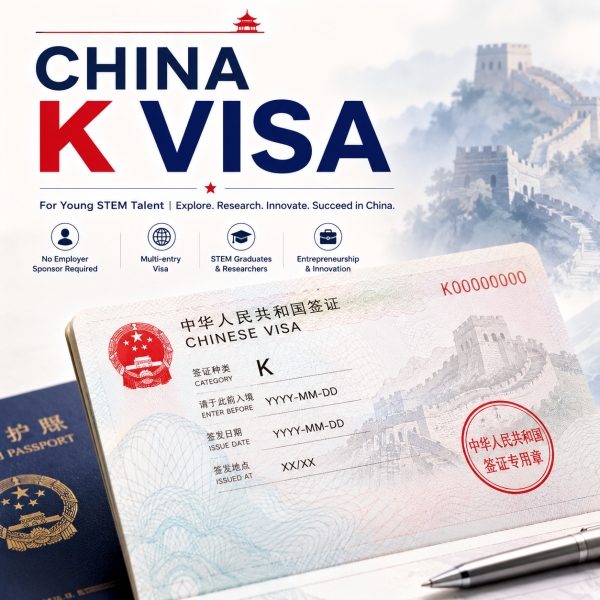
China K Visa for Global STEM Talents
The China K visa is a new visa category created under State Council Decree No. 814 — the Decision on Amending the Regulations on Administration of the Entry and Exit of Foreigners — signed on 7 August 2025 and in force from 1 October 2025. It adds the letter K to China's existing twelve ordinary visa types, the first new addition for over a decade.
Its principal benefit is simple: no employer sponsor required to apply — and no work permit required before you get on the plane. If you subsequently take full-time employment in China, a work permit and residence permit conversion will be required, but you can touch down, sightsee, research and launch a business while that happens. Multi-entry from day one and all on a single visa. Before we go any further, one caveat: the China K visa has nothing to do with the US K-1 fiancé(e) visa or the US H-1B. They just share a letter. This article is about entry into mainland China for STEM professionals.
✈️ Essential Advice for American Visitors: For US-based STEM professionals and tourists planning their trip, review complete entry procedures, required documentation, and practical travel tips in our guide to Americans Traveling to China.
Visa Eligibility (STEM Professionals Only)
The eligibility framework comes directly from the official decree and the Ministry of Public Security press conference on 14 August 2025. Two pathways qualify — and the critical word in the official text is "renowned."
STEM Degree and Research Standards
- Pathway 1 — Degree holders: Graduated from a renowned domestic or overseas university or research institution with a bachelor's degree or higher in a STEM discipline (science, technology, engineering, or mathematics).
- Pathway 2 — Active researchers: Currently engaged in STEM-related education or research at one of those same recognised institutions, with a formal employment or affiliation letter as proof.
The word "renowned" carries real weight — each embassy determines which institutions qualify in their local guidelines, not every STEM programme qualifies automatically. If you are unsure which visa category fits your situation, a full overview of China's visa types can help you compare options.
Age and Nationality Requirements
Nationality is open — no closed list of excluded countries. As for age, the national decree sets no hard limit. The policy targets "young science and technology talent"; some local materials reference an informal working range of around 18 to 35 years old — not a statutory number. Mid-career applicants are not excluded, but expect closer scrutiny.
Not the US K-1 or H-1B Visa
⚠️ Quick reality check on "STEM" boundaries: The official text states that you need to have a degree in science, technology, engineering, or mathematics from a world-class institution. They don’t make it explicit that applied social sciences that use quantitative methods - economics, psychology, urban planning - can apply, but it doesn't seem automatic either. If it’s not a clearcut STEM classification, ask your embassy if you pay for authentication or legalisation. Research using dual-use or defence-adjacent technologies gets extra scrutiny or requires security review, and if your field touches that space you should disclose that upfront rather than having people discover it during your clearance investigation.
Visa Comparisons (K, Z, and R Categories)
The China K visa sits in the middle of China's talent visa spectrum — more accessible than the elite R visa, more flexible than the employer-locked Z visa. Here is how the three compare:
Already have a signed contract in China? Take the Z visa — cleaner and faster. Still exploring, no contract yet? The China K visa gives you time on the ground first. Nobel-level credentials? Ask about R. Some nationalities may also enter visa-free for short visits — check whether your passport qualifies for China's visa-free entry before going through a full application.
How to Apply (Online and In-Person)
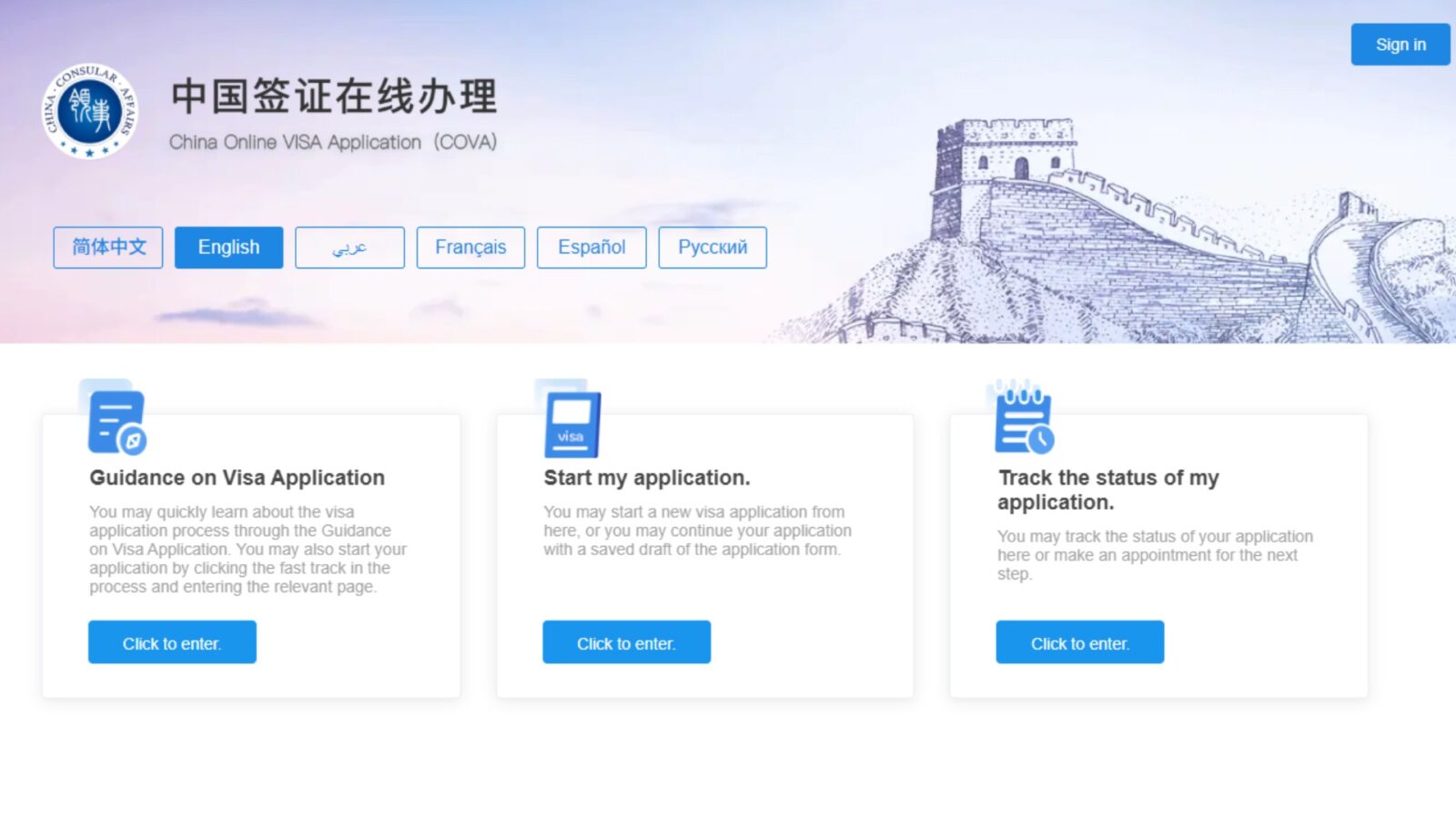
COVA Interface
Each Mission has its own list of required documents - treat the K visa page on your local Chinese embassy’s website as the definitive checklist. Applications are submitted via Chinese embassies, consulates, or the China Visa Application Service Center (CVASC). Most Missions use the China Online Visa Application system (COVA) at cova.mfa.gov.cn, or a Mission-specific version linked from the Mission’s own website - start there, and avoid third party aggregator sites for the form.
Required Documents Checklist
- Passport: Valid 6+ months beyond your stay, with 2+ blank pages.
- Application form: Completed via the COVA system (or mission portal); print the barcode confirmation page. Plus one passport photo — 33 × 48 mm, white background — sized to the spec on your embassy's page (varies slightly by country).
- Proof of STEM education (Pathway 1): Degree certificate and transcripts from a renowned institution.
- Proof of research employment (Pathway 2): Formal affiliation letter from a qualifying institution — replaces the degree route.
- CV / résumé: STEM background and a specific description of your planned activities in China.
- Authentication: Apostille (HCCH members) or full consular legalisation (non-members) on your degree or employment letter.
May also be required (confirm with your embassy):
- Criminal record certificate: Required by many missions — especially in North America and Europe. Usually must be issued within the past 6 months and submitted with Apostille/legalisation plus a certified Chinese translation. If the embassy's K visa page does not mention it, email the visa section to confirm before assuming you are exempt.
- Proof of funds: To show you can support yourself during an initial period without employment income.
- Supporting evidence: Published papers, patents, or awards — optional but can strengthen a borderline application.
Activity Description (The Key Decider)
Most K visa refusals and supplement requests don’t stem from passport photo sizing or lack of a stamp. They’re from a wobbly description of what you actually plan to do in China. Consular officers are sorting for one, single, simple thing: are you really here for science, tech, education, or culture — or is this a dodge?
In your CV and any supporting statement, be specific about timeline, institution, and funding:
- ❌ "Exploring opportunities in China's tech sector" — will almost certainly trigger a supplement request or refusal.
- ✅ "Collaborating with Prof. [Name] at [University]'s Materials Science Lab on thin-film solar cell research, 3-month visit from [date], self-funded / [scholarship name], invitation letter from lab director attached."
- ✅ "Participating in [Accelerator Name]'s Jan–Jun 2026 cohort in Shenzhen to prototype an IoT water-monitoring device; programme acceptance letter attached, estimated stay budget USD [X]."
The formula that works: concrete institution + named contact or programme + specific dates + funding source = significantly higher approval odds. The more a consular officer can verify the claim independently, the better.
Apostille and Certified Translation
China joined the Hague Apostille Convention on 7 November 2023. For HCCH-member countries, one Apostille stamp replaces the old legalisation chain — non-members still need full consular legalisation. Even with Apostille, embassies typically require a certified Chinese translation with an official stamp. For context on visa timelines, see how long China visa applications typically take.
Costs and Processing Times
⚠️ K visa caveat: The 4–5 day figure is standard for long-established visa types such as L or M. Since the China K visa is a newer category (from post-October 2025) and each mission is developing its own internal review pipeline, first-submission processing may take 7-15 business days — especially if the consular officer thinks they need additional evidence for your institution's "renowned" status, or requesting a more detailed plan of activities. Definitely don’t book flights until you have your passport back!
Note: the government visa application fee is typically a small fraction of the total. The large end of the USD 200–600 range is driven by authentication, certified translation, courier fees, and visa centre service charges — not the visa fee itself. Multiple documents each needing Apostille can quickly push costs toward the upper end.
Permitted Activities (Research and Business)
The China K visa is wider than a tourist visa and narrower than a residence permit — one distinction about employment catches most applicants off guard.
Scope for Research and Business
Per the Ministry of Public Security official press conference (14 August 2025), holders may carry out:
"Exchanges and collaborations in education, science, technology, and culture, as well as entrepreneurial and business activities."
In practice, that covers:
- Research and academic exchanges: Lab visits, conferences, university collaborations, self-directed scientific work.
- Entrepreneurship: Registering and operating a business in China — explicitly permitted.
- Business activities: Client meetings, negotiations, and commercial activity.
The China K visa is not a work permit. For formal employment — signed contract, payroll — your employer applies for a work permit separately; you then convert to a work-type residence permit. The China practical living guide covers daily life once you arrive.
Travel, Family and Tax Rules
- Geographic scope: Mainland China only — Hong Kong and Macau have separate immigration systems.
- Family members: Spouses and minor children need S1 or S2 dependent visas, submittable alongside your application.
- Tax residency: Over 183 days per year typically makes you a Chinese tax resident; worldwide income may then be taxable (subject to applicable treaties).
Administrative Compliance (Post-Arrival Requirements)
Getting the K visa sticker is only half the job. China's public security system expects foreign visitors to complete several administrative steps immediately after landing — and China K visa holders are not exempt.
Temporary Accommodation Registration (24-Hour Rule)
Every foreign national staying overnight in China must register their accommodation with local public security within 24 hours of arrival.
- Hotel stays: The hotel handles this for you — ask the front desk for the stamped registration receipt (境外人员临时住宿登记表). Keep it: you will need it to open a bank account and get a SIM card.
- Airbnb / friends / rented flat: You — or your host — must go to the nearest police substation within 24 hours with your passport and a copy of the lease or property documents. Missing this step can trigger fines and create complications when you later apply to extend your stay or convert to a residence permit.
Extended Stay Paperwork (Medical and Banking)
- Medical examination: Required if you later apply for any residence permit or long-stay extension. Must be completed at a designated local hospital or clinic — a foreign medical certificate from home is not accepted. Ask your local Exit and Entry Administration Bureau (出入境管理局) which facility they recognise.
- Health insurance: Not always checked at the border, but virtually all residence-permit pathways expect continuous coverage. Secure a China-recognised policy — or confirm your university, incubator, or employer's scheme before you need it.
- Bank account and SIM card: Bring your passport, visa page, and your stamped accommodation registration receipt. Major banks (Bank of China, ICBC) handle foreign national accounts routinely; however, tellers typically ask for your registered address first — which is why completing the 24-hour registration on arrival matters.
Visa-to-Residence Permit Conversion
The China K visa gets you in and gives you legal presence to explore, to research, or to build. But if you sign an employment contract, accept a paid lab appointment, or want to stay continuously longer than the duration your entry stamp will allow, you must visit your local Exit and Entry Administration Bureau and apply for a conversion to the appropriate residence permit.
Rules and incentives vary wildly by city — Shanghai, Shenzhen, Beijing, Hainan each have their own service windows and talent-attraction schemes. One city’s answer is not national policy, so be sure to check the local procedure rather than assuming it is the same procedure you read about for a different city!
Is the K Visa Open for Applications in 2026
This is the question that keeps appearing in expat forums and Reddit threads — and the answer requires separating what the law says from what is actually happening operationally.
Embassy and Applicant Feedback
The law isn’t the issue here, although the K visa category is included in Article 6 of the Regulations on Administration of the Entry and Exit of Foreigners, which came into force on 1 October 2025. One article in The Diplomat from December 2025 said the China K visa was still missing from CVASC’s official list months after launch. R/chinavisa had threads asking if anyone had even managed to get through?
By mid-2026, momentum has shifted: more missions have quietly added K visa pages, and some cities — Shanghai in particular — have published dedicated service guidance. However, activation remains postcode-dependent and globally uneven. Contact the Chinese embassy or consulate for your location directly and confirm the K visa window is open before preparing any documents. While you wait, the 144-hour transit visa covers visa-free stays in select Chinese cities.
From K Visa to Permanent Residence
Achieving the 4-Year Residency Rule
Foreign Permanent Resident ID card: The residency requirement is evaluated by the local Exit and Entry Administration Bureau but typically involves meeting a threshold of 4 consecutive years of legal residence, at least 6 months a year physically present in China, and maintaining substantive ties – employment, business ownership, on-going research etc.
Important note on China K visa: the K visa (as well as the TAvisa) is in fact an entry visa, and once you convert to a legal residence status – work-type residence permit for example – that is the time upon which compliant residence starts accumulating towards the threshold. Ask your local bureau how they count it.
One more point worth stating clearly: the China K visa is not a fast-track permanent residence guarantee. The Foreign Permanent Resident ID Card has its own standalone criteria — investment thresholds, exceptional contribution routes, marriage to a PRC citizen, and others — none of which the K visa automatically satisfies. Holding a K visa simply means you are in China legally and have the opportunity to build toward those criteria over time.
Choosing the Optimal Visa Path
The China K visa works best when you want to be in China before a contract is finalised — a researcher with an invitation but no signed contract, or a founder scouting opportunities before registering a company. Not a good fit: already have a contract? Go straight to the Z visa. Non-STEM professionals use M or Z. For medical trips, China's medical visa is a separate route.
Frequently Asked Questions about Details
Q: How long is the China K visa valid for?
The China K visa typically comes as a multi-entry visa valid for two to three years, with the permitted duration of each individual stay stamped on the visa itself. Exact terms are set at the embassy level and vary by applicant and nationality — always read the sticker carefully when you collect the China K visa from the mission.
Q: Does a China K visa let me work for any employer?
The China K visa is not a work permit. Holders can enter, research, start a business, and attend scientific exchanges freely — but formal employment with a Chinese employer requires the employer to separately obtain a work permit. Once issued, you then convert to a work-type residence permit. The China K visa grants presence, not employment authorisation.
Q: Can my spouse and children join me on a China K visa?
Family members cannot travel on the China K visa itself, but spouses and minor children can apply simultaneously for S1 (stays over 180 days) or S2 (shorter stays) dependent visas. Submitting family applications at the same embassy appointment as the China K visa application is both allowed and practical — confirm document requirements for dependents with your local mission.
Q: What happens if my China K visa application is refused?
A refused China K visa does not permanently block future applications. Common causes include incomplete documents, a vague activity description — "exploring opportunities" is routinely flagged — or applying to an embassy that has not opened its K visa window yet. Address the specific issue, write a concrete activity plan, and confirm the embassy is actively processing China K visa applications before resubmitting.
Q: Which Chinese embassies are processing K visa applications right now?
No centralised public list exists for China K visa-enabled embassies. Missions have activated at different paces since October 2025, and as of mid-2026 some are processing while others have not. Start by searching your embassy's website for "K visa" or "青年科技人才签证" — if no dedicated page appears, email the visa section with your degree and transcript attached and ask directly whether they are accepting China K visa submissions.
Q: Can Chinese nationals with foreign passports apply for the K visa?
The China K visa targets foreign nationals entering China for STEM purposes — not defined by ethnicity. Individuals with a foreign passport, including those of Chinese heritage, are in principle eligible under the same framework. Applications from ethnic Chinese backgrounds may face closer consular review, so confirm the specific position with the embassy handling your China K visa before applying.
Q: Does the China K visa cover Hong Kong or Macau?
The China K visa covers mainland China only — Hong Kong and Macau operate entirely separate immigration systems. A visa valid for the mainland does not extend to either territory. If you plan to visit both, check Hong Kong's and Macau's entry requirements for your nationality separately, and arrange any permits needed independently from the China K visa application process.
Q: Is there a minimum or maximum age for the China K visa?
The China K visa decree sets no statutory age ceiling. The target group is "young science and technology talent"; some local implementation materials reference an informal range of around 18 to 35 years, but this is not a binding limit. Mid-career applicants with strong STEM credentials are not excluded — confirm with the relevant embassy if you fall outside that range.
Q: Can I apply for the China K visa entirely online?
The China K visa application form is completed online, but most embassies still require an in-person appointment to submit original documents and leave your passport. A fully remote end-to-end process is not standard as of 2026. Some missions may accept courier submission for certain nationalities — always check your local Chinese embassy's official website for the current China K visa procedure.