Happiness Palace (Jianfugong)
An English search for "happiness palace" does not point to a single Chinese attraction literally named 幸福宫. Instead, the term loosely groups several buildings inside Beijing's Forbidden City whose names contain characters for happiness or tranquility — most notably the Palace of Established Happiness (Jianfugong / 建福宫), built in 1742 for the Qianlong Emperor. Other halls with similar names, including the Palace of Prolonging Happiness (Yanxigong) and the Palace of Earthly Tranquility (Kunninggong), also surface in search results, often boosted by the popularity of TV dramas set within these walls. This guide sorts out which buildings are real, which ones you can visit, and what happened to Jianfugong after a catastrophic fire in 1923.
Quick Facts
What "Happiness Palace" Means in China
Happiness Palace (Jianfugong)
There is no Chinese attraction literally called 幸福宫 that corresponds to the English search term. The closest real-world referent is the Palace of Established Happiness (Jianfugong) inside Beijing's Forbidden City. Several other Forbidden City halls bear names containing happiness or tranquility characters, and these are frequently confused with one another — a mix-up compounded by popular TV drama titles that use "palace" names as shorthand for the complex itself. The result is a SERP landscape where visitors arrive searching for a single "happiness palace" but must choose between multiple real buildings inside the same UNESCO World Heritage Site. Meanwhile, searches for "幸福宫" sometimes redirect to the Chengde Mountain Resort, which holds no hall literally translated as "Happiness Palace."
- Jianfugong (建福宫): Palace of Established Happiness; northwest corner of the Forbidden City; not open to general tourists.
- Yanxigong (延禧宫): Palace of Prolonging Happiness; northeast of the inner court; open to standard-ticket visitors; notable for its Western-style yellow-brick facade built in 1909.
- Kunninggong (坤宁宫): Palace of Earthly Tranquility; rear of the inner court; open to standard-ticket visitors; functioned as a shamanic worship hall during the Qing era.
- Chuxiugong (储秀宫): Palace of Gathered Elegance; western side of the inner court; open to standard-ticket visitors.
Jianfugong as the Closest Match
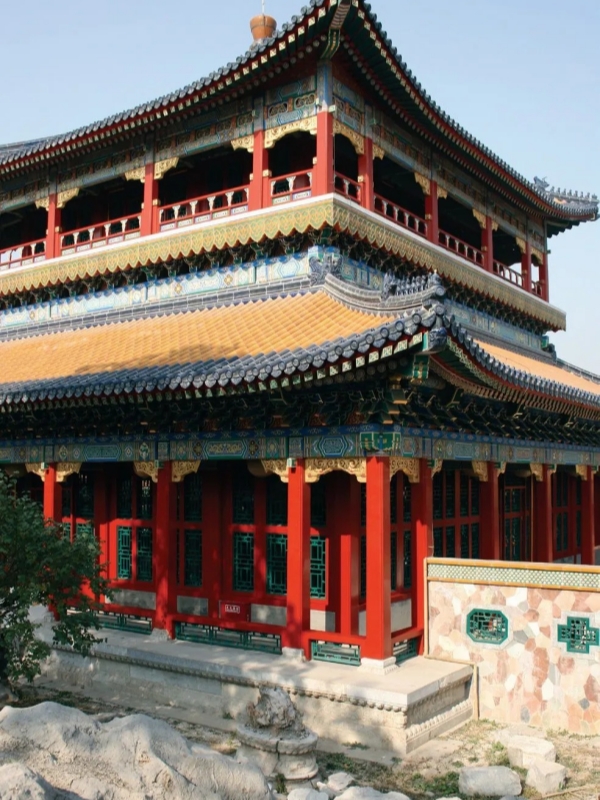
Jianfugong (建福宫) translates literally as "Palace of Established Happiness," with 建 (jian) meaning "establish" and 福 (fu) meaning happiness or blessing — the same character that decorates Chinese doorways during Lunar New Year. The Qianlong Emperor commissioned its construction in 1742, his seventh year on the throne, and used the building as a private poetry room and repository for imperial treasures. Its name was no accident: the emperor practiced writing the character 福 on the twelfth month of the lunar calendar and bestowing copies on officials, a ritual that reinforced his image as a benevolent distributor of fortune. After his death, memorial tablets for Empress Xiaodexian (1831–1850) and Empress Xiaozhenxian were placed within the complex. Today the building functions as a venue for distinguished guests and academic salons rather than general tourist access; visitors can view the exterior walls from the perimeter near Xuanwu Gate.
Other "Happiness" Palaces in the Forbidden City
Three other inner-court halls carry names that visitors commonly associate with the "happiness palace" search. Yanxigong, the Palace of Prolonging Happiness, sits in the northeast section and draws extra attention because of the popular Yanxi Palace TV drama. Its current most photographed feature is a Western-style yellow-brick building completed in 1909 on the ruins of the original hall — an anomaly in the Forbidden City's otherwise Chinese-style architecture. Kunninggong, the Palace of Earthly Tranquility, occupies the rear of the inner court and was used as a shamanic worship hall during the Qing dynasty, with empress dowagers of that era residing there. Chuxiugong, the Palace of Gathered Elegance, lines the western side of the inner court. All four halls are accessible with a standard Forbidden City ticket — except Jianfugong itself, which remains restricted to invited guests.
Chengde and the Happiness Palace Question
Visitors searching for "幸福宫" sometimes arrive at results for the Chengde Mountain Resort (Bishu Shanzhuang), a vast Qing dynasty estate in Hebei Province. However, the Mountain Resort does not contain a hall that translates literally as "Happiness Palace." Its principal structures include the Hall of Simplicity and Sincerity (澹泊敬诚殿), the main audience hall, and the Hall of Misty Waves (烟波致爽殿), where the Qing court signed the Boxer Protocol in 1901. Those specifically hunting for a "happiness palace" should redirect their search to the Beijing Forbidden City, which is where the term has a verifiable architectural referent.
🏰 Explore the Imperial Palace Complex: Understanding the layout of individual halls like Jianfugong and Yanxigong is easiest when navigating the world's largest palace complex. Plan your visit with our guide to the Forbidden City (The Palace Museum).
History of Jianfugong and the 1923 Fire
Happiness Palace (Jianfugong)
The Qianlong Emperor built Jianfugong in 1742 as a personal retreat for composing poetry and storing treasures. The emperor's tradition of writing the character 福 on the first day of winter in the lunar calendar and bestowing it on officials gave the building symbolic weight beyond its function as a treasury. After his death, memorial tablets for Empress Xiaodexian (1831–1850) and Empress Xiaozhenxian were installed within the complex.
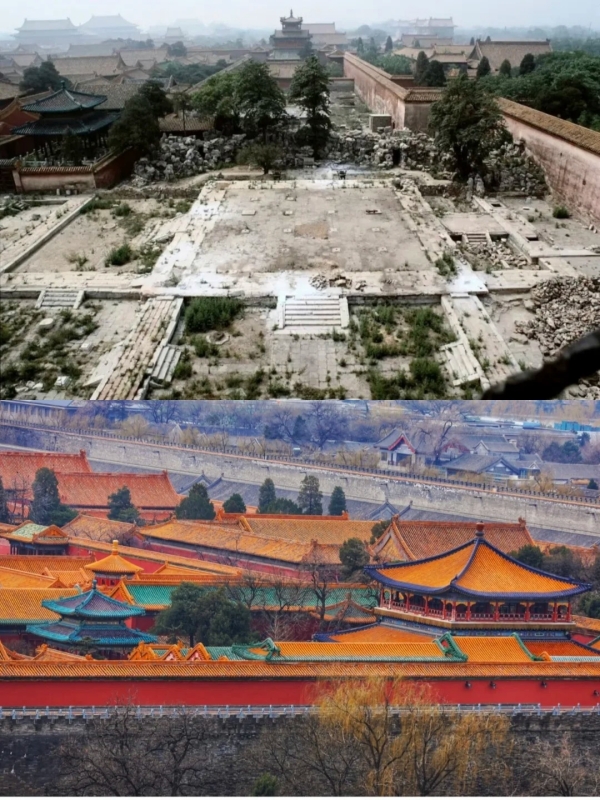
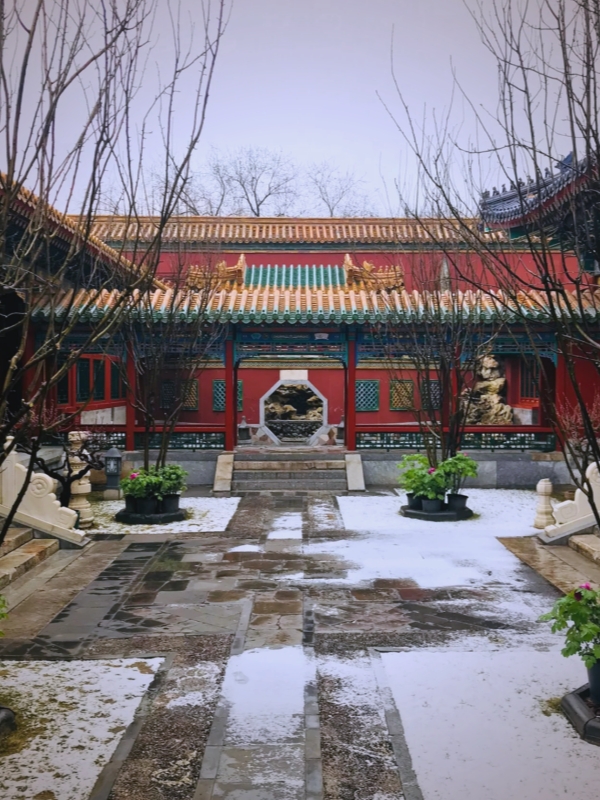
On the evening of June 26, 1923, a fire broke out and destroyed the north half of Jianfugong. Over 300 rooms burned, along with thousands of Buddha statues, gold items, Tibetan scriptures, and unopened tribute boxes that had sat untouched since Qianlong's era. Investigators traced the blaze to eunuchs who had stolen treasures and set the fire to hide evidence of their theft. The last emperor Puyi responded by expelling most eunuchs from the Forbidden City. The ruins sat for over 80 years before a renovation project ran from 1999 to May 2006. After restoration, Jianfugong reopened not as a museum but as a venue for invited guests, academic salons, and press events.
Jianfugong Architecture and Garden
Happiness Palace (Jianfugong)
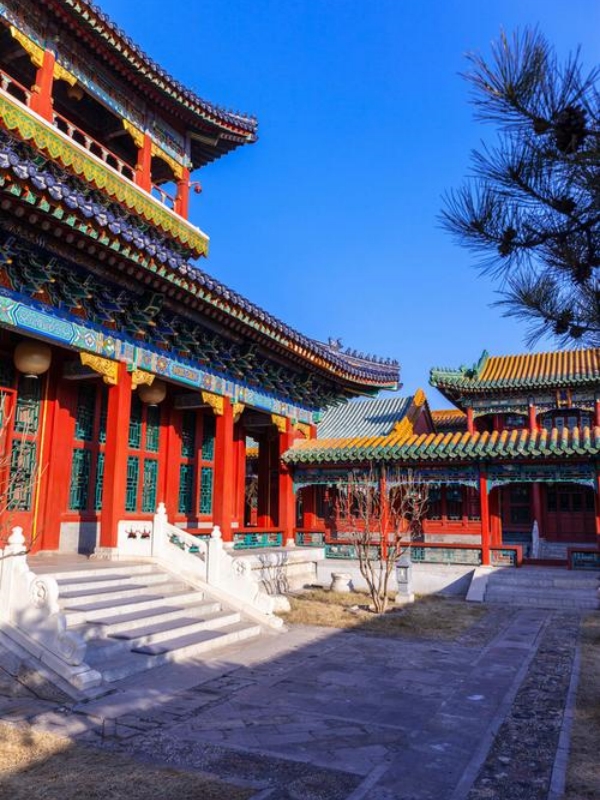
The Jianfugong compound divides into two distinct zones: a block of axisymmetric buildings along an east-west axis, and a western garden arranged on concentric principles rather than symmetry. The garden area covers 4,020 square meters and holds more than ten distinct buildings. Visitors approaching from the east first encounter Fuchendian, a gate hall with a curved saddle roof, green ridge tiles, and blue body tiles. Nine corridors extend from each side of Fuchendian, linking it to the main Jianfugong hall.
The main hall inside carries rich interior decoration — wooden partition boards with black bases and golden floral patterns, painted motifs of peonies, lotus, and magpies. The two side rooms were lined with silver wallpaper bearing round dragon, crane, and butterfly motifs, making this the most elaborately appointed space in the compound. Huifengting, a square pavilion at the eastern end of the axis, features a double-layered pointed roof of purple glazed tiles and blue ridge tiles, a white-rock balustrade, and columns carved with wavy patterns. Beyond it lie Jingyixuan, a transitional building, and Huiyaolou, a two-story structure once used to store Buddhist statues.
Fuchendian, the Main Hall, and Huifengting
Fuchendian functions as the entrance building to the compound, identifiable by its curved saddle roof and the paired nine-corridor links to the main hall. The main Jianfugong hall served as Qianlong's preferred private residence and poetry studio, a role reflected in its gilded decorative scheme and silver-wallpapered side chambers. Huifengting closes the east axis with its distinctive purple glazed tile roof and carved columns — an elegant architectural punctuation mark at the compound's edge.
The Jianfugong Garden (Yanchunge and Pavilions)
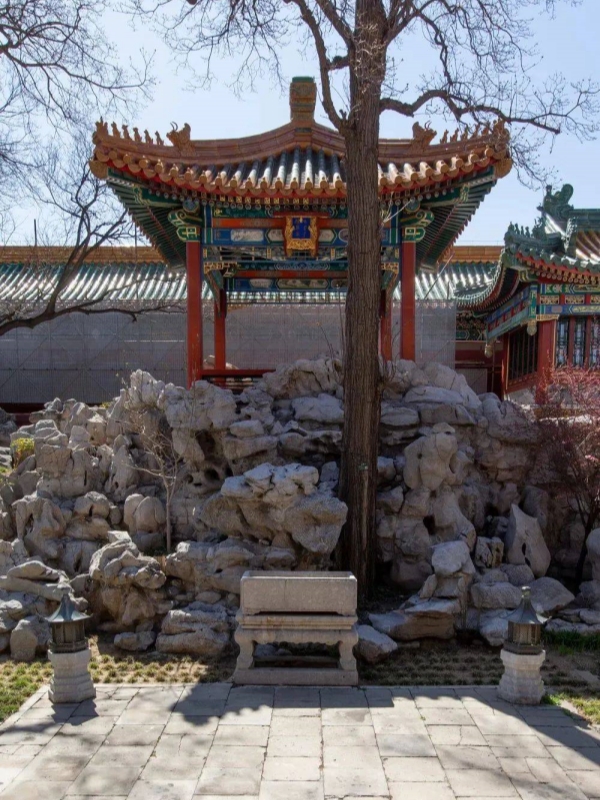
The West Garden (Xihuayuan) replaces the eastern axisymmetric layout with a centric design anchored by Yanchunge Hall at its center. Yanchunge is a square building crowned with a double-layered pyramidal roof, making it the largest structure in the garden. Four pavilions surround it at roughly cardinal positions.
- Jingshengzhai: northeast pavilion of Yanchunge.
- Bilinguan: northwest pavilion of Yanchunge.
- Ninghuitang: southwest pavilion of Yanchunge.
- Miaolianhuashi: southeast pavilion of Yanchunge.
Jingyixuan and Huiyaolou serve as connective structures linking the east axis to the garden's central zone. The southern garden area features grotesque rock formations, dense vegetation, and winding paths between the structures.
🌸 Discover Other Qing Dynasty Imperial Retreats: Beyond the residential courtyards of the Forbidden City, Qing emperors spent their summers surrounded by serene lakes, landscaped gardens, and ornate pavilions. Learn more in our guide to the Summer Palace.
Visiting the Forbidden City's Happiness Palaces
Happiness Palace (Jianfugong)
For foreign visitors who searched "happiness palace" and landed on Jianfugong, the practical plan is straightforward: enter the Forbidden City on a standard combined ticket and focus on Yanxigong, Kunninggong, or Chuxiugong instead. These three halls are open to regular visitors and carry "happiness" or "tranquility" in their names. Jianfugong itself remains off-limits to tourists, though its exterior walls are visible from the perimeter near Xuanwu Gate. Booking through Trip.com or Klook avoids the Chinese phone number requirement of the official site, and entering through Xuanwu Gate on the northwest side puts visitors closest to the Jianfugong perimeter and the Yanxigong and Chuxiugong halls.
- Book online: Use Trip.com or Klook — the official Palace Museum site requires a mainland Chinese phone number and WeChat Pay or Alipay.
- Carry your passport: Foreign visitors need a valid passport for ID verification at the gate.
- Arrive early: Enter before 9 a.m. to avoid peak crowds on the central axis.
- Prepare for the terrain: The Forbidden City covers 72 hectares — bring water, a sunhat, and comfortable walking shoes.
- Rent an English audio guide: At $7 (¥50), the self-service English audio guide is worth the cost for understanding Yanxigong and Kunninggong.
Tickets and Opening Hours
Access to Jianfugong and the Main "Happiness" Halls
Jianfugong itself is not open to general tourists. However, three other "happiness" and "tranquility" halls are accessible with a standard combined ticket. Yanxigong, the Palace of Prolonging Happiness, stands in the northeast section of the inner court and is open to all visitors. The hall's most photographed feature today is the Western-style yellow-brick building completed in 1909 on the ruins of the original — a surprise for visitors expecting purely Chinese architecture and the reason Yanxigong appears so often in travel photos.
Kunninggong, the Palace of Earthly Tranquility, sits at the rear of the inner court and is open to standard-ticket holders. Inside, visitors can see the shamanic worship tables still arranged at the rear of the hall. Chuxiugong, the Palace of Gathered Elegance, occupies the western side of the inner court and is also open. Entering through Xuanwu Gate on the northwest side places the Jianfugong perimeter and these three "happiness palace" buildings within the shortest walking distance.
Tips for Foreign Visitors
The official Palace Museum website requires a mainland Chinese phone number and WeChat Pay or Alipay for booking, which makes Trip.com and Klook the practical channels for international visitors. Carry your passport — gate staff verify identity against the booking. Arrive before 9 a.m. to beat the heaviest foot traffic on the central axis, especially during peak season. The 72-hectare site demands comfortable shoes, water, and sun protection. The English self-service audio guide costs $7 (¥50) and provides context for Yanxigong and Kunninggong that would otherwise be difficult to pick up without a Chinese-speaking guide.
Frequently Asked Questions
Q: Can tourists visit Jianfugong today?
No. Jianfugong is reserved for distinguished guests, academic salons, and press briefings. General tourists cannot enter the compound. Visitors can view the exterior walls from the perimeter path near Xuanwu Gate, but the building itself is not accessible on a standard ticket.
Q: Why was the Palace of Established Happiness closed?
A fire on the evening of June 26, 1923 destroyed the north half of the compound and over 300 rooms, along with thousands of Buddha statues, gold items, and unopened tribute boxes from Qianlong's era. Investigators determined that eunuchs had set the blaze to cover up prior thefts. Puyi expelled most eunuchs from the Forbidden City in response. The site lay in ruins for over 80 years, and a renovation ran from 1999 to May 2006. The restored building reopened for non-tourist purposes only.
Q: Where is the Palace of Prolonging Happiness (Yanxigong)?
Yanxigong is in the northeast section of the Forbidden City's inner court, open to all standard-ticket holders. The hall gained fame through the Yanxi Palace TV drama, and visitors often find the Western-style yellow-brick building constructed on its ruins in 1909 to be the most visually striking feature — the most-photographed "happiness" hall in the complex.
Q: How much does the Forbidden City cost?
Peak season (April 1 – October 31) costs $8 (¥60). Off-peak (November 1 – March 31) costs $6 (¥40). The Treasure Gallery and Clock Gallery each add $1 (¥10). English audio guides rent for $7 (¥50) at the entrance. All tickets are bookable on Trip.com or Klook without needing a Chinese phone number.
Q: Is the Forbidden City wheelchair accessible?
Most central-axis routes have been paved smooth for accessibility, and ramps have been installed at the main halls. Some side passages between historic pavilions, including areas near Jianfugong, still involve steps. Visitors requiring an accessible route should request guidance at the entrance gate upon arrival.
Q: What is the best season to visit the Forbidden City?
April through May and September through October offer the mildest weather and clearest skies. The National Day holiday week (October 1–7) draws the year's heaviest crowds and should be avoided if possible. Winter visits mean smaller crowds but shorter daylight hours and colder temperatures.
Q: Are English tours available inside the Forbidden City?
Yes. Self-service English audio guides rent for $7 (¥50) at the entrance. Guided English-language tours led by Palace Museum staff operate on weekends and can be reserved through the museum's English-language website.