
Best Time to Visit Guilin
Guilin draws visitors for one reason above all others: the karst landscape along the Li River. Spring (March to May) and autumn (September to November) deliver the mildest temperatures, clearest water, and the lowest crowds outside of holiday weeks. July and August add heat above 36 °C and school-vacation crowds.
Winter (December to February) cools the air and lowers river levels on the Li and Yulong. This guide covers weather, scenery, the Longji Rice Terraces, and the cruise (like Guilin Nightlife) and rafting seasons month by month, so you can match your trip to the conditions you actually want.
Quick Facts
Spring in Guilin (March to May)
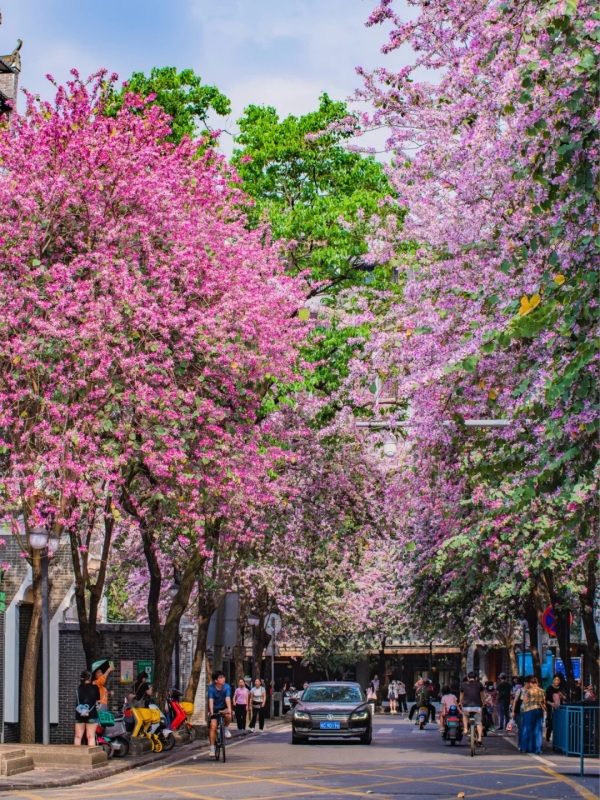
Spring Blossoms and Scenery in Guilin
March averages 14.9 °C across the Guilin region, April climbs to 19.4 °C, and May reaches 22.8 °C. Spring rainfall grows with each month — 229 mm in March, 296 mm in April, and 356 mm in May — but it falls steadily rather than in violent bursts. That steady rain refills the Li River and keeps the cruise and rafting routes open through late May.
Spring Weather and River Levels
March runs 14.9 °C average (min 11.4, max 18.1). April warms to 19.4 °C (min 16.2, max 23.0). May reaches 22.8 °C (min 20.0, max 26.3). Monthly rainfall climbs from 229 mm in March to 296 mm in April and 356 mm in May, so the Li River stays full enough for cruise boats and bamboo rafts. Mornings are often misty; afternoons can feel muggy by late May.
Blossoms and Scenery
Green returns to the riverbanks in spring, and several species come into bloom across the karst valleys:
- Rapeseed flowers: flat plains outside Guilin city (March)
- Azaleas: hillsides and ridge paths (April)
- Hydrangeas: shaded valleys (May into June)
- Wisteria: courtyards, parks, and older villages (April–May)
The dense green vegetation set against pale limestone peaks is the defining spring image, and the contrast sharpens through May.
🦇 Top Rainy Day Attraction: When spring showers pick up along the Li River, retreat underground to explore illuminated limestone formations and ancient stalactites in our complete guide to Reed Flute Cave Guilin China.
Autumn in Guilin (September to November)
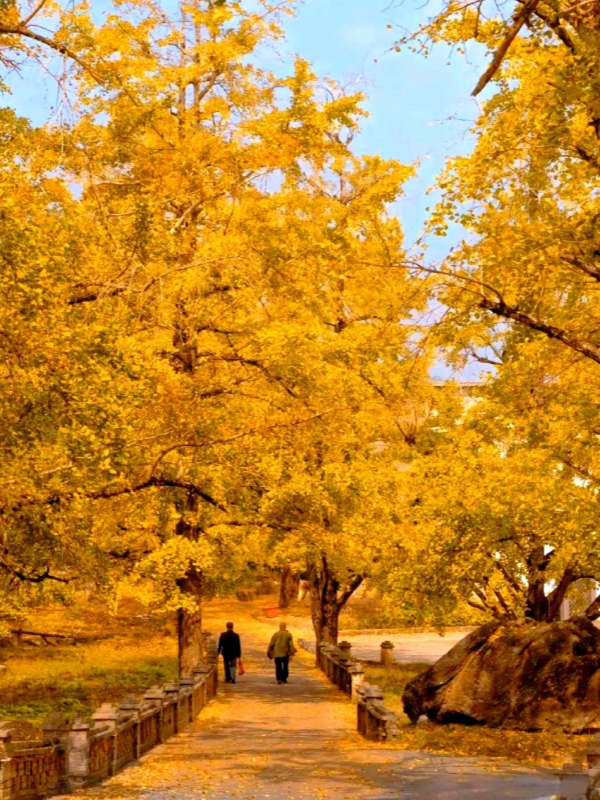
Ginkgo Season at Haiyang Town
September averages 25.1 °C and October 21.0 °C, while November cools to 15.5 °C. Rainfall drops sharply after the summer monsoon — 73 mm in September and 76 mm in October — which keeps the Li River clearer than at any other time of year. Humidity falls to 66–70%, and visibility across the karst peaks stretches for miles.
Autumn Weather
September averages 25.1 °C, October 21.0 °C, and November 15.5 °C. Rainfall drops to 73 mm in September and 76 mm in October before ticking up to 98 mm in November. Humidity sits at 70% in September, 66% in October, and 69% in November. Daily sunshine runs 8.5 hours in September, 7.5 in October, and 6.3 in November — enough for clear karst panoramas most days.
Longji Rice Terrace Harvest
The layered rice paddies at Longji ripen to gold across late September and into mid-October. This two-to-three-week window is the single best time to photograph the terraces from the main viewing platforms. The catch is timing: it overlaps the start of the National Day Golden Week, so the platforms, buses, and village lanes fill up fast.
Haiyang Town Ginkgo Season
About 50 km northeast of Guilin, Haiyang Town in Lingchuan County holds clusters of ancient ginkgo trees. Leaves turn yellow from mid-November into early December, turning the village lanes into a short, concentrated autumn corridor. Pair it with a Longji visit if dates line up; otherwise plan it as a half-day trip on its own.
Longji Rice Terraces
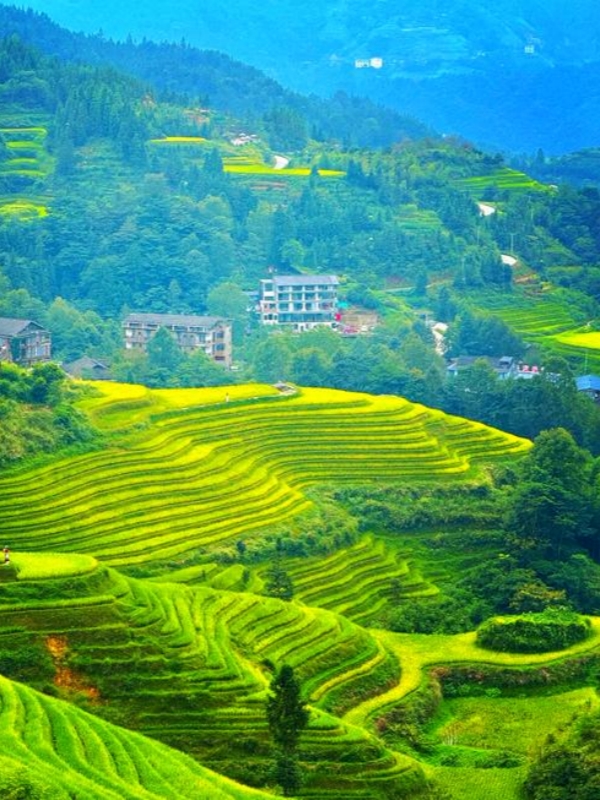
Guilin Longji Rice Terraces
The Longji (Dragon's Backbone) Rice Terraces sit in Longsheng County, roughly 100 km or about 2.5 hours north of Guilin. Villages inside the system include Ping'an, Dazhai (also called Jinkeng or Red Yao), and the Longji village area. Elevations run 600–1,100 m, so the air stays cooler than in Guilin city and fog drifts in and out of the valley folds.
Two short windows define the year here:
- Late September to mid-October: golden rice harvest
- Late April to mid-June: flooded mirror terraces
Outside these windows the terraces stay quiet, but the views themselves lose their signature color or reflection.
Golden Harvest Window
Late September to mid-October is peak. The ripening rice turns the terraces into a single sheet of gold from the main viewing platforms. Morning and late-afternoon light work best for photos. The October 1–7 National Day Golden Week falls inside this window, so the terraces, viewing platforms, and buses from Guilin to Longsheng get heavily crowded.
Water-Filled Mirror Terraces
From late April to mid-June, farmers flood the paddies for planting. The still water reflects sky and peaks during clear mornings. Domestic tour groups run lighter than in October, so the platforms and village lanes feel calmer. Cloud cover matters more here — overcast days flatten the reflection effect.
Getting to Longji
The standard route runs through Guilin Qintan Bus Station. Plan it in steps:
- Bus Guilin Qintan → Longsheng: about 2.5 hours, fare ~$5 (¥35)
- Minibus Longsheng → Ping'an or Dazhai: about 30–40 minutes, fare ~$2 (¥14)
- Peak-season direct bus Guilin → Ping'an: bookable through Trip.com ground transport
English signage outside the main villages is limited, so pin your drop-off point on a map before boarding.
🌾 China's Other Terraced Wonder: If you are captivated by Longji's sweeping mountain contours and want to compare them with the massive, mirror-like flooded steps sculpted by the Hani people in southwest China, explore our deep-dive guide to the Yuanyang Rice Terraces.
Yangshuo and the Li River

Guilin and the Li River
Yangshuo sits about 65 km south of Guilin along the Li River corridor. The signature activity is the Li River cruise from Guilin Zhujiang Pier down to Yangshuo, a 4–5 hour trip on a 4-star boat. The river runs best in spring and autumn. June is the riskiest month because summer runoff turns the water visibly muddy.
Typical ticket tiers, bookable through Trip.com and Klook:
- Li River cruise (4-star boat, Guilin → Yangshuo, 4–5 hr): ~$45–65 (¥320–460) per adult
- Yulong River bamboo raft (shorter route): ~$20 (¥140)
- Yulong River bamboo raft (full Yulong): ~$30 (¥210)
Li River Cruise Timing
The 4–5 hour cruise from Guilin Zhujiang Pier to Yangshuo costs about $45–65 (¥320–460) per adult. April–May and September–October give the clearest water and mildest air. June is the riskiest month for muddy water after heavy rain. In December and January, low water levels force some operators to shorten the route.
Bamboo Rafting on the Yulong River
Manual bamboo rafts move slower than the cruise boats and stay quiet. The Yulong season runs roughly April through October. Shorter routes (Jinlong Bridge to Jiuxian) run about $20 (¥140); the full Yulong route runs about $30 (¥210). Rafting can be canceled after heavy rain, so build a backup day into your plan.
Xingping and West Street
Xingping sits about 20 km south of Yangshuo and holds the karst view printed on the back of the 20 RMB banknote. Access runs year-round. West Street in Yangshuo town stays lively after dark and works as a backup if weather shuts down the river activities.
🚢 Plan Your Perfect River Cruise: To get detailed tips on booking tickets, choosing between rafts and larger cruise boats, and finding the most iconic photo spots along this world-famous waterway, explore our complete guide to the Li River Yangshuo.
Summer Crowds and Storms
July and August combine the year's highest temperatures with school-vacation crowds. July averages 26.8 °C and August 26.9 °C, but humidity at 77–81% pushes perceived temperatures well above 36 °C on most afternoons. Rain still falls — 231 mm in July and 145 mm in August — often as heavy downpours that cancel rafting trips and trigger landslides in mountain areas.
Heat, Humidity, and Rainfall
July averages 26.8 °C with 81% humidity and 231 mm of rain across roughly 16 wet days. August averages 26.9 °C with 77% humidity and 145 mm of rain. Heavy downpours can cancel river rafting on short notice. Landslides have been reported in mountain areas after prolonged rain, so check local conditions before driving into Mao'er Mountain or Longji.
Crowds and Hotel Surcharges
Late July and early August form a peak domestic travel window. A 3-star hotel in Guilin city typically runs about $45–70 (¥320–500) per night in low season, jumping to about $90–140 (¥640–1,000) in late July or early August.
Our picks for working around the heat and the queues:
- Book early: flights and rooms should be locked in several weeks ahead
- Start before 9 a.m.: skip midday heat and queues on the river
- Caves as cool-downs: Silver Cave and Reed Flute Cave stay around 16–18 °C year-round
- Head uphill: Mao'er Mountain is the main cooling option for heat-sensitive travelers
Winter and Chinese Holidays
Winter is the dry, cool low season. December through February averages 9.0–11.4 °C, with monthly rainfall between 75 mm and 121 mm. The Li River drops enough that some shorter cruise routes run instead of the full Guilin-to-Yangshuo trip. The caves keep a stable 16–18 °C, and Mao'er Mountain can produce rime-ice scenery under the right conditions.
December to February
January is the coldest month at 9.0 °C average, with lows around 5.3 °C. Monthly rainfall runs 75–121 mm — light compared with summer. Li River levels drop, and some cruise operators shorten their route. Mao'er Mountain sometimes produces rime-ice scenery when cold air meets lingering valley moisture. Silver Cave and Reed Flute Cave hold a steady 16–18 °C and work as warm-clothing-free stops.
Chinese Public Holidays to Avoid
Holiday weeks distort the calendar far more than the season itself. The heaviest impact comes from:
- Spring Festival (Chinese New Year, late January to mid-February in 2026)
- May Day: May 1–5
- National Day Golden Week: October 1–7
Moderate-pressure periods:
- Qingming: April 4–6
- Dragon Boat Festival: June 19–21
- Mid-Autumn Festival: September 25–27
- New Year's Day: January 1–3
During the heavy weeks, flights and trains sell out, hotels push rates 50–100% higher, and main attractions fill by mid-morning.
Frequently Asked Questions
Q: When is the best time to visit Guilin?
Spring (March–May) and autumn (September–November) combine mild temperatures, lower rainfall, and clear river views. April, May, September, and October are widely considered the four top months. Skip July and August for the heat and school-vacation crowds, and avoid the Spring Festival, May 1–5, and October 1–7 holiday weeks. Outside those windows, river cruises and the Longji terraces both perform well.
Q: What is the best month for the Longji Rice Terraces?
Late September to mid-October for the golden rice harvest, ideally before the October 1–7 National Day crowds arrive. Late April to mid-June for the flooded mirror terraces and planting season. Both windows deliver the terrace views the site is known for. Outside these periods, the terraces stay quiet but lose their signature gold or reflection.
Q: When is the best time to cruise the Li River?
April–May and September–October give the clearest water and mildest weather for the 4–5 hour Guilin-to-Yangshuo cruise. June is the riskiest month — heavy rain turns the river visibly muddy. December through February lowers water levels, and some operators shorten the route. Book through Trip.com or Klook about a week ahead.
Q: What months should I avoid in Guilin?
July and August for sustained heat above 36 °C, high humidity, and school-vacation crowds. Also avoid the Spring Festival week (late January to mid-February in 2026), May 1–5, and the National Day Golden Week October 1–7. During those holiday windows, hotels raise rates 50–100% and main attractions fill by mid-morning.
Q: When is the rainy season in Guilin?
April through June is the wettest stretch. June alone averages 372 mm (about 14.6 inches), the heaviest single month of the year. Rain eases sharply from July onward. September (73 mm) and December (around 75 mm) are the driest months, and visibility over the karst peaks is at its best in autumn.
Q: How cold is Guilin in winter?
December through February averages 9.0–11.4 °C, with January the coldest at 9.0 °C average and lows around 5.3 °C. Damp air can make it feel colder than the thermometer suggests. Pack a warm layer, especially for Mao'er Mountain, which can produce rime-ice scenery under suitable conditions.
Q: Do Chinese public holidays affect Guilin travel?
Yes. Spring Festival (Chinese New Year), May 1–5, and National Day Golden Week October 1–7 are the heaviest. Flights and trains sell out, hotels raise rates 50–100% or more, and main attractions become very crowded. Qingming, Dragon Boat, Mid-Autumn, and New Year's Day produce moderate pressure. Book early or travel the week before or after.