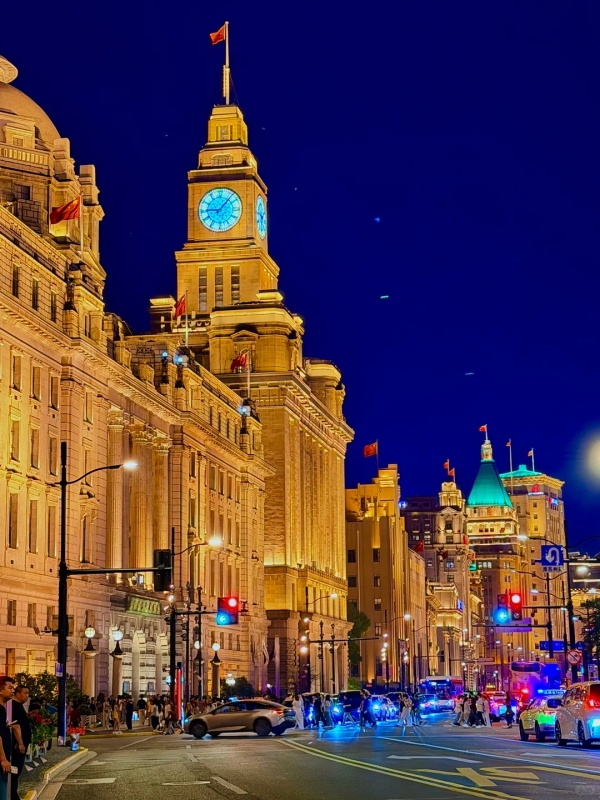
The Bund in Shanghai
The Bund in Shanghai is the city's historic waterfront, where former banks and trading houses face the Huangpu River and the towers of Lujiazui beyond. Its appeal comes from looking in both directions: toward the stone facades behind the promenade, then across the water to modern Pudong. For a first visit, begin with the riverfront and learn to recognize a few buildings rather than trying to identify every address. The Customs House clock tower, the Peace Hotel's green roof, Waibaidu Bridge, and the old signal tower give the walk its landmarks, while daylight and evening reveal different parts of the scene.
Quick Facts
🌉 Iconic City Panoramas: Looking to understand how the historic waterfront architecture pairs with the famous futuristic towers across the river? Explore the full architectural contrast in our guide to the Shanghai Skyline & Architectural Evolution.
The Bund in Shanghai Through Time
The Bund in Shanghai is a stretch of city rather than a single attraction behind an entrance gate. Its historic buildings line the western side of the waterfront road, while the promenade runs beside the river. Understanding that arrangement makes the scene easier to read.
A Riverfront, Not One Building
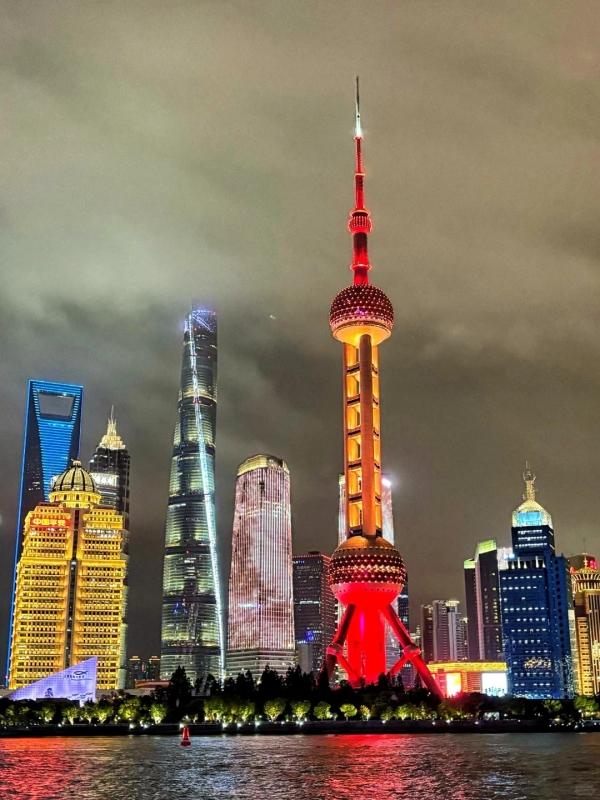
Lujiazui Night Skyline View
Stand near the water and the modern skyline lies across the Huangpu in Pudong. Turn back toward the road to see the old financial frontage. Both views belong to the experience, but they show different districts and different periods of Shanghai's development.
The traditional sightseeing stretch runs from East Yan'an Road to Waibaidu Bridge. Wider uses of the name can include surrounding streets and waterfront developments, so a hotel or attraction advertised as “Bund” may stand beyond this central section.
- The Bund: The historic waterfront in Huangpu district, on the Puxi side of the river.
- Lujiazui: The modern district opposite, in Pudong, where the recognizable cluster of tall towers stands.
- North Bund: A separate waterfront area in Hongkou, beyond the Suzhou Creek side of the historic Bund.
From Port to Financial District
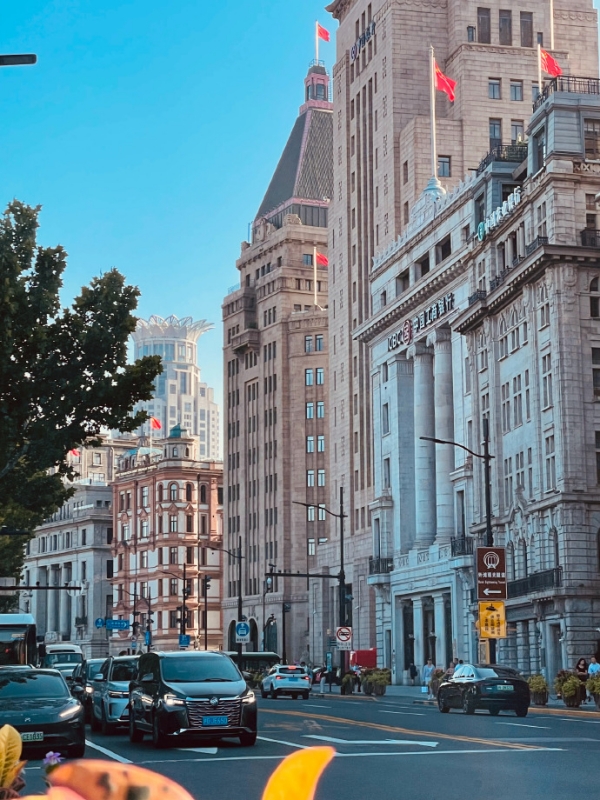
Shanghai Bund Historic Street View
Shanghai opened as a treaty port in 1843. Foreign trading firms and financial institutions gathered near the waterfront, where shipping, commerce, and banking were closely connected. The river was the reason for the location, not merely a backdrop for impressive offices.
The frontage developed over decades. Its surviving buildings therefore do not share one construction date or architectural style. Classical columns, domes, clock towers, and later geometric forms record different attempts to express commercial importance along the same riverbank.
- Trade: Shipping and overseas commerce helped establish the waterfront's concentration of business institutions.
- Finance: Substantial bank buildings gave the riverfront a monumental appearance that still shapes its identity.
- Public space: Embankments, roads, landscaping, and walking areas evolved alongside the commercial frontage.
These buildings also belong to the history of foreign concessions and unequal colonial power. Their architecture deserves attention without treating that period simply as a glamorous stage set. Looking at who commissioned and used each building gives the waterfront more meaning than a list of styles alone.
🚢 River Terminals & Cruise Hubs: Exploring the broader Huangpu riverfront beyond the central promenade? Learn about nearby maritime facilities and connections in our Shanghai International Cruise Terminal Guide.
✨ Underriver Light Art Experience: Want to cross between Puxi and Pudong through the colorful multimedia passenger tunnel beneath the river? Discover what to expect in our Bund Sightseeing Tunnel Shanghai Guide.
Historic Buildings Along the Bund
The easiest way to appreciate The Bund in Shanghai is to give a few buildings your full attention. Four useful anchors represent banking, customs administration, a private social club, and a hotel. Their different functions explain much of the waterfront's character.
Former HSBC Building
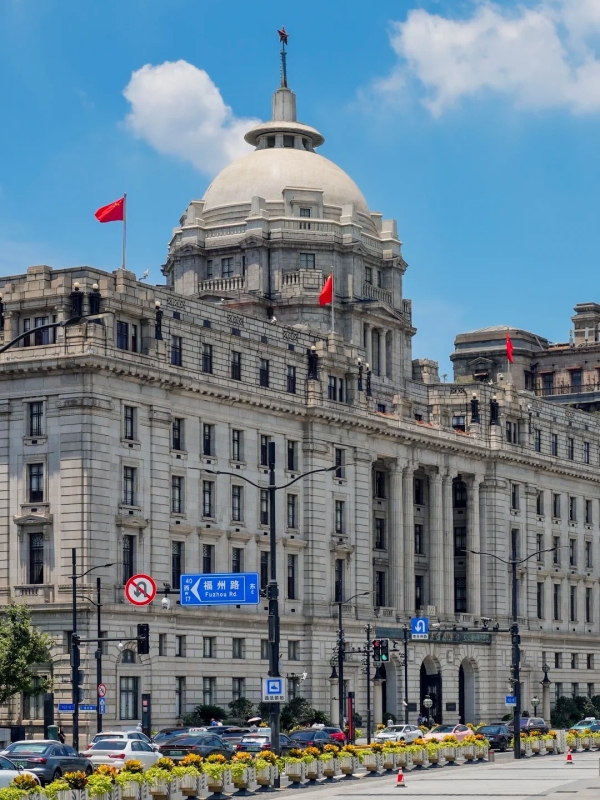
Former HSBC Building Shanghai Bund
The former HSBC building at No. 12 was completed in 1923 to designs by Palmer & Turner. Its neoclassical frontage and central dome make it one of the clearest places to begin recognizing the architecture. The building now houses Shanghai Pudong Development Bank.
Start with the whole composition before studying details. The dome draws attention upward, while the columns and balanced facade organize the broad frontage below. This architectural language gave a bank the presence of a major civic institution facing the river.
- From a distance: Compare the rounded dome with the neighboring Customs House's upright clock tower.
- At the frontage: Look for the relationship between the main entrance, large columns, and repeated windows.
- Inside, when admitted: The octagonal entrance hall is known for its mosaic decoration, a separate experience from viewing the exterior.
The interior has more than one significant space. Its entrance mosaics and the historic Chinese Banking Hall are not interchangeable names for a single room. Unless you have arranged a specific visit, appreciate the facade without assuming that every decorated hall is accessible.
Customs House
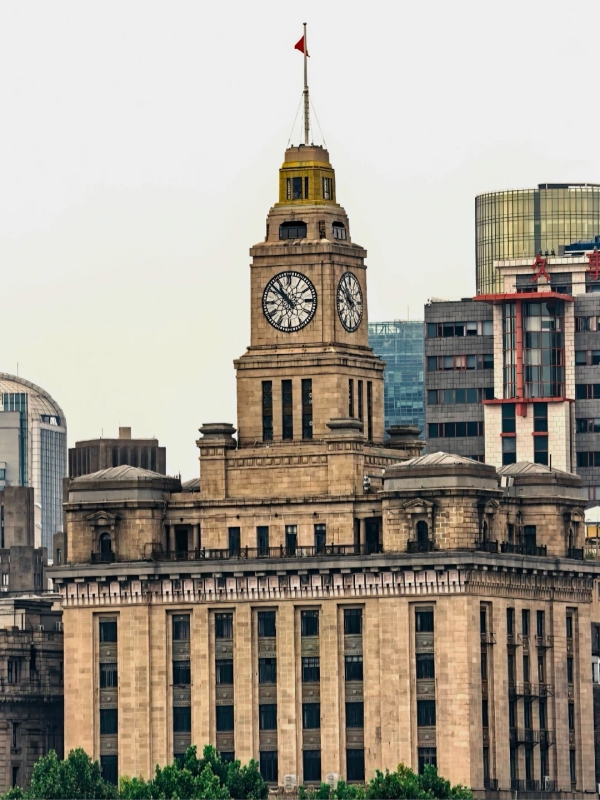
Shanghai Customs House Clock Tower
Next door, the Customs House at No. 13 is recognizable by its clock tower. Built in 1927, it provides a different silhouette from the neighboring bank: a strong vertical marker rising above the lower building frontage.
Compare the two together. The bank's dome and the customs clock explain why this part of the row attracts attention even in a wide view. One building represents finance; the other connects the waterfront to the administration of a busy trading port.
Shanghai Club
Farther south, No. 2 was the Shanghai Club, whose new clubhouse opened in January 1911. It now forms the heritage portion of the Waldorf Astoria Shanghai on the Bund. Its story adds social life to a waterfront often described only through banks.
The club's Long Bar became closely associated with its identity. However, membership historically involved substantial expense and selective admission. That social exclusiveness is part of the building's history, alongside the hospitality and entertainment for which it became known.
- Historic frontage: Read the old clubhouse as part of the street-facing architectural row.
- Later addition: The modern hotel tower stands behind the restored club, rather than replacing the riverside facade.
- Present-day use: This is a working hotel. Public hospitality spaces and guest accommodation have different access conditions.
Peace Hotel
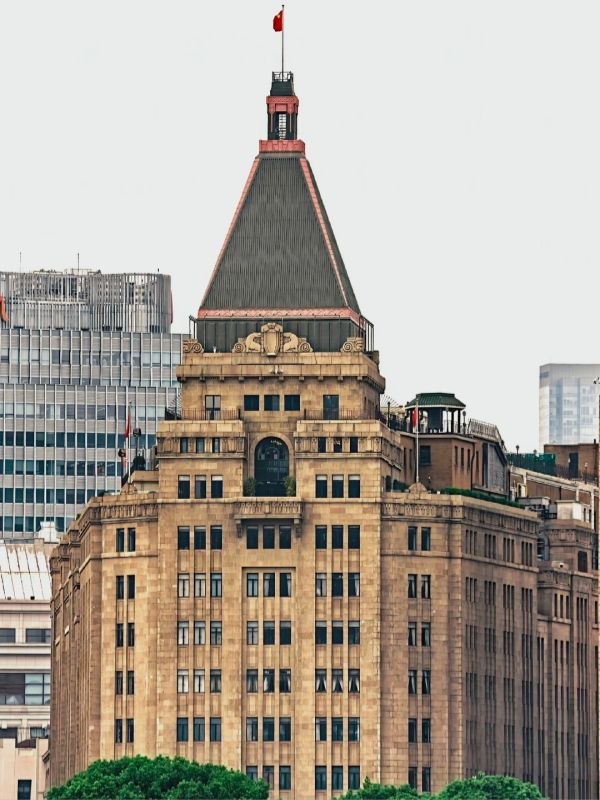
Peace Hotel Bund Facade
The Peace Hotel's north building is the former Sassoon House, which housed the Cathay Hotel when it opened in 1929. Its Art Deco character offers a useful contrast with the more overtly classical vocabulary of the former HSBC building.
Look first for the green copper roof, then follow the building's vertical lines down toward the street. The green color developed through oxidation. During restoration, the architect retained that familiar appearance because it had become part of Shanghai's collective memory.
🎆 Holiday Light Celebrations: Planning a visit during the winter holidays or looking for the best spots to view nighttime celebrations along the river? Discover festive happenings in our guide to New Year's Eve Events & Celebrations in Shanghai.
Riverside Landmarks and River Views
The riverfront adds another layer to The Bund in Shanghai. Parks, a memorial, a steel bridge, and a maritime signal tower show how this shoreline has served public life and navigation as well as commerce.
Huangpu Park and the Monument
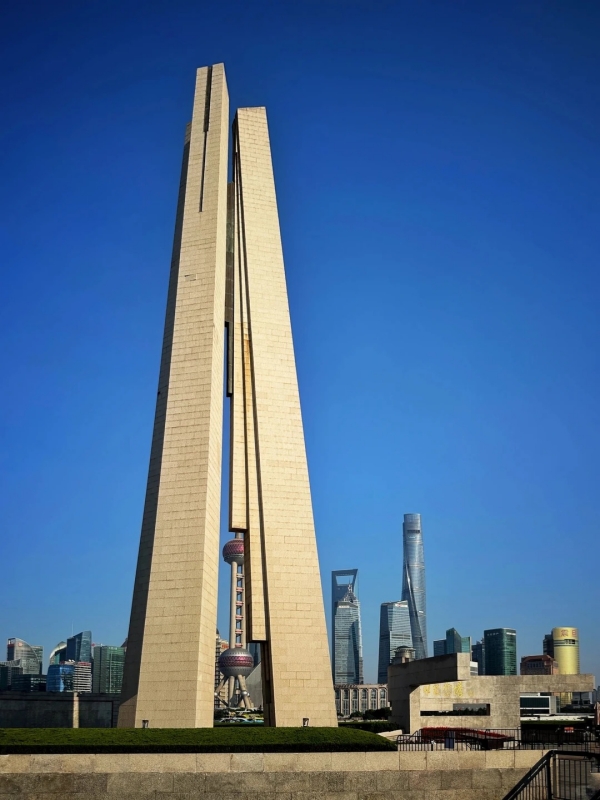
Shanghai People's Heroes Memorial
At the northern end, Huangpu Park occupies the area near the meeting of Suzhou Creek and the Huangpu River. The Monument to the People's Heroes stands here, commemorating revolutionary martyrs associated with Shanghai's liberation.
Use this location to understand the waterfront's geography. The Huangpu continues past the Bund, while Suzhou Creek enters from the west. Pause to identify the two waterways before walking toward the bridge; the smaller waterway is easy to overlook when the skyline commands your attention.
Waibaidu Bridge
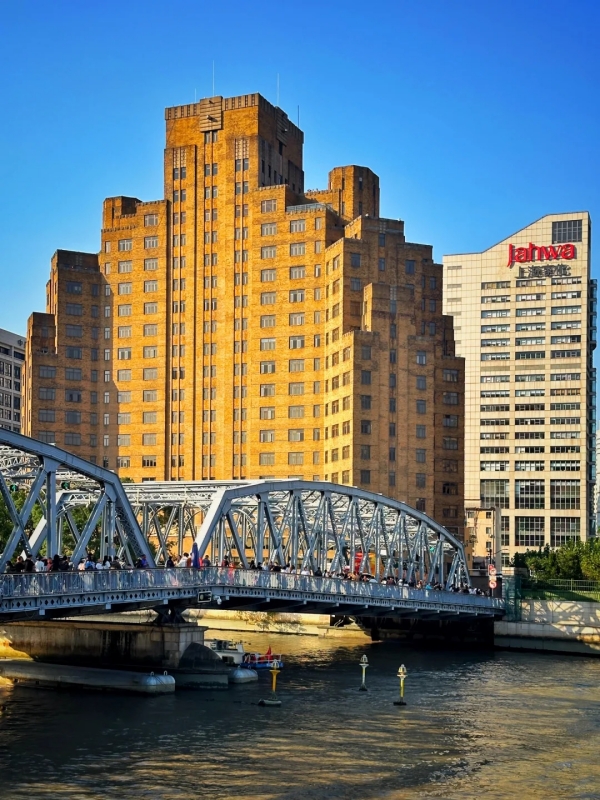
The Waibaidu Bridge And Old Building
Waibaidu Bridge crosses Suzhou Creek at the Bund's northern end. Also known as Garden Bridge, its steel trusses provide a recognizable outline beside the water. The present bridge belongs to the early twentieth century, with its history closely associated with 1907.
Here the view changes from a long architectural frontage to a framework of steel and water. Look along the creek as well as toward the Huangpu. From nearby positions, the bridge can become a foreground element for the much taller skyline beyond.
- On the bridge: Notice the repeated steel members and how they frame smaller portions of the surrounding city.
- Beside the creek: Look back at the bridge's overall shape instead of photographing only from within it.
- For orientation: Crossing this bridge takes you over Suzhou Creek, not across the Huangpu to Pudong.
Gutzlaff Signal Tower
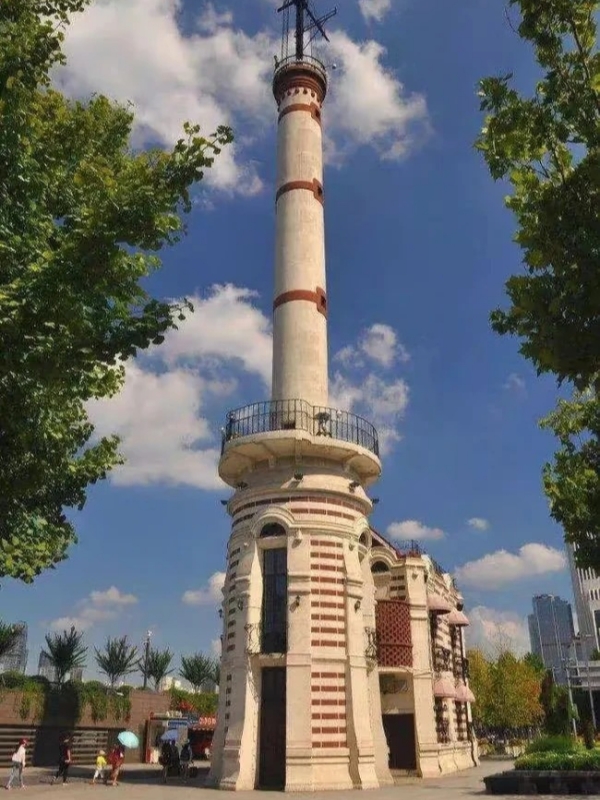
Gutzlaff Signal Tower Shanghai
Near the southern end, the Gutzlaff Signal Tower tells a more practical river story. The station began in 1884, and the concrete tower followed in 1907. Weather signals and a time ball helped ships receive information and set their navigation clocks.
Its striped tower and smaller scale distinguish it from the broad bank and hotel buildings. In 1993, the structure moved toward the river during road widening. That survival story is worth remembering when the taller buildings draw most of the attention.
Waitanyuan's Historic Side Streets
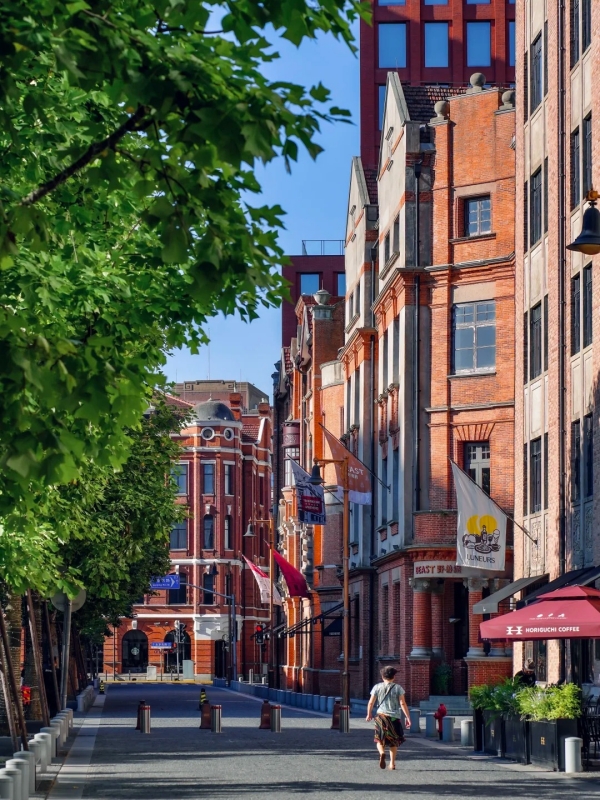
Waitanyuan Historic Street
For a short extension near the northern end, turn toward Waitanyuan and Yuanmingyuan Road. This historic area sits near the confluence, with streets and buildings that offer a closer view of the neighborhood behind the river frontage.
Choose it when you want to look at architecture at street scale after the open promenade. It is distinct from North Bund across the creek. Keep the extension separate in your plans rather than treating every nearby area with “Bund” in its name as one uninterrupted sightseeing strip.
The Skyline Across the Huangpu
Much of the famous view from The Bund in Shanghai is actually Lujiazui, across the river. Learning four silhouettes makes the panorama easier to understand without turning your visit into a tour of every tower.
Four Shapes to Recognize
These shapes are more useful from the riverbank than a list of floor counts. Find the spheres first, then the stepped crown, the opening, and the twist. Depending on your position and visibility, some buildings can overlap or become less distinct.
The forms also have different design purposes. Gensler describes Shanghai Tower's spiral as helping reduce wind loads, while Jinmao combines a pagoda-like profile with a modern high-rise structure. These are different responses to making a tall building recognizable within an increasingly dense skyline.
Two Sides of Shanghai
Pudong's modern development accelerated after the announcement of its development and opening-up in 1990. Across the Huangpu, the new towers offer a clear visual contrast with the older financial buildings of Puxi.
However, looking only across the water leaves half the visit unseen. After identifying the towers, turn back toward the historic frontage. Compare its rooflines and repeated windows with the much taller, more individual silhouettes opposite.
Daylight, Dusk, and Evening Visits
The Bund in Shanghai offers different things at different hours. Choose daylight for architecture, or allow time around dusk when you want to see the river scene change. Evening illumination adds another layer, but weather and actual lighting arrangements affect the result.
Daylight at The Bund in Shanghai
Daylight makes it easier to separate stone surfaces, windows, columns, and roof shapes. It is especially useful when your interest extends beyond the distant skyline to the buildings on the western side of the road.
Give yourself a small observation task: compare the HSBC dome and Customs House clock, then find the Peace Hotel's copper roof. This creates a manageable introduction to the architecture without reducing the walk to a hurried sequence of building numbers.
- Architecture first: Spend more of your attention on the historic frontage, returning to the river view between buildings.
- River first: Follow the promenade and use the main landmarks to keep track of your position.
- History first: Include the signal tower's maritime story and the northern memorial, rather than concentrating only on hotels and banks.
Dusk and the Night View
A visit spanning daylight and dusk lets you compare the same buildings under changing conditions. As the sky darkens, illuminated facades, tower outlines, and reflections can become more prominent than the small details you noticed earlier.
Plan around the day's sunset rather than assuming one arrival time works throughout the year. Likewise, an evening waterfront view is not a promise of a special light show. Allow some flexibility for weather, visibility, crowd conditions, and lighting changes.
A Simple First Visit
East Nanjing Road station, on Metro Lines 2 and 10, provides a straightforward approach. Walk east toward the Huangpu, then orient yourself using the waterfront buildings. The station and riverfront are separate places, so include the approach in your plans.
For The Bund in Shanghai, a suggested allowance of 90 minutes to two hours gives you room for exterior stops. This is a planning suggestion, not a measured walking requirement. Add more time for a booked interior visit, a cafe stop, or Waitanyuan.
- Short visit: Recognize the clock tower and green roof, then spend your remaining time with the river view.
- Longer walk: Use Waibaidu Bridge and the signal tower as the northern and southern bookends.
- Less walking: Choose one section and look carefully. You can understand the relationship between old frontage and new skyline without completing the whole length.
Frequently Asked Questions
Q: Is the Bund the same as Lujiazui?
No. The Bund in Shanghai is the historic waterfront on the west bank of the Huangpu River, while Lujiazui is the modern district opposite in Pudong. The towers in many famous Bund photographs stand across the water. Choose the Bund for views toward those towers and for the historic buildings behind the promenade.
Q: Is the Bund worth visiting during the day?
Yes, especially if you enjoy architecture. Daylight helps you examine the historic facades, compare domes and clock towers, and identify details that evening lighting treats differently. A daytime visit also explains the geography before darkness. You can return for the illuminated skyline, or stay through dusk when your schedule allows.
Q: How much time should I allow?
Allow around 90 minutes to two hours as a planning suggestion for The Bund in Shanghai, including pauses for buildings and river views. You can shorten the visit by choosing one section. Add time separately for indoor exhibitions, hotel visits, or nearby streets; these are not included in a simple exterior walk.
Q: Can I enter the historic buildings?
Access varies because the buildings serve different purposes, including banking, hospitality, and cultural activities. Seeing a decorated interior in a guide does not establish a right to enter it. Identify the specific building and visitor arrangement you want. An exterior walk remains worthwhile even when an indoor space is unavailable.
Q: Does Waibaidu Bridge lead to Pudong?
No. Waibaidu Bridge crosses Suzhou Creek near its meeting with the Huangpu River. Crossing it keeps you on the Puxi side, toward Hongkou, rather than taking you to Lujiazui. The distinction matters when planning onward travel: the creek bridge and a crossing of the much wider Huangpu are different journeys.
Q: Do I need a river cruise?
No. The promenade already gives you the main relationship between the historic waterfront and the Lujiazui skyline across the river. A cruise offers another perspective, but it is an optional, separate experience. For a first introduction, spend time recognizing the buildings and both riverbanks before deciding whether you want a boat trip.