Dental Implant Process China
The dental implant process China international patients can get a taste of is a different beast when compared to 2023. You can now receive premium Straumann or Osstem implants at top hospitals in Beijing for around $840 - $2,100 per tooth—some 60 - 70% cheaper than in the west. The dental implant process that China follows requires patients to make two separate trips spaced 3-6 months apart while the titanium implant fuses with your jawbone.
This guide will walk you through each tooth and implant in detail. I’ll tell you exactly what to expect at each stage of the process, how to verify the quality of your clinic, however much it will cost you depending on the city, and key travel logistics. By the end of this guide, you will know if the dental implant process China offers is right for you, and how to plan your trips.
China's Dental Implant Costs Beat Western Prices by 60-70%
John, 30, of London, needed three dental implants and was quoted £9,000 ($11,400) by his UK dentist. Research into the dental implant process hospitals in China offer saw him flying to Beijing for the procedure at a cost of £2,800 ($3,500) inclusive of the flights and the hotel. Same Straumann implants, 70% savings.
China's 2023 VBP (Volume-Based Procurement) policy slashed implant costs by 55% at public hospitals. The government negotiated bulk purchases covering 2.25 million implant sets annually, capping medical service fees at CNY 4,500 (~$630). Here's what you'll actually pay:
Single Implant Pricing: Single implants in Beijing and Shanghai cost between $1,000 and $1,800 per tooth at top public hospitals. Southern cities like Shenzhen and Guangzhou offer even lower rates, starting from just $840 for a complete procedure.
All-on-4 Full Arch Costs: A full-arch All-on-4 restoration ranges from $8,500 to $11,000 in major hubs like Beijing and Shanghai. Patients can save more in Shenzhen or Guangzhou, where full-arch costs drop to between $7,000 and $9,000.
Global Brand Material Costs: Premium Swiss Straumann implants cost $253, while high-quality Korean Osstem brands are available for only $105. Swedish Nobel Biocare materials are priced between $280 and $350, ensuring world-class quality at much lower prices.
Real-World Savings Example: Michael from Texas saved nearly 60% by flying to Shanghai for four implants and custom zirconia crowns. His total medical and travel expenses reached $11,300, saving him $16,700 compared to his local Dallas quote.
📊 Get the full price map: Don’t book your flight until you’ve seen the side-by-side data. Explore exactly how different regions stack up in our latest report: [Dental Implants in China Under $800 per Tooth: Cost & Hospital Price Comparison].
Pre-Trip Preparation: Step-by-Step Clinic Verification Process (3 Weeks)
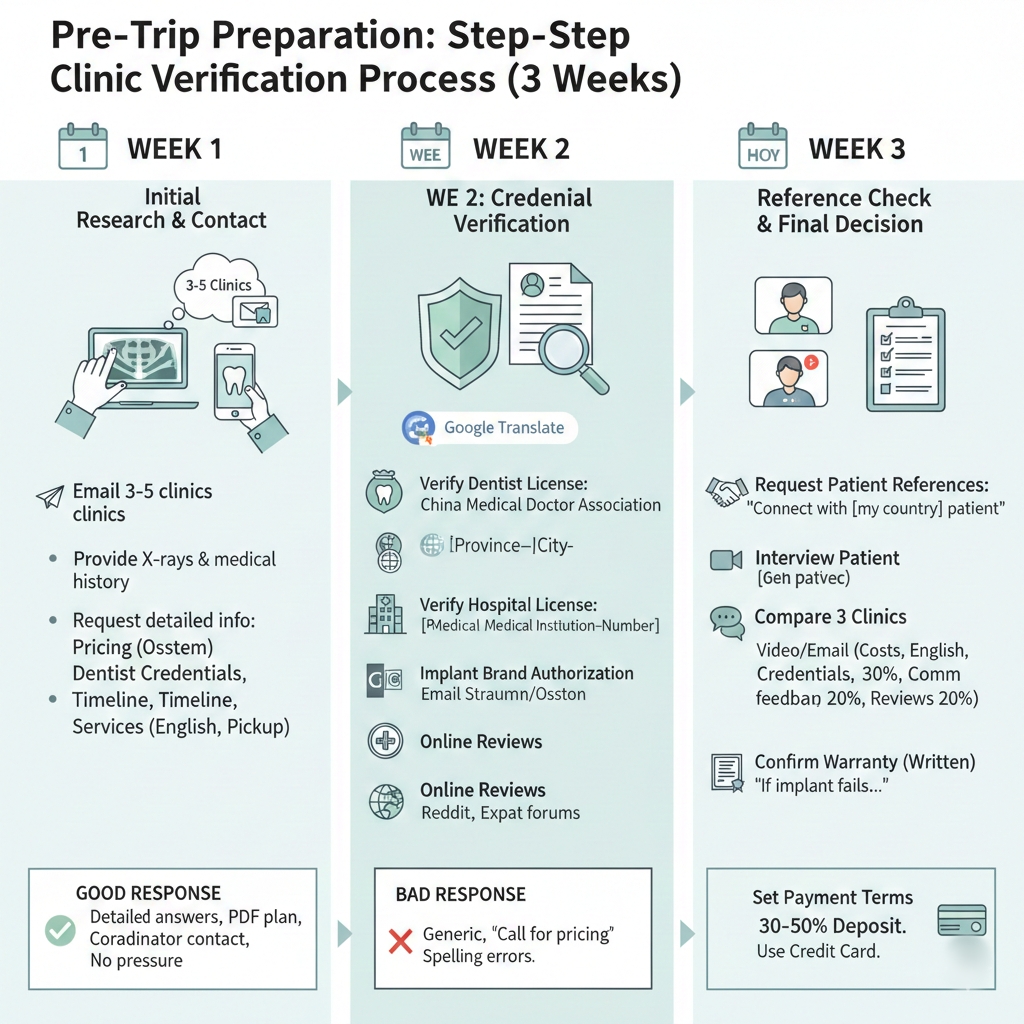
Step-by-Step Clinic Verification Process (3 Weeks)
Week 1: Initial Research and Contact
Email 3-5 clinics requesting a preliminary consultation. Include recent X-rays (get locally for $50-100 each or wait to do in China), photos of your teeth from multiple angles, and the answers to any medical history questionnaire relating to smoking, diabetes, osteoporosis, or medications you’re taking.
Ask for the following: Pricing for implants (Straumann vs Osstem vs Nobel?), additional procedure costs (bone graft, sinus lift, CT scan), materials and costs for the crowns, dentist credentials and years of experience using implants, estimated timeline for treatment (how many visits and how long for each), any services for international patients (support in English and picking us up/dropping us off in the airport, recommendations for hotels etc., translators if needed)
Good response arrives within 3 business days: Detailed answers addressing all questions, PDF treatment plan with 3D renderings, coordinator contact info for follow-up, no pressure to book immediately.
Bad response: Generic copy-paste message, "call us for pricing" without specifics, spelling errors and broken English suggesting lack of international patient experience.
Week 2: Credential Verification
Verify dentist license: Ask for license number. China Medical Doctor Association website allows public lookup (Chinese only, use Google Translate). Verify hospital license: Should be displayed in lobby (photos often on clinic website). Format is [Province]-[City]-Medical Institution-[Number].
Check implant brand authorization: Email Straumann, Nobel Biocare, or Osstem directly asking "Is [Clinic Name] an authorized dealer in China?" Manufacturers confirm legitimate sourcing versus gray market implants.
Research online reviews: Search clinic on Reddit r/DentalTourism, expat forums (ShanghaiExpat.com, Beijing subreddit), medical tourism platforms. Look for detailed patient stories not generic 5-star reviews posted same week.
Week 3: Reference Check and Final Decision
Ask for patient references: Ask the clinic “Are you able to put me in touch with one of your international patients from [my country]?” A legitimate clinic will have satisfied patients who are willing to share their experiences.
Arrange a phone or email interview with that patient: Were the costs exactly what was quoted with no surprise fees? Is the quality of their English good throughout the appointment and in emergencies? What do their implants feel like 6 months or 1 year later? Have there been any complications?
Compare 3 clinics using scoring system: Cost (30%), Medical credentials (30%), Communication quality (20%), Patient reviews (20%). Don't pick cheapest automatically—balance all factors.
Confirm warranty policy in writing: "What happens if implant fails in first year?" "Do you replace implant for free including labor? What about my travel costs to return?" Get written warranty terms before paying deposit.
Set payment terms: Safe structure is 30-50% deposit upfront, remainder on completion. Unsafe is 100% payment before treatment starts. Use credit card when possible for chargeback protection.
Trip 1 Overview: Implant Surgery and Recovery in China (Days 1-10)
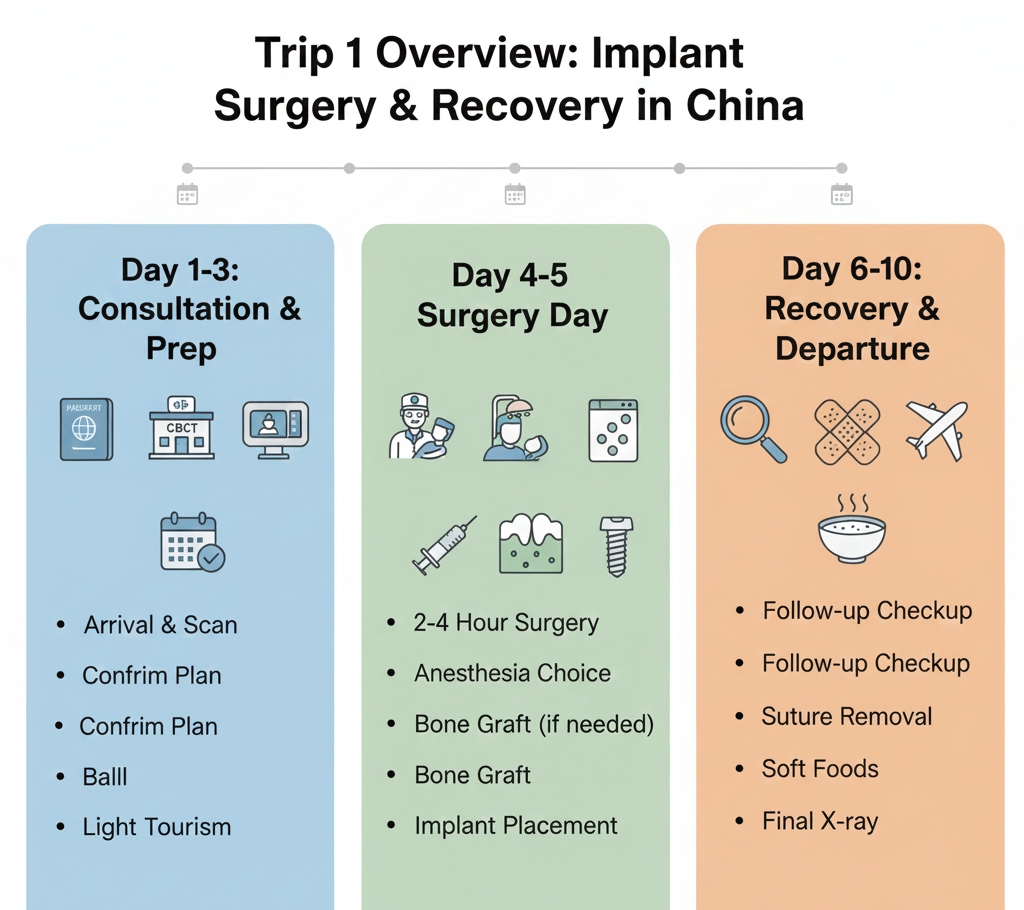
Implant Surgery and Recovery in China (Days 1-10)
Day 1: Arrival and consultation (2-3 hours). Get 3D CBCT scan ($80), confirm treatment plan with dentist, sign English consent forms, pay 50% deposit.
Day 4-5: Surgery day (2-4 hours depending on implant count). Choose local anesthesia or IV sedation ($200-300 extra). Bone graft added if needed ($500-1,000). Implant placed using surgical guide for 0.2mm accuracy. Healing cap attached, sutures close gum. Receive post-op kit with antibiotics, pain meds, mouthwash.
Day 6: Follow-up checkup (30 minutes). Dentist examines for infection signs and healing progress.
Day 7-10: Suture removal (5-minute process) plus final X-ray before flying home. Light sightseeing OK after Day 5—visit museums, parks, try soft foods at local restaurants (soup dumplings, congee).
Days 1-3 Detailed: Consultation, Prep, and Pre-Surgery Protocol
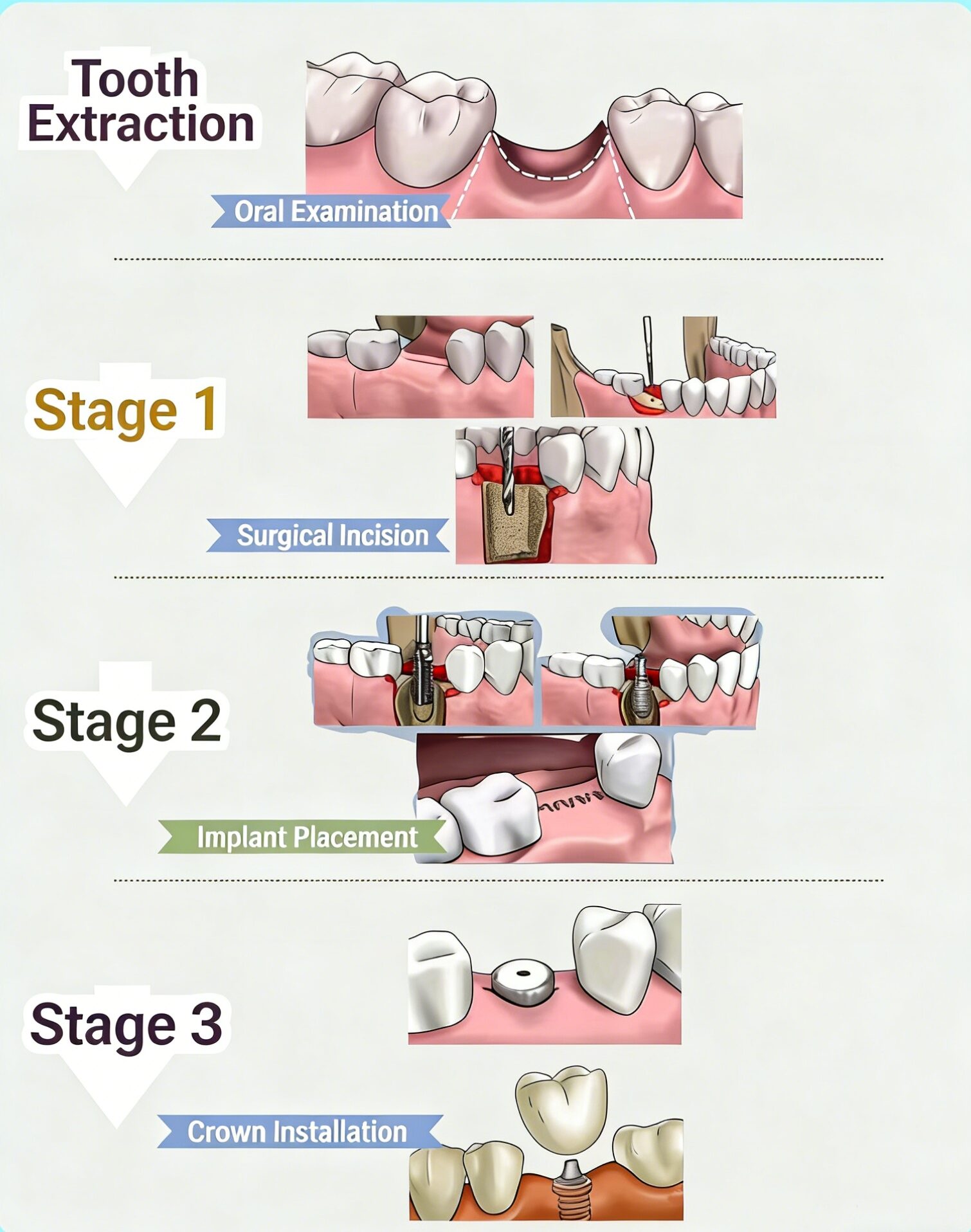
Arrive at the clinic with your passport, cash or credit card for the deposit, and the Google Translate app (with offline Chinese pack). The consultation included an intraoral examination as well as taking a 3D scan that only took 15 minutes and came with immediate results where the dentist explained using the 3D models.
Decide on the sedation option: local anaesthesia, or IV “twilight sleep.”
Day 4-5 is surgery day! Spend Days 2-3 doing light tourism (but no strenuous activity of any sort), perhaps picking up soft foods from the 7-Eleven or FamilyMart: silken tofu (¥8/$1.10), congee cups, yogurt drinks. Grab ice packs from the pharmacy (¥20/$3) and refrain from any alcohol 48 hours prior.
If using IV sedation, arrange post-surgery transport back to hotel. The clinic often provides car service included or for $20-30 extra.
Day 4-5 Detailed: The Implant Surgery Step-by-Step
8:30 AM: Arrive at clinic. No eating 2 hours prior if using IV sedation. Local anesthesia patients can have light breakfast.
9:00 AM: Anesthesia administered. Local uses Novocaine injections (10 minutes). IV sedation creates "twilight sleep"—you're conscious but won't remember the procedure.
9:15 AM: Bone graft if your jawbone lacks the required 3mm width or 2mm height (the 3/2 rule). Dentist adds Bio-Oss or synthetic bone material (20-40 minutes per site), covers with collagen membrane.
9:45 AM: Implant placement (20-30 minutes per implant). Surgical guide ensures accuracy within 0.2mm. Titanium post screwed into jawbone. Healing cap placed on top. Sutures close gum tissue.
11:00 AM: Return to hotel with written post-op instructions. Pain level most patients report: 3-4 out of 10, manageable with ibuprofen.
Days 6-10 Detailed: Post-Op Care and Comfortable Recovery Activities
Day 6 checkup (15-30 minutes): Dentist verifies no infection, checks swelling reduction (peak swelling Days 2-3, subsides by Day 5-6), confirms proper healing.
Sutures removed Day 7-10. Takes 5 minutes, painless. Some clinics use dissolvable sutures requiring no removal.
Recovery timeline: Days 1-2 moderate swelling (ice packs 20 minutes on/off). Days 3-4 swelling peaks then reduces (transition to warm soft foods). Days 5-7 comfortable for activities (light walking tours, museums, food experiences with soft options).
Tourism-friendly activities: Forbidden City walking tours, Bund riverside strolls, temple visits, soup dumpling tastings. Avoid: gym workouts, running, spicy foods, crunchy snacks.
Day 9-10 final checkup: X-ray confirms implant stability. Pay remaining 50% balance. Receive medical records in English on USB with implant serial numbers and certificates.
Healing Period at Home: Osseointegration and Remote Monitoring (Months 2-6)
The titanium implant fuses with your jawbone over 3-6 months. Upper jaw takes longer (4-6 months) than lower jaw (3-4 months). This process creates permanent stability for your crown.
Month 1: Slight tenderness, avoid chewing on that side. And Month 2-3: Feels like natural tooth root, no pain. Month 4+: Often forget the implant is there.
Contact your Chinese clinic via WeChat if you experience severe pain not relieved by over-the-counter meds, fever over 101°F (38.3°C), or implant feels loose. Most clinics respond within 24 hours via video call or messages.
Implant failure rate: 2-5% (rare). If it happens, clinics typically replace the implant for materials cost only. You pay travel costs to return. Plan Trip 2 by booking flights 4-5 weeks before scheduled return. Send X-ray photo via WeChat for healing assessment first.
Trip 2 Overview: Crown Placement and Final Restoration (Days 1-7)
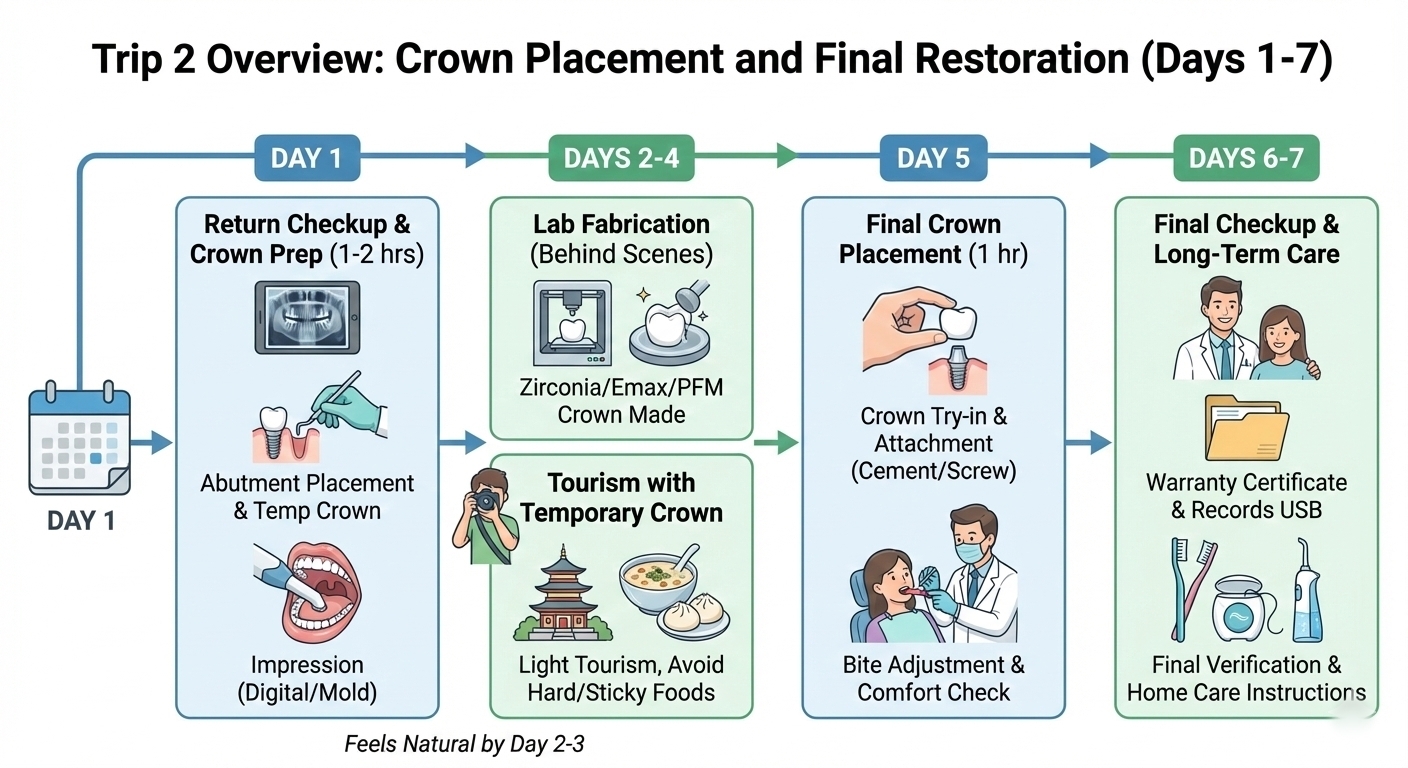
Crown Placement and Final Restoration (Days 1-7)
Day 1: Return checkup and crown preparation (1-2 hours). X-ray confirms bone integration. Remove healing cap, place abutment (connector piece). Take impression for crown using digital scanner or putty mold. Attach temporary acrylic crown.
Crown material options: Zirconia $300-450 (most popular, strong and aesthetic). Emax $350-500 (best aesthetics for front teeth). PFM (porcelain-fused-metal) $200-300 (budget option for back teeth).
Days 2-4: Crown fabricated at lab. You do tourism with temporary crown—avoid hard and sticky foods.
Day 5: Final crown cemented or screwed onto abutment. Bite adjustment using articulating paper ensures natural contact. First 24 hours avoid very hard foods while cement cures.
Day 6-7: Final checkup verifies bite comfort. Receive warranty certificate (1-3 years typical) and updated medical records.
Day 1 Detailed: Abutment Placement and Crown Impressions
X-ray confirms bone fusion to implant. Dentist performs stability test checking for any movement (there should be none). Remove healing cap to expose implant top.
Abutment: Titanium, custom-made ($150-$250) provides better aesthetics for your gums and is recommended for front teeth; stock titanium ($50-$80) is fine for back molars; or zirconia, custom-made ($200-$300), is nice to teeth for the best look on front teeth.
Crown - impression: Digital intraoral scanner - takes just 10 or 15 minutes - and is nicer than the putty. Putty mold takes 5 to 10 minutes, less desirable than the powder. Digital scanner is used to fabricate a 3D model that’s sent to the lab for your new crown.
Temporary crown attached same visit. Can eat soft foods normally. Protects abutment while permanent crown being made.
Days 2-4 Detailed: Crown Fabrication Timeline and Tourism Options
Lab process (you don't see this): Day 2 wax-up and design. Day 3 porcelain layering and firing in kiln. Day 4 polishing and quality inspection.
Your schedule: Light tourism with temporary crown. Visit local attractions—Shanghai's Yu Garden, Beijing's Summer Palace, Guangzhou's Canton Tower. Eat soft foods like noodle soups, steamed buns, congee. Avoid: hard bread crusts, nuts, ice, sticky candy.
Same-day crown option: Clinics with CEREC/CAD-CAM systems can mill zirconia crown in-house in 2-4 hours ($250-400). Good for patients wanting single-trip solution. Most choose lab-made crown for superior aesthetics and precision fit.
Some clinics offer "try-in" appointment Day 3. Check crown fit and color before final glazing. Minor adjustments possible at this stage.
Day 5 Detailed: Final Crown Placement and Bite Adjustment
Morning appointment (1 hour total). Crown try-in: Check fit against adjacent teeth, verify bite feels natural, confirm color matches your natural teeth. Dentist makes minor adjustments if needed—grinding contact points, polishing edges.
Permanent attachment method: Cemented crowns use dental cement, more aesthetic (no screw hole visible). Screw-retained crowns secured with tiny screw, easier to remove if future adjustment needed. Front teeth usually cemented, back teeth often screw-retained.
Bite adjustment: Dentist uses articulating paper—thin colored paper you bite on. Shows exactly where teeth contact. Adjusts until bite feels even and natural. You'll test by chewing, talking, smiling.
Feels slightly weird first 1-2 days (like when you get new filling). By Day 2-3, indistinguishable from natural tooth.
Days 6-7 Detailed: Final Checkup and Long-Term Care Instructions
Last clinic visit optional but recommended. Dentist verifies bite comfort after 24 hours wearing crown. Addresses any minor sensitivity or adjustment needs. Most patients report zero issues by this point.
Receive complete package: Updated medical records with all X-rays on USB drive. Crown warranty certificate (1-3 years typical, verify what's covered). Implant card with brand name, serial number, placement date—keep for life.
Long-term care same as natural teeth: Brush twice daily with soft toothbrush. Floss daily using unwaxed floss or water flosser around implant crown. Professional cleaning every 6 months at your home dentist. Annual X-ray monitoring to detect any bone loss early.
Show your home dentist all China records. Provide implant serial number. They can order replacement parts if needed years later. Avoid using implant tooth to open bottles, bite fingernails, chew ice, or crack nutshells.
Implant body warranty: Straumann and Nobel Biocare offer 10-year to lifetime warranties. Osstem offers 10-year warranty. If implant fails due to manufacturing defect, company replaces free. Crown warranty separate, typically 1-3 years from Chinese clinic covering fractures or detachment (not damage from trauma or poor hygiene).
Beijing, Shanghai, and Shenzhen: Choosing Your Dental Implant City
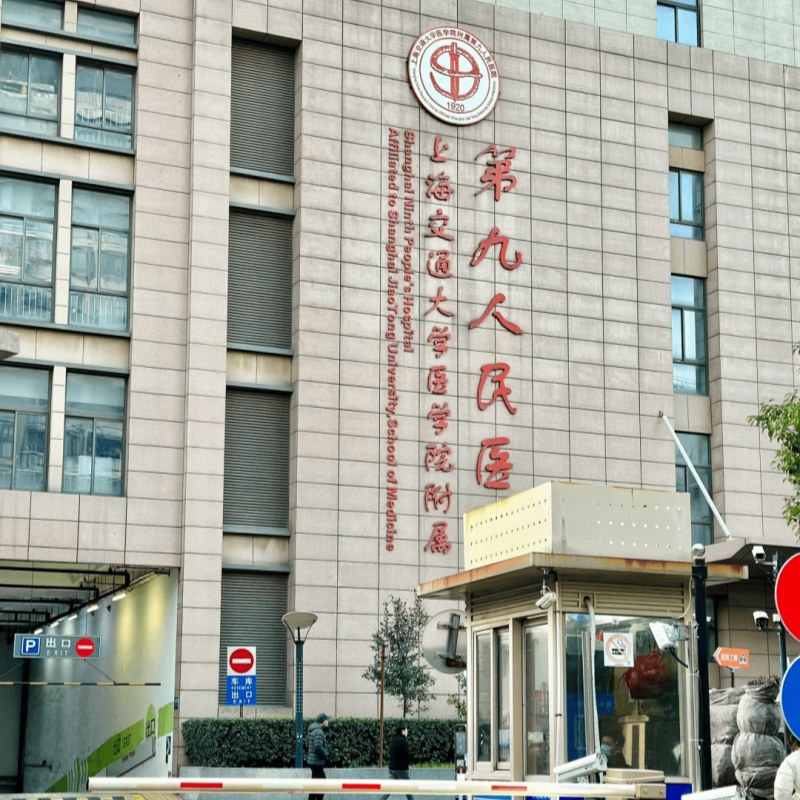
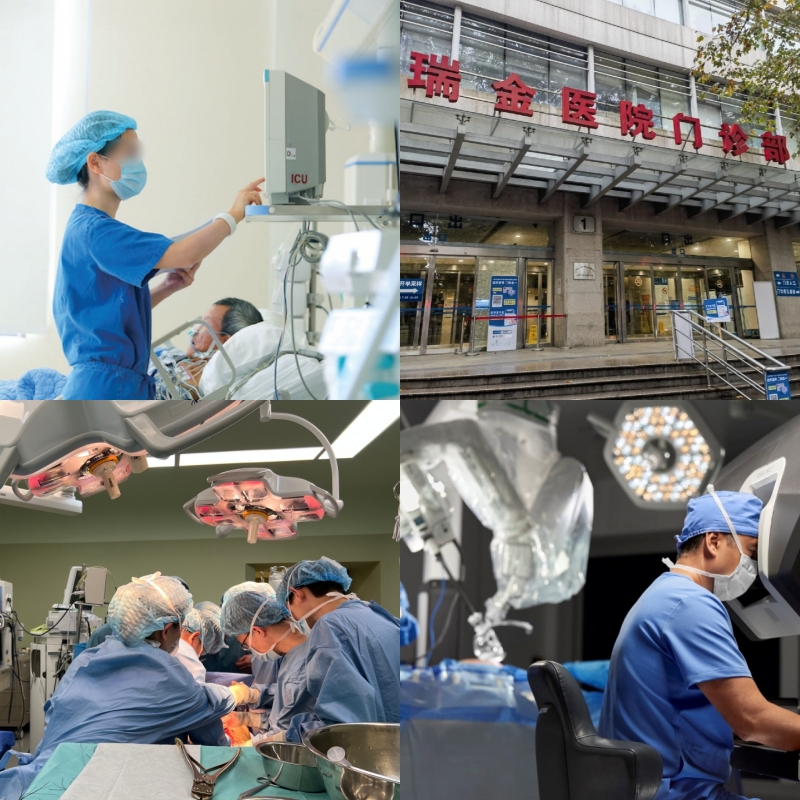
Shanghai Ninth Hospital
Your city choice impacts cost, English support, and tourism experience. Here's the direct comparison for the dental implant process China's major cities offer.
Beijing: Top Medical Institutions and Imperial Tourism
Peking University Hospital of Stomatology (13th) - Home to the largest implantology centre in Asia, placing more than 12,000 implants a year, a recent study revealed a five-year survival of 99.2% from those treated with an All-on-4 procedural approach. In 2024, the Hospital launched their International Clinical Division, providing English diagnostic and treatment services across a 6,000m² site with 65 dental treatment units.
Cost: $1,200-1,800 per implant. Beijing Stomatological Hospital (public) offers lower $900-1,200 but less English support.
Airport: Capital Airport (PEK), 40 minutes to hospital district. Hotels: $40-120 per night near Haidian university area—Home Inn near Peking University Hospital runs $45/night.
Tourism: Forbidden City (UNESCO World Heritage), Great Wall Mutianyu section (90 minutes away), Summer Palace, Temple of Heaven, Hutong walking tours. Recovery-friendly: tea ceremony experiences, 798 Art District galleries, National Museum (gentle pace).
Language: Good English at Peking University International Division. Moderate English in public areas. Translation app helpful at restaurants.
Shanghai: International Hub with Maximum Convenience
Shanghai 9th People's Hospital in China is the largest dental facility in Asia. The Shanghai 9th People's Hospital also has a National Clinical Research Centre for Dental and Jaw Disorders, and there are international divisions that have English-speaking staff and a translator. You can direct bill your charges to BUPA, ALLIANZ, and AIA insurance companies.
Cost: $1,000-1,500 per implant at 9th People's. Private clinics (PureSmile, DDS Dental) charge $1,300-2,000 with higher English proficiency and flexible scheduling.
Airport: Pudong Airport (PVG), excellent metro connection to city center (45 minutes, $4). Hotels: $50-150 per night in French Concession and Jing'an districts. Many have English-speaking staff.
Tourism: The Bund waterfront skyline, Yu Garden and Jade Buddha Temple, Tianzifang art district, Zhujiajiao water town (1-hour day trip). Recovery-friendly: Huangpu River cruise, Xintiandi pedestrian shopping, Museum of Contemporary Art, soup dumpling food tours.
Language: Highest English proficiency in China. Restaurant menus often bilingual. Didi taxi app has English interface.
Shenzhen/Guangzhou: Best Value with Hong Kong Safety Net
Guangdong Provincial Stomatological Hospital offers high quality at lowest China costs. Shenzhen private clinics benefit from newer city infrastructure and growing expat population.
Cost: $840-1,200 per implant (lowest in China). U-Family Dental in Shenzhen provides services in seven languages including English.
Airport: Guangzhou Baiyun (CAN) or Shenzhen Bao'an (SZX). Hotels: $30-100 per night. Shenzhen-Hong Kong border crossing just 30 minutes by metro—allows easy escape if overwhelmed by mainland China.
Tourism: Canton Tower and Pearl River in Guangzhou, Shamian Island colonial architecture, easy high-speed train to Hong Kong (1 hour). Chimelong Safari Park for families.
Language: Moderate-high barrier. Less English than Shanghai. Younger generation in Shenzhen speaks decent English. Cantonese spoken (different from Mandarin).
City Quick Comparison:
- Beijing: Best medical credentials + historic tourism. Choose if you want China's top dental institution and Great Wall visit.
- Shanghai: Best convenience + modern city. Choose if first-time China visitor or prioritize easy navigation.
- Shenzhen: Best budget + Hong Kong access. Choose if cost is priority and you've traveled Asia before.
All three cities use same implant brands. Quality difference is minimal—decision is about convenience, English support, and tourism preference.
China vs Thailand, Turkey, Mexico: The Honest Dental Implant Comparison
The dental implant process China offers competes with three other major medical tourism destinations. Here's the data-driven comparison.
Cost Comparison (Single Implant Complete):
- China: $840-2,100
- Thailand: $1,500-3,000
- Turkey: $530-1,000
- Mexico: $1,200-1,800
Cost Comparison (All-on-4 Full Arch):
- China: $7,000-11,000
- Thailand: $7,600-10,000
- Turkey: $4,000-9,000
- Mexico: $6,998-11,000
Flight Times:
| Destination | From USA | From UK | From Australia |
|---|---|---|---|
| China | 12-14 hrs | 10-11 hrs | 10-12 hrs |
| Thailand | 18-20 hrs | 11-12 hrs | 9 hrs |
| Turkey | 10-12 hrs | 3-4 hrs | 18-20 hrs |
| Mexico | 3-5 hrs | 10-12 hrs | 20+ hrs |
Real Total Cost Examples (4 Implants Including Travel):
US Patient:
- Mexico: $6,350 (driveable from California/Texas, no flight needed)
- China: $11,300 (implants $7,920 + flights $2,200 + hotels $750 + food $430)
- Thailand: $13,500 (implants $9,600 + flights $2,400 + hotels $950 + food $550)
UK Patient:
- Turkey: $8,250 (short 3-hour flight + all-inclusive packages)
- China: $11,750 (implants $7,920 + flights $800 + hotels $750 + food $2,280)
- Thailand: $13,100
Australian Patient:
- China: $11,050 (shorter flight than Thailand, better value)
- Thailand: $12,700
When China Is the Clear Winner:
You require complex procedures (All-on-4, extensive bone grafts). The infrastructure and technology at Chinese hospitals rival or exceed those of the West—3D printing, CBCT imaging, CAD/CAM systems, navigation-guided placement. China is a leader in the world regarding the implantation of digital dentistry. Peking University Hospital is now employing state-of-the-art dynamic navigation systems and even immediate loading protocols.
You are combining extensive tourism with treatment. The hospitals are located in cities full of attractions—the Forbidden City and Great Wall in Beijing, Taipei Medical University Hospital in Taiwan or the modern city experience of Shanghai with easy access to tourism. The recovery periods do not demand you be bored in a hotel room like with other quick in and out trips, but allow for meaningful exploration.
And you are from Australia. Visa free entry through December of 2026 and the 10-12 hour flight flight time makes China the most convenient and accessible option. Thailand is good for a 9 hour flight but it does not offer the complex procedures you need to justify a trip.
When to Choose Alternatives:
Thailand: You prioritize absolute comfort and hand-holding. English proficiency highest among all Asian destinations. Medical tourism infrastructure most developed—all-inclusive packages, luxury recovery hotels, tourism integration.
Turkey: You're from Europe wanting short 3-hour flight. Lowest implant prices globally ($530-1,000). Comprehensive packages including transfers, hotels, translation. Quality varies more—requires careful clinic vetting.
Mexico: You're US-based near border (California, Texas, Arizona). Driveable from San Diego to Tijuana (40 minutes). No visa requirements. Same time zone. But border clinic quality varies dramatically—avoid "implant mills."
Bottom Line: China offers best value-to-quality ratio globally for complex implant procedures, but requires comfort with adventure and language barriers. Thailand beats China for comfort. Turkey beats China for Europeans prioritizing cost. Mexico beats China for Americans near the border.
Clinic Vetting: Red Flags vs Green Flags Checklist
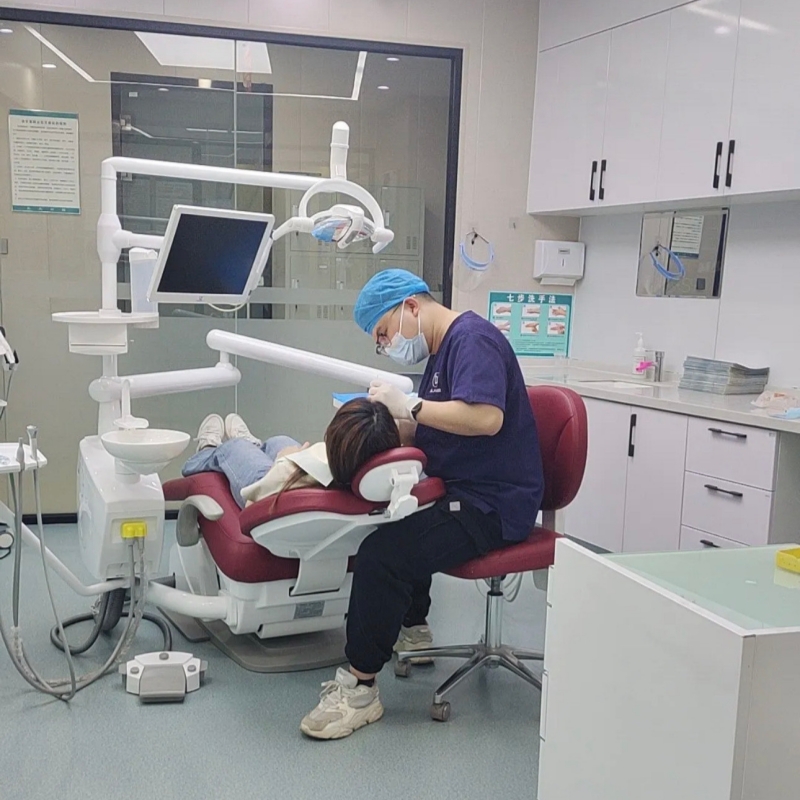
Private International Clinics
The dental implant process China hospitals offer varies dramatically in quality. You can't rely on Google reviews alone (many are fake). Use this systematic verification.
Immediate Red Flags That Signal Untrustworthy Clinics
🚩 Unrealistic pricing below $800 per implant. Safe range is $840-2,100 depending on city and brand. Prices at $400-500 indicate non-certified Chinese domestic brands, corner-cutting on sterilization, or bait-and-switch tactics where quoted price doesn't include essential components.
🚩 No physical address or hospital license. Legitimate clinics display medical institution license number and business registration. Search clinic name plus address on Google Maps—should show as "Medical Clinic" or "Hospital" not generic office building.
🚩 Pressure to book immediately. "Special discount if you book today!" or "Only 2 slots left this month!" are red flags. Legitimate clinics maintain professional approach, no pressure tactics, happy answering questions over weeks.
🚩 No English medical records after procedure. You should receive treatment summary in English, X-rays on USB drive, implant serial numbers and authenticity certificates. If clinic refuses or says "Chinese only," major warning sign.
🚩 Payment only via cash or wire transfer. Legitimate clinics accept credit cards (even with 2-3% processing fee), WeChat Pay, Alipay, and hospital payment kiosks. Cash-only demand to "save you fees" indicates sketchy operation.
Green Flags That Indicate Quality and Safety
✅ ISO 9001 certification. Quality management certification verifying standardized procedures. Ask for certificate number and verify online. Note: Top public hospitals like Peking University and Shanghai 9th People's lack JCI accreditation (97.8% of JCI facilities in China are private), but maintain high standards through alternative credentials.
✅ Named dentists with verifiable credentials. Dr. [Full Name], DDS degree, education listed ("Beijing Medical University 2005"), implant training certificates ("Straumann Certified 2010" or "ITI Member"). Google the dentist's name—should find professional profiles, research papers if at teaching hospital, conference presentations.
✅ Detailed treatment planning before booking. Clinic provides 3D CBCT analysis, implant brand options explaining pros/cons of each, itemized cost breakdown separating implant/abutment/crown/procedures, realistic timeline with visit schedule. Not generic—personalized to your specific case.
✅ International patient coordinator speaking fluent English. Dedicated contact responding within 24 hours. Helps with hotel booking, airport pickup arrangement, translation during appointments, insurance billing if applicable. Test by email—if responses are broken English or take 3+ days, reconsider.
✅ Implant authenticity proof before surgery. Clinic willing to show unopened Straumann/Osstem/Nobel packages with serial numbers, manufacturer authenticity certificates, and FDA/CE markings. Ask: "Can I see the Straumann certificate before my procedure?"—if they hesitate, red flag.
Practical Tips for Your China Dental Implant Trip
Money & Payments
Bring $500-1,000 USD or EUR cash. Easier to exchange at airport than finding ATM accepting foreign cards. Notify your bank about China transactions before departure—prevents card being frozen for "suspicious activity."
WeChat Pay setup gives 3-5% discount at some clinics versus credit card. Requires Chinese bank account or workaround through Alipay Tour Pass. Daily budget beyond medical costs: Food $15-30 (street food to sit-down restaurants), transportation $5-10 (metro very cheap at $0.50-1.50 per ride), SIM card $15 for 2-week tourist plan at China Mobile airport booth.
Many clinics accept international credit cards (Visa, Mastercard) with 2-3% processing fee. Confirm before trip. Public hospitals often require cash or Chinese payment apps for non-medical expenses like hospital cafeteria.
Essential Apps (Download Before Arrival)
Google Translate with offline Chinese pack. Maps.me for offline navigation. WeChat (clinic contacts you here, essential for communication). Didi for taxis (English interface, safer than street taxis). VPN if you need Google, WhatsApp, Facebook ($10-15/month—ExpressVPN or NordVPN work best).
Pleco Chinese dictionary app helpful for reading signs and menus. Alipay Tour Pass for foreigners wanting mobile payments without Chinese bank account. TripAdvisor for restaurant and attraction research.
Soft Food Spots Post-Surgery
Congee restaurants (粥店, zhou dian): Rice porridge with toppings available everywhere. Nutritious and gentle on surgical sites. Order: 皮蛋瘦肉粥 (preserved egg and pork congee) or 海鲜粥 (seafood congee).
Hot pot (火锅, huo guo): Order tofu, soft vegetables, thinly sliced meats you can cook until very tender. Avoid spicy broths first week—request 清汤 (qing tang, clear broth).
7-Eleven and FamilyMart: Silken tofu bowls, soft bread (面包), yogurt drinks, instant congee cups (just add hot water). Open 24 hours, accept cash and mobile payments.
Soup dumpling shops (小笼包, xiao long bao): Soft filling, just let dumplings cool before eating. Bite carefully to avoid burning mouth with hot soup inside.
Avoid very hot drinks first 48 hours. Request 温的 (wen de, "warm not hot") at tea shops and coffee chains.
Packing Essentials
Medical items: Passport (required at every appointment). Travel insurance documents. Copies of X-rays and dental records. Current medication list. Ibuprofen or Tylenol backup (clinic provides but good to have extras).
Comfort items: Neck pillow for flights and recovery rest. Reusable ice pack or buy gel pack in China (pharmacies stock them). Soft toothbrush and gentle toothpaste. Lip balm (mouth stays open during surgery causing dryness).
Tech items: Adapter plug (China uses Type A, C, and I plugs at 220V—North American devices need converter for voltage). Portable charger for phone. Headphones for procedure if you want music distraction.
Best Travel Seasons
Spring (April-May): Mild weather 15-25°C (59-77°F), cherry blossoms in Beijing parks, less crowded than fall. Hotels moderately priced.
Fall (September-October): Comfortable temperatures 18-26°C (64-79°F), golden ginkgo trees, peak tourism season. Book hotels advance. October 1-7 is Golden Week—avoid if possible, domestic tourism crush.
Avoid Chinese New Year (late January/early February): Everything closes for 1-2 weeks, flights expensive, hospitals operate minimal staff, impossible to schedule procedures.
Avoid August: Extremely hot and humid in Shanghai (35°C/95°F+) and Beijing. Uncomfortable for post-surgery recovery when you need rest.
Emergency Contacts
Save clinic's 24/7 emergency line before surgery. Test it by calling once to verify it works. International SOS medical emergency helpline (English-speaking): Beijing +86 10 6462 9100, Shanghai +86 21 5298 9538. Your country's embassy emergency line (can help communicate with hospitals if crisis): US Embassy Beijing +86 10 8531 4000, UK Embassy Beijing +86 10 5192 4000, Australian Embassy Beijing +86 10 5140 4111.
Cultural Tips
Arrive 15 minutes early to appointments. Punctuality matters in medical settings. Bring passport to every clinic visit—required for registration and records. Tipping not customary—don't tip dentists or nurses (can be awkward or insulting). Patient coordinators appreciate ¥200-500 ($30-70) tip at end if they provided exceptional service, but not expected.
Public hospitals expect crowds and longer waits despite appointments. Private clinics offer quieter, more personalized experience but cost 20-30% more. Both provide same quality implants and procedures.
FAQs: Common Questions About Dental Implant Process in China
Q: How much does the dental implant process China hospitals use actually cost?
Complete single implant costs $840-2,100 including consultation, surgery, abutment, and crown. Beijing's Peking University Hospital charges $1,200-1,800. Shanghai 9th People's Hospital charges $1,000-1,500. Shenzhen and Guangzhou charge $840-1,200. Additional costs: bone graft $500-1,000, 3D CT scan $50-100, IV sedation $200-300. All-on-4 full arch costs $7,000-11,000. Compare to USA $3,500-5,000 per implant, UK £2,800-4,000, Australia AU$5,000-6,500.
Q: Is the dental implant process China provides safe for international patients?
Yes, when choosing accredited hospitals like Peking University (ranked 13th globally) or Shanghai 9th People's Hospital. These institutions use identical brands—Straumann, Nobel Biocare, Osstem—all FDA-approved and CE-marked. Success rates match international standards at 96-99%. Verify clinic ISO 9001 certification, dentist credentials, and implant authenticity. Avoid clinics quoting under $800 per implant. Peking University reports 99.2% five-year survival for All-on-4 procedures.
Q: What is the 3/2 rule in the dental implant process China follows?
The 3/2 rule requires 3mm bone width around the implant and 2mm bone height above it. If your jawbone doesn't meet these minimums, you need bone grafting verified by 3D CBCT scans. Materials used are same as Western countries: Bio-Oss, BioGide, or synthetic options costing $500-1,000. Graft can happen with implant placement (4-6 months healing) or staged separately (graft heals 3-4 months, then implant placed).
Q: How long does the complete dental implant process China requires take?
Two separate trips required. **Trip 1** (7-10 days): Day 1 consultation, Day 4-5 surgery, Days 6-10 recovery and checkups. **Healing period** (3-6 months at home): Implant fuses with bone, remote monitoring via WeChat. **Trip 2** (5-7 days): Day 1 abutment and impressions, Days 2-4 crown fabrication, Day 5 crown placement. Total in China: 12-17 days. Some clinics offer immediate loading—one trip, 10-14 days total.
Q: Do I need a visa for the dental implant process China offers?
Requirements depend on nationality. Australian citizens: 30-day visa-free entry through December 2026. US and UK citizens: Hainan Province 30-day medical visa, 240-hour transit visa, or standard L-visa through embassy. German, French, Italian citizens: 15-day visa-free transit. No COVID-19 testing, vaccination, or quarantine required. Standard timeline (7-10 days first trip, 5-7 days second trip) fits most visa allowances.
Q: What happens if problems occur after I finish the dental implant process China provided?
Contact clinic via WeChat for issues. Minor (bite discomfort): Home dentist adjusts for $50-150. Moderate (loose crown): Return to China for repair ($200-400 materials) or local replacement ($1,200-1,800). Serious (implant failure, 2-5% rate): Straumann, Nobel, Osstem provide 10-year to lifetime warranties. Clinic replaces free within 1-3 year warranty. Keep medical records, X-rays, implant serial numbers. Get annual X-ray monitoring.
Q: Does the dental implant process China uses include English-speaking staff?
English support varies by city. Beijing Peking University International Division: Full English services. Shanghai 9th People's Hospital: English-speaking doctors and translators. Shanghai private clinics: 80% conversational English. Shenzhen/Guangzhou: 50% private clinics, 20-30% public hospitals. Request international patient coordinator for translation during appointments and 24/7 WeChat support. Test clinic English by email before booking.
Q: Is the dental implant process China offers cheaper than Thailand?
Yes, 20-40% cheaper. Single implant: China $840-2,100, Thailand $1,500-3,000. All-on-4: China $7,000-11,000, Thailand $7,600-10,000. China's VBP policy reduced costs while Thailand maintains premium pricing. Thailand advantages: highest English proficiency, all-inclusive packages, beach tourism. Choose China for budget priority and complex procedures. Choose Thailand for comfort over savings.
Q: How do I choose between Beijing, Shanghai, and Shenzhen for the dental implant process China offers?
Beijing: Top institution (Peking University ranked 13th globally), cultural tourism, $1,200-1,800 per implant. Shanghai: Highest English proficiency, modern convenience, best for first-timers, $1,000-1,500 per implant. Shenzhen: Lowest costs $840-1,200, Hong Kong border access, best for budget-conscious travelers. All cities use same Straumann, Osstem, Nobel brands with equivalent quality.
Q: What dental implant brands does the dental implant process China use?
Leading hospitals use premium international brands. Straumann (Switzerland): $253 per implant, used at Peking University, 98%+ survival rates, lifetime warranty. Osstem (South Korea): $105 per implant, widely available, proven 15-year success. Nobel Biocare (Sweden): $280-350, TiUnite technology. Chinese domestic: $280-500, growing quality. Over 90% of implants remain foreign-manufactured—identical products to Western clinics.