Cost of Laser Eye Surgery in China
A glance at the price of laser eye surgery in China explains why thousands of overseas patients fly here each year. SMILE - the most advanced surgery currently available - costs around $2,150-$3,000 here, versus $5,000-$8,000 in the West. Standard LASIK - $1,100-$1,400 versus $4,000-$6,000 in the US. These are not budget clinic prices. Leading Chinese hospitals like Shanghai Fudan Eye Hospital and the Aier Eye Hospital Group offer high-quality care, the surgeons perform 5,000+ procedures annually, and the same Carl Zeiss and Alcon equipment that you will find in Western clinics is in use.
This comprehensive guide breaks down every expense you'll encounter. Beyond procedure costs, we cover flights, accommodation, payment methods, and hidden fees most guides overlook. You'll discover which hospitals offer the best value, how to navigate visa requirements at no cost, and whether your total trip expenses—including surgery—remain lower than the procedure alone back home. We address language barriers, follow-up care options, and practical strategies to maximize your savings while ensuring world-class outcomes.
Core 3 advantages make laser eye surgery in China compelling
VisuMax 800
Foreign patients choose laser eye surgery in China for three decisive reasons. Understanding these advantages helps you evaluate whether China fits your needs.
Massive procedure volumes create unmatched surgical expertise
China’s surgeons perform the most laser eye procedures of any nation on the planet. Prof. Wang, of the Aier Eye Hospital, performed the first LASIK in China in 1993. He has personally performed more than 100,000 refractive surgeries. Another leading Chinese refractive surgeon, Prof. Zhou Xingtao, undertook the first SMILE surgery in China in 2010. Since then Prof. Zhou’s team has performed 55,000 SMILE, 20,000 LASEK and 20,000 LASIK procedures.
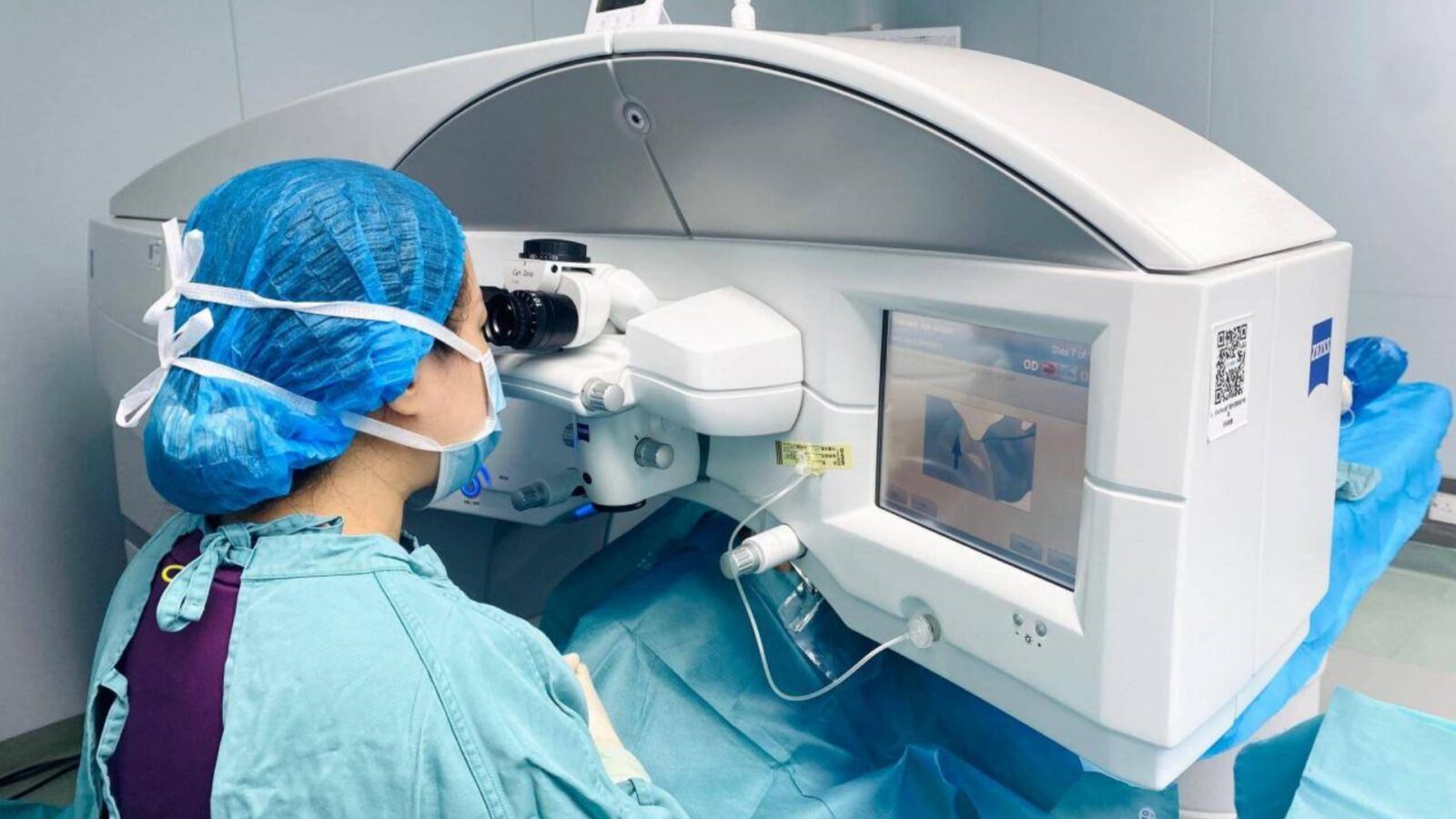
Aier Eye Hospital Group treats more than 800,000 patients a year across a network of 350 refractive surgery centers. This volume of work builds a pattern recognition that lower volume surgeons cannot expect to match. 9,500 ophthalmologists are employed and there are continual education programs. Every main centre has Carl Zeiss VisuMax 800 systems.
High volumes drive better outcomes and faster complication management. Surgeons encounter rare edge cases regularly rather than once per career. The Shanghai Fudan Eye Hospital serves as the Asia-Pacific SMILE training center. Surgeons from 100+ hospitals have trained there under Prof. Zhou's supervision.
Advanced technology arrives in China before Western markets
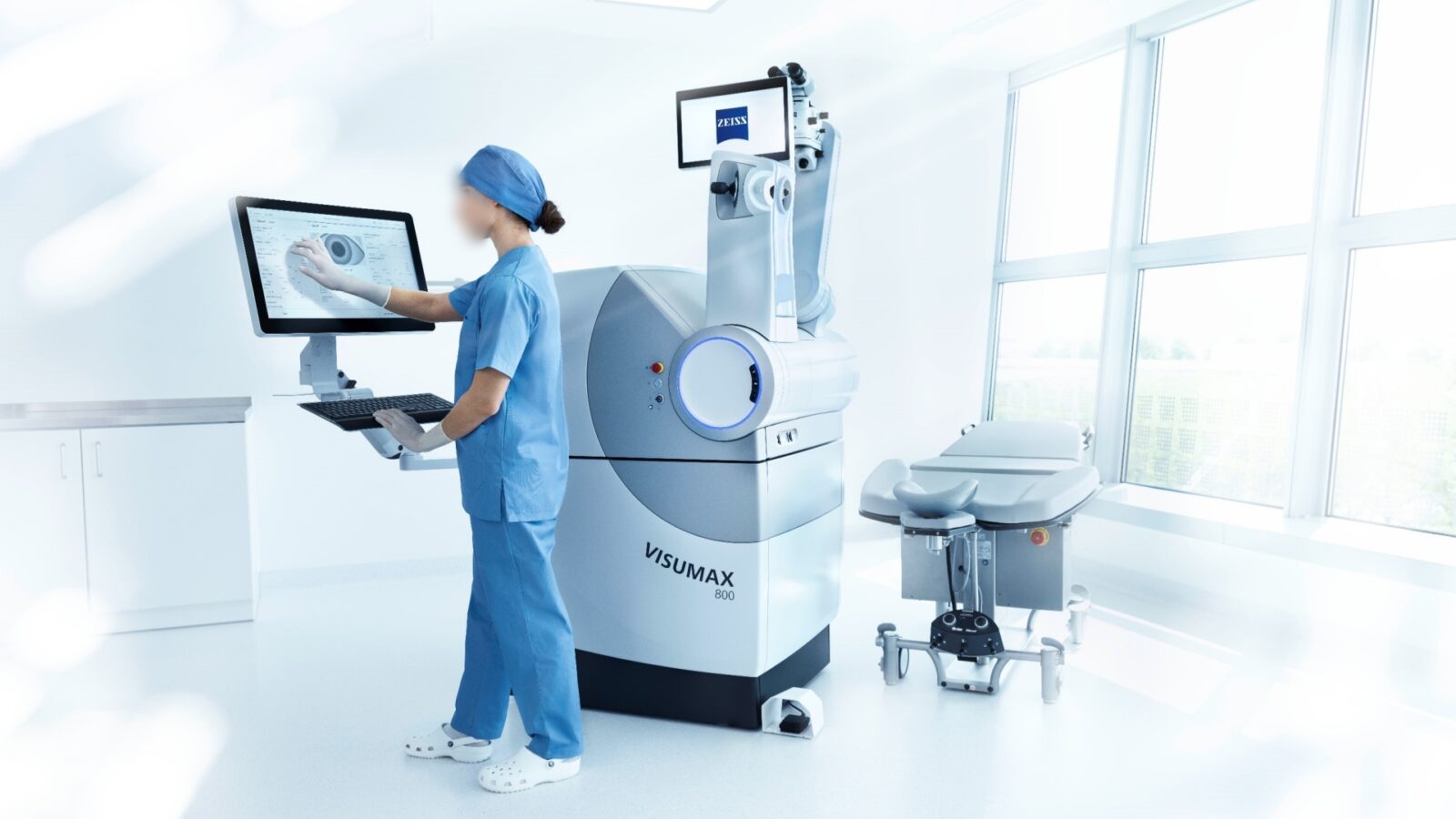
China begins receiving advanced ophthalmic technology ahead of the US. The Alcon WaveLight Plus launched in China before any other Western nation. Zeiss brought its VisuMax 800 for SMILE Pro procedures first to Shanghai.
It was in May of 2025 that Prof. Zhou and his team in Shanghai performed the very first in China a SMILE Pro procedure lasting only 10 seconds with this technology. VisuMax 800 enables completion of procedures in 8-10 seconds versus the previous 25-30 second timeframe. CentraLign tracking, with the OcuLign cyclotorsion control module, improves reliability. Patients achieved 1.0 vision or better within 24 hours.
Chinese hospitals have completed over 8,000 WaveLight Plus procedures already. This platform creates 'digital eye twins' using 100,000+ data points per eye. Ray tracing technology enables fully personalized ablation patterns. Clinical data shows 100% achieved 20/20 vision at 3 months.
Pricing delivers genuine savings without quality compromise
The cost of laser eye surgery in China represents a fraction of Western prices. The savings come from lower operating costs, not inferior care or equipment.
| Procedure | China Price (USD) | United States Price (USD) | Savings |
| Standard LASIK | $1,100-1,400 | $4,000-6,000 | 65-75% |
| Femto LASIK | $2,000-3,200 | $5,000-7,000 | 55-60% |
| SMILE | $2,150-3,000 | $5,000-8,000 | 55-65% |
| ICL (per eye) | $1,920-3,500 | $6,000-8,000 | 50-60% |
Shanghai's Fudan Eye Hospital offers SMILE at just $2,150 (¥15,500) for both eyes. This represents China's lowest SMILE price at a world-class research institution. EuroEyes charges premium rates of $3,200 for SMILE with German standards. Budget clinics in Hainan start LASIK at $1,100 with qualified surgeons.
💡 PRACTICAL TIP #1: Timing Your Trip
Schedule your laser eye surgery in China during spring (April-May) or autumn (September-November). Avoid Chinese New Year (late January-February) and National Day week (October 1-7). Summer months offer lower hospital volumes but higher humidity during recovery.
Vital 4 mainstream surgery types and how to choose between them
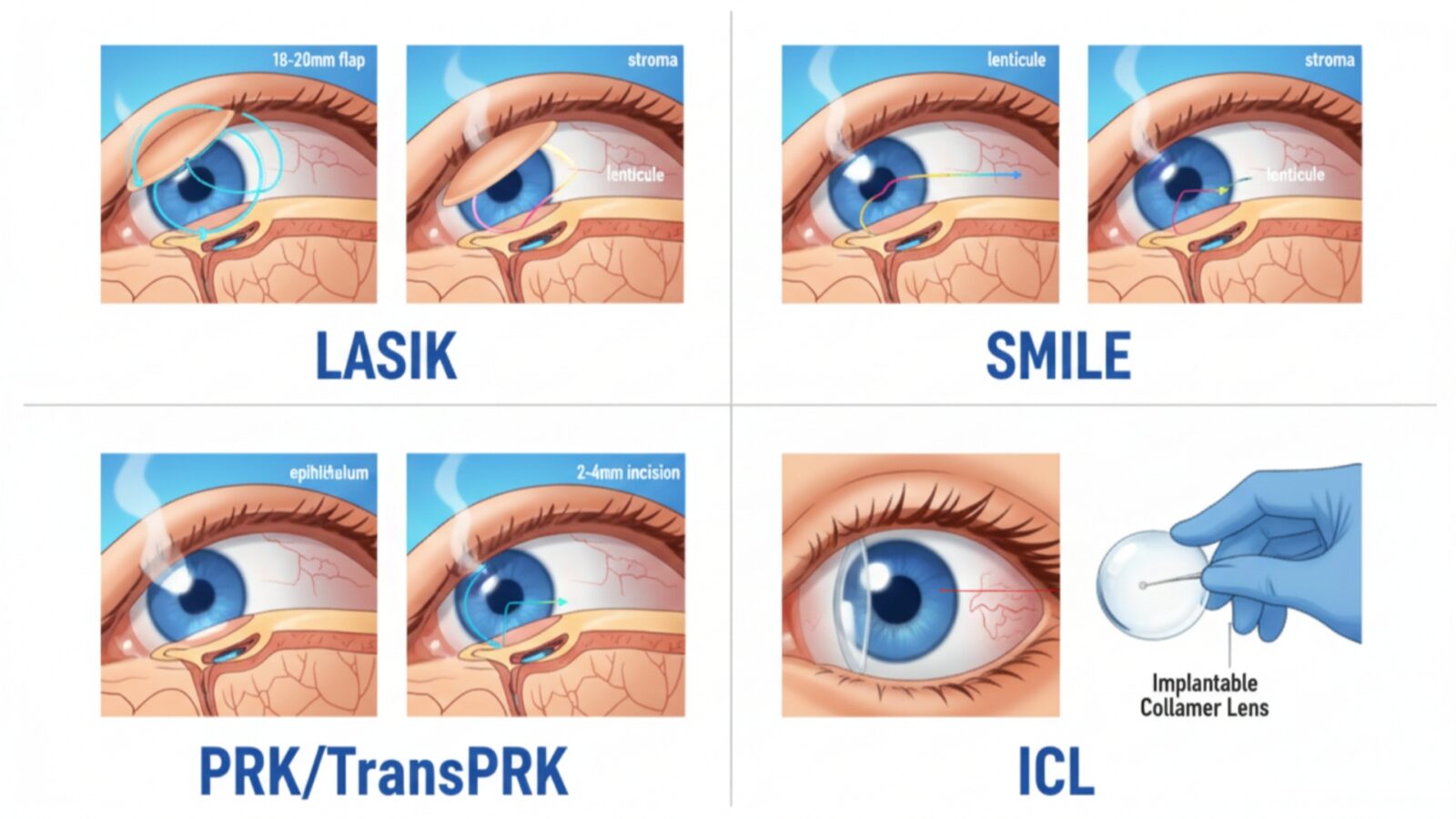
4 Mainstream Surgery Types
Selecting the right procedure for your laser eye surgery in China depends on multiple factors. Each technique suits different vision profiles and lifestyle needs. Understanding the cost of laser eye surgery in China for each procedure type helps you make informed decisions.
Understanding each procedure's mechanics and ideal candidates
LASIK (Laser-Assisted In Situ Keratomileusis) remains the most established procedure. Surgeons create an 18-20mm corneal flap using a femtosecond laser. The excimer laser then reshapes the underlying stroma. Recovery takes just 24-48 hours for functional vision.
Laser Eye Surgeon in Dubai LASIK is designed for myopia (nearsightedness) from -1.00 to -12.00 diopters and astigmatism up to 6.00 diopters. Your cornea must be at least 500-510 microns thick. Expect to spend a total of 15-30 minutes for the entire procedure including preparation, and over 99% of you will achieve 20/40 vision or better.
SMILE (Small Incision Lenticule Extraction) uses a flapless approach for enhanced safety. The femtosecond laser creates a lens-shaped disc within your cornea. Surgeons extract this lenticule through a 2-4mm incision. No flap means lower dry eye risk and faster nerve recovery.
SMILE corrects myopia up to -10.00 diopters and astigmatism to -5.00 diopters. SMILE Pro now treats hyperopia up to +7.00 diopters with the VisuMax 800. Corneal thickness must exceed 550 microns. This procedure preserves more biomechanical strength than LASIK.
PRK/TransPRK (Photorefractive Keratectomy) works for patients with thin corneas. Surgeons remove the epithelium and reshape the stroma directly. No flap creation preserves 100-150 more microns of corneal tissue. Recovery takes 1-2 weeks for functional vision.
PRK deals with myopia up to -10.00 diopters with a minimum corneal thickness of 480 microns. This is a treatment especially suited to people who partake in contact sports or military roles. TransPRK is used for single-step “no-touch” treatment using the SCHWIND Amaris. Both of these treatments give results on par with LASIK in the long run, despite the slower recovery period.
ICL (Implantable Collamer Lens) adds correction without removing tissue. Surgeons implant a permanent contact lens between the iris and natural lens. This procedure reverses fully if needed. No corneal reshaping occurs.
ICL corrects high myopia from -3.00 to -20.00 diopters. Candidates must be 21-45 years old with adequate anterior chamber depth. No corneal thickness requirement exists since no ablation occurs. This suits patients with thin corneas or extreme prescriptions.
Your prescription range determines viable options
| Diopter Range | LASIK | SMILE | PRK | ICL |
|---|---|---|---|---|
| Mild (-1.00 to -3.00) | ✓ Ideal | ✓ Good | ✓ Good | Not recommended |
| Moderate (-3.00 to -6.00) | ✓ Good | ✓ Ideal | ✓ Good | ✓ Alternative |
| High (-6.00 to -10.00) | ✓ Possible | ✓ Good | Limited | ✓ Ideal |
| Very High (-10.00+) | Not recommended | Limited | Not recommended | ✓ Only option |
| Thin Cornea (<500μm) | Not safe | Possible | ✓ Best | ✓ Ideal |
Chinese hospitals evaluate your candidacy through comprehensive diagnostics. Expect 3+ hours of testing including corneal topography and pachymetry. Surgeons then recommend appropriate procedures based on your anatomy.
The decision framework Chinese surgeons apply
“SMILE”, advises Prof. Wang of Aier Group, “we do all types of surgery. Corneal irregularity drives which surgeries we’ll do. SMILE today can’t do customized treatment. Irreg cornea, should do topography-guided LASIK instead.”
“For normal candidates,” Wang says, “lifestyle of individual is taken into account. Sport, personnel in military and law enforcement, prefer flapless SMILE or PRK. Patients who want fastest recovery choose LASIK. Patients with dry eyes avoid flapbased procedures.”
Cost differences between procedures remain smaller in China than Western markets. When comparing the cost of laser eye surgery in China, SMILE costs just $2,150-3,000 versus $2,000-3,200 for Femto LASIK at top facilities. This narrows the price gap that often drives Western patients toward LASIK.
Complete cost breakdown with all fees itemized
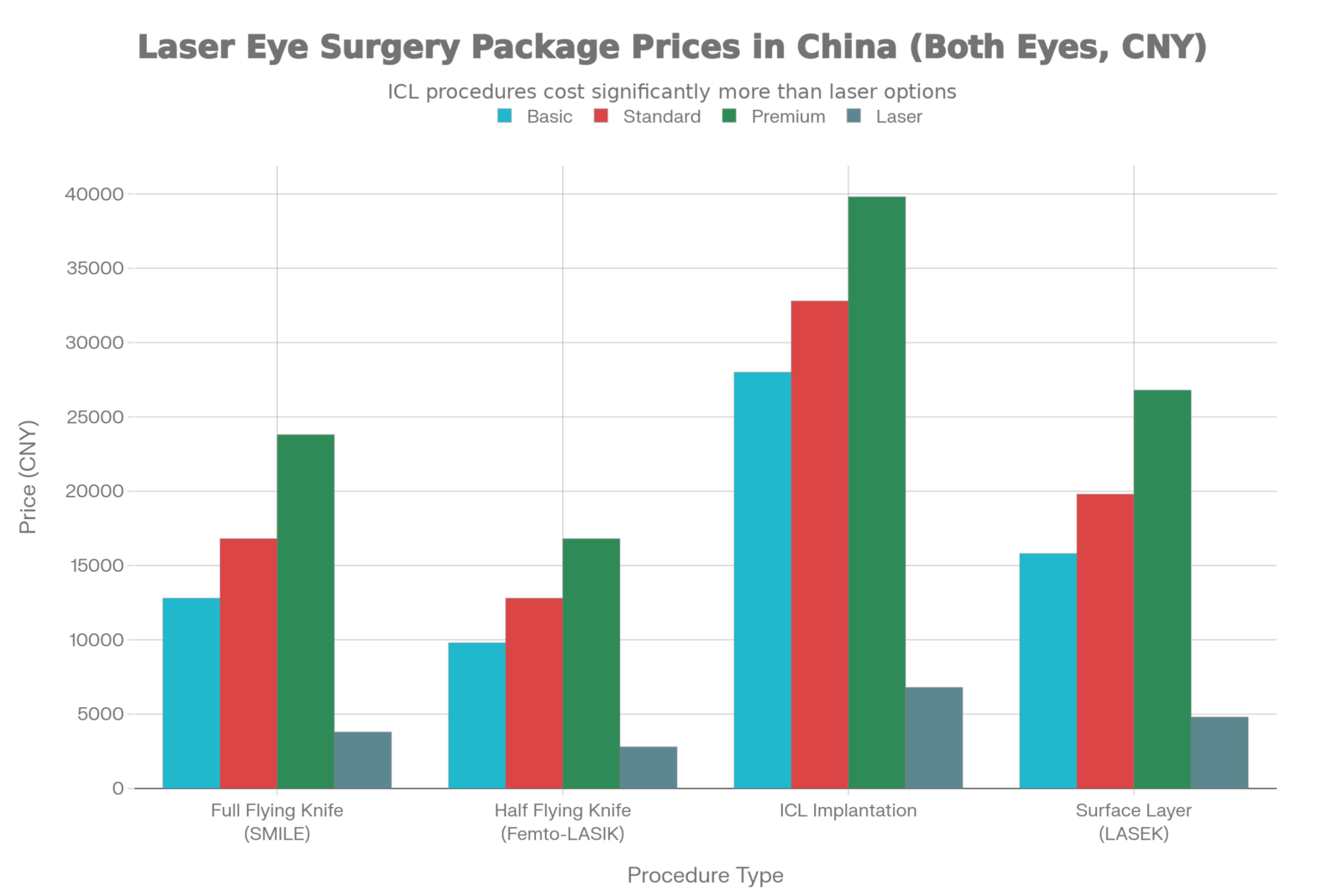
Laser Eye Surgery Package Prices in China (Both Eyes, CNY)
Understanding the total cost of laser eye surgery in China requires looking beyond procedure prices. This breakdown covers everything you'll spend from booking to recovery.
| Surgery Type | Basic Tier (Both Eyes) | Standard Tier (Both Eyes) | Premium/Custom Tier (Both Eyes) | Key Features & Price Description |
|---|---|---|---|---|
| Full Flying-Spot SMILE | $1,700 - $2,500 | $2,500 - $3,500 | $3,500+ | Most advanced laser surgery, high technical and equipment requirements, comprehensive pricing often includes personalized customization and top expert surgeons |
| Half Flying-Spot FS-LASIK | $1,100 - $1,600 | $1,600 - $2,500 | $2,500 - $4,500 | Most common choice, widest price range, basic tier is traditional LASIK, premium tier uses femtosecond laser flap with personalized ablation (Femto LASIK) |
| ICL Lens Implantation | $3,500 - $5,000 | $5,000 - $7,000 | $7,000+ | No corneal incision, suitable for high myopia or thin cornea patients, price depends on lens type and customization (e.g., toric for astigmatism correction - TICL, V5 lens), as this is implant surgery |
| Surface Laser (TransPRK/Smart) | $1,100 - $1,500 | $1,500 - $2,100 | $2,100+ | No incision, no flap, suitable for thin cornea, high motion demands, longer recovery time, non-premium procedures, relatively concentrated pricing |
Prices typically include:
- Pre-operative consultation and examinations
- Surgical procedure for both eyes
- Same-day post-operative medications
- First follow-up appointment (24-48 hours)
Prices may exclude:
- Extended eye drop supplies (¥200-500)
- Additional follow-up appointments (¥100-300 each)
- Medical escort/translation services
- Transportation and accommodation
Key Factors Affecting Price Tiers
The prices of the eye surgery procedures vary across different cities and hospitals depending on the following factors: advanced technology and newer equipment like Zeiss VisuMax or SMILE Pro for premium prices, while half flying-spot procedures with mechanical flap creation will cost less. The pricing will more or less depend on their geographic location and hospital tier. A first-tier city like Beijing, Shanghai and Western China are more expensive than cities fall in a second-tier city. Top hospitals in the capital cities will charge you more than regional medical institutions.
Physician credentials and reputation—especially experienced specialists with high surgical volumes—warrant higher fees. Finally, personalized customization needs, including wavefront-guided or topography-guided treatments (such as toric TICL for astigmatism), elevate costs into premium tiers.
💡 PRACTICAL TIP #2: Insurance Options
Purchase travel insurance covering medical procedures before departure. World Nomads and Allianz offer medical tourism coverage. Keep all receipts for potential FSA/HSA reimbursement at home. Some employers' international health plans cover elective procedures abroad.
Cost comparisons: China vs. other Asian medical tourism destinations
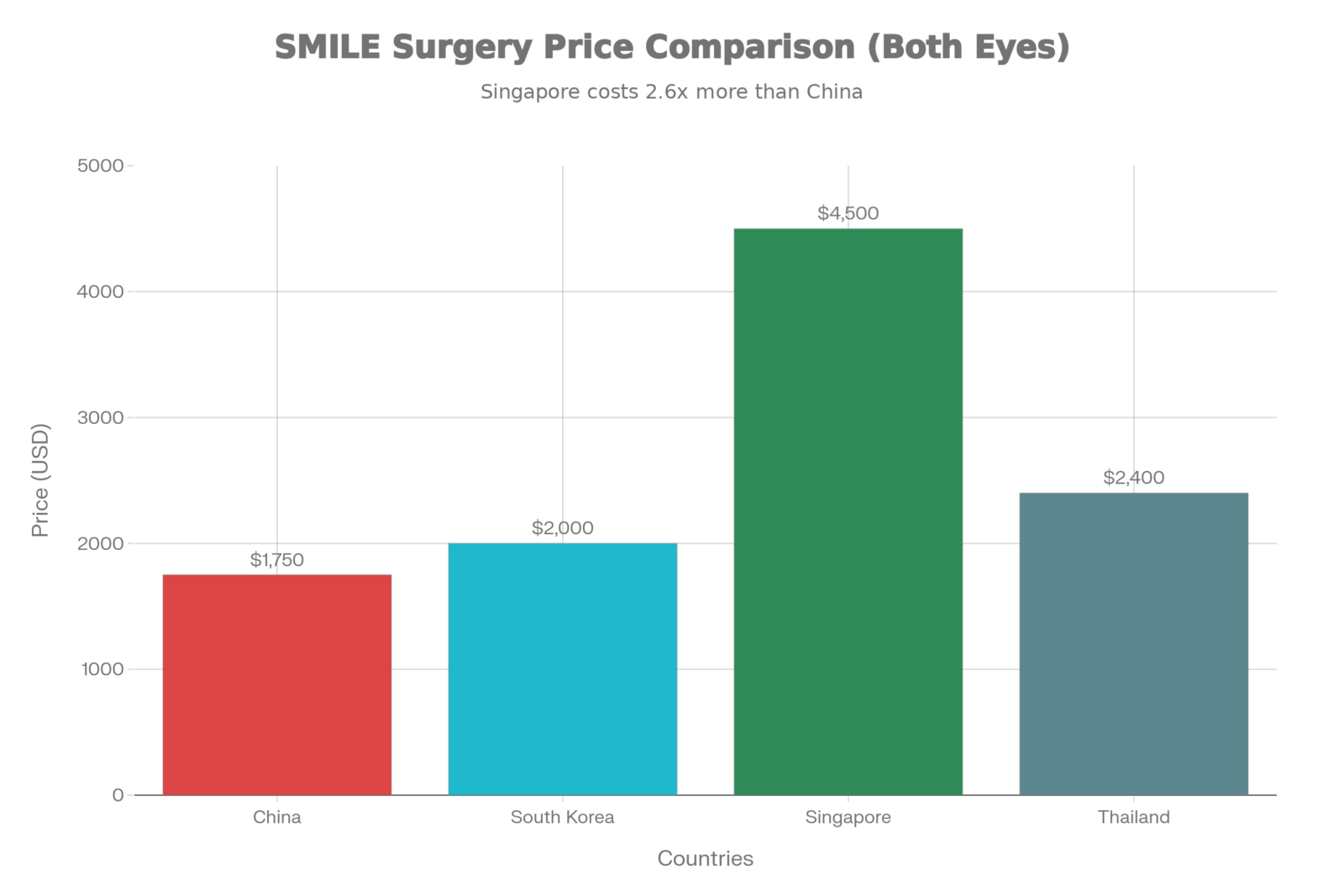
Smile Surgery Price Comparison(Both Eyes)
Comparing the cost of laser eye surgery in China against regional alternatives helps you choose wisely. Each destination offers distinct advantages across pricing, quality, and convenience factors.
Head-to-head comparison across key factors
| Factor | China (Highlight) | South Korea | Singapore | Thailand |
|---|---|---|---|---|
| SMILE Price (Both Eyes) | $1,500–2,000 | $2,000 | $4,000–5,000 | $1,800–3,000 |
| LASIK Price (Both Eyes) | $1,200–1,500 | $1,500 | $3,000–4,000 | $1,800–3,000 |
| ICL Price (Both Eyes) | $2,000–2,500 | $3,000–4,000 | $5,000–6,000 | $3,500–4,500 |
| English Service (EU/USA) | ⭐⭐⭐ | ⭐⭐⭐⭐ | ⭐⭐⭐⭐⭐ | ⭐⭐⭐ |
| Surgery Volume | Highest globally | Very high | Moderate | High |
| JCI Accreditation | Limited | Limited | Available | Extensive |
| Latest Technology | First access | Fast adoption | Current | Current |
When China beats the competition
- You want maximum surgical experience—China performs more procedures than any nation
- You seek SMILE specifically—Shanghai Fudan is the world's leading center
- You want access to newest technology—China receives equipment before Western markets
- Your prescription is complex—high-volume surgeons handle edge cases regularly
- Price sensitivity matters for comparable quality
South Korea offers comparable or lower SMILE prices with better English service. However, Korean clinics cannot match China's procedure volumes. Singapore provides Western standards at significantly higher costs. Thailand combines good quality with excellent hospitality but lacks China's technological edge.
When other destinations make more sense
- English communication is paramount—Singapore eliminates all language barriers
- JCI accreditation matters—Thailand's hospitals hold extensive international certifications
- Same-day surgery appeals—Korean clinics offer fastest turnaround
- Vacation integration is priority—Thailand combines beaches with recovery
- Visa simplicity is essential—Korea, Singapore, and Thailand all offer easier entry
Your specific priorities determine the best choice. China excels on expertise depth and technology access. Competitors win on convenience and communication.
💡 PRACTICAL TIP #3: Korea Alternative
South Korea's B&VIIT Eye Center has performed 550,000+ surgeries with AI prediction systems. SMILE prices run $1,800-2,000. English interpreters work on-site. Consider this if language concerns outweigh volume considerations when evaluating the cost of laser eye surgery in China.
Top 5 hospitals foreign patients choose for laser eye surgery in China
-
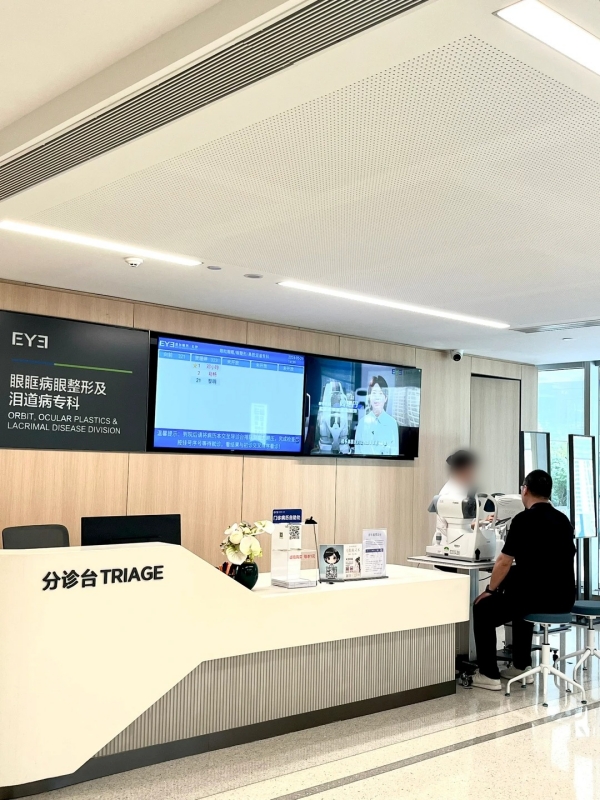

- Shanghai Eye & ENT Hospital
-
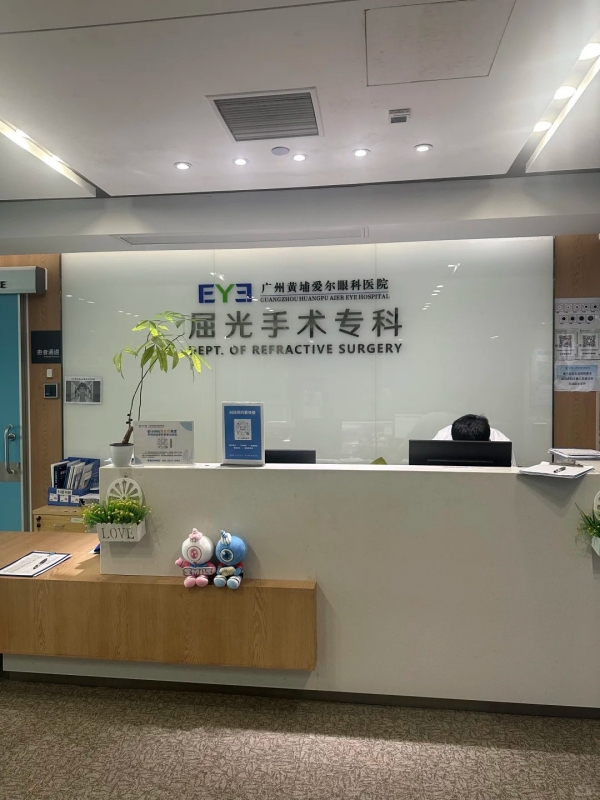
- Aier Eye Hospital
-
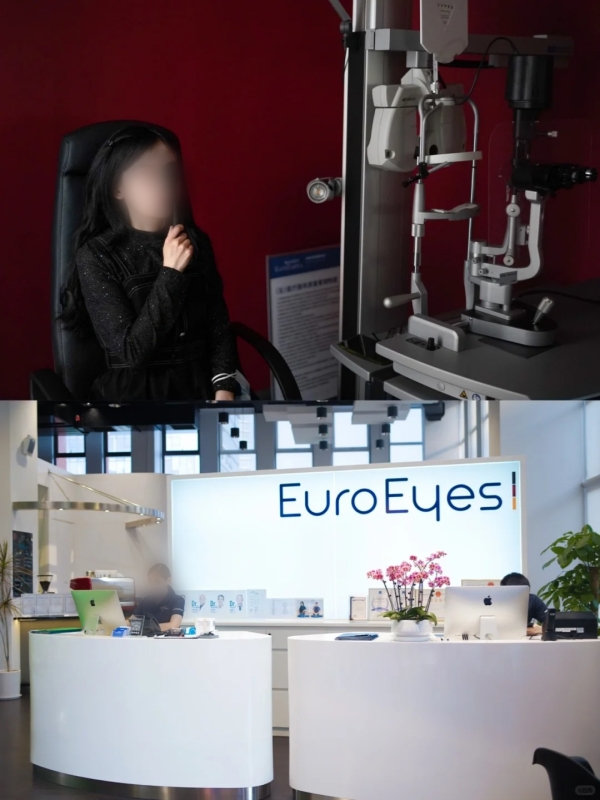
- EuroEyes
Selecting the right facility matters enormously for your outcome and overall cost of laser eye surgery in China. These hospitals specialize in serving international patients seeking world-class care.
Shanghai Eye & ENT Hospital of Fudan University: World's SMILE leader
Location: No. 83 Fenyang Road, Xuhui District, Shanghai (plus Pudong and Minhang campuses)
This public hospital performs more SMILE surgeries than any facility worldwide. Prof. Zhou Xingtao leads the refractive surgery center. His team has completed 260,000+ SMILE procedures since pioneering China's first in 2010. The hospital serves as the Asia-Pacific SMILE and ICL training center.
| Surgery Type | Price Range (USD) | Suitable Candidates | Description |
|---|---|---|---|
| Full Flying-Spot SMILE | $2,330 - $3,470 | Myopia ≤1000°, Astigmatism ≤500° | Small incision (2-4mm), no flap, faster recovery, less tear film damage |
| Half Flying-Spot Laser | $1,170 - $3,610 | Myopia ≤1200°, Astigmatism ≤600° | Individualized incision, suitable for high myopia |
| ICL Implantable Lens | $3,890 - $5,420 | High myopia (≥1000°) or thin cornea | Non-flap incision, reversible, EVO ICL requires no pre-correction (Cost: $4,190-$5,430) |
| Smart All-Laser | $1,830 - $2,080 | Corneal ectasia, moderate to low myopia | No flap, no corneal contact, suitable for corneal thinness |
| Quasi-Molecular Laser | $560 - $830 | Low myopia, thin cornea | Suitable for corneal thickness and thin patients |
The hospital used the VisuMax 800 for China's first 10-second SMILE Pro surgery. Equipment includes the latest Carl Zeiss systems. The facility handles 2.4 million+ outpatient visits annually. This represents China's cheapest SMILE price at a world-class institution.
Limitation: English services remain limited as a public hospital. Expect crowded conditions and potentially rushed consultations. Bring a translator or medical escort service.
Aier Eye Hospital Group: China's largest network with international standards
Locations: 800+ hospitals including Beijing, Shanghai, Shenzhen, Chengdu flagship centers
Aier operates the world's largest ophthalmology network spanning 649 mainland China locations. Prof. Wang established Aier's refractive surgery standards after performing China's first LASIK. The group employs 600+ refractive surgeons performing 800,000+ procedures annually.
| Surgery Type | Key Features/Technology | Reference Price Range (Double Eyes) |
|---|---|---|
| Full Flying-Spot Laser (SMILE) | No flap, micro-incision (about 2mm), no posterior recovery, minimal corneal damage, lower dry eye risk | Approx. $1,810 - $3,750 |
| Half Flying-Spot Laser | Flying-spot laser flap + quasi-molecular laser cutting, can be personalized (such as precision C+) | Approx. $1,250 - $3,060 |
| Surface Laser (e.g., TransPRK) | No flap, no incision, suitable for thin cornea, longer recovery time | Approx. $1,110 - $1,810 |
| ICL/TICL Implantable Lens | Non-corneal incision, reversible, suitable for high myopia or thin cornea, no iris damage, no need for early laser surgery | ICL: Approx. $3,890 - $5,280 TICL: Approx. $4,440 - $5,970 |
International patient departments offer English, Japanese, and Spanish services. Equipment includes Carl Zeiss VisuMax and WaveLight excimer laser systems. Aier has completed 8,000+ WaveLight Plus procedures.
Strength: Consistent standards across locations with established international protocols. Research institution status ensures access to latest techniques.
EuroEyes: Premium German care in major Chinese cities
Locations: Shanghai (Pudong), Beijing (East & West), Guangzhou, Shenzhen, Hangzhou, Hong Kong
This German company entered China's market in 2013 as the first foreign provider. Founder Dr. Jørn Jørgensen has performed 100,000+ eye surgeries personally. EuroEyes surgeons each complete 1,000+ procedures annually.
| Surgery Category | Specific Technique | Reference Price Range (USD) |
|---|---|---|
| Laser Surgery | Full Flying-Spot Laser (SMILE) | $1,810 - $4,140 (Note: Micro-incision, faster recovery. Price varies by city, whether high-end or SMILE Pro, or personalized customization) |
| Half Flying-Spot Laser | $1,180 - $3,890 (Note: Basic version is cheaper, personalized e.g., "Micro-Vision A+" is more expensive) | |
| Quasi-Molecular Laser (LASIK) | $1,390 - $2,500 (Note: Basic quasi-molecular laser surgery) | |
| Lens Implantation Surgery | ICL/TICL Lens Implantation | $2,150 - $5,530 (Note: Suitable for high myopia or thin cornea. TICL scatter correction type is usually more expensive) |
| Tri-focal Lens Implantation | $4,860 and above (Note: Mainly for correcting presbyopia and cataracts, suitable for people over 45) |
All staff speak English fluently. German doctors utilize German instruments and protocols. Premium facilities occupy landmark locations like Shanghai's Jinmao Building.
Best for: Patients prioritizing Western communication standards and premium experience over lowest price when considering the cost of laser eye surgery in China.
C-MER Dennis Lam Eye Hospital: Hong Kong quality in Shenzhen
Location: Floors 1-2, Shengtang Mansion, Tairan No. 9 Road, Futian District, Shenzhen
This was the first hospital in mainland China to be founded by a Hong Kong investor, Dr. Dennis Lam, who is a Hong Kong legislator and trained at the Chinese University of Hong Kong. The hospital has attained AA rating and NO.3 ranking in Shenzhen for patients’ satisfaction. It is staffed by doctors from Hong Kong as well as those trained in the UK and the US.
English-speaking service is available. Follow up care is offered at satellite clinics in other parts of HK. They operate a day surgery approach which minimises the length of stay in hospital.
Best for: Patients who want English service with geographic convenience to Hong Kong.
Beijing Tongren Hospital: China's most famous eye center
Location: 8 Chongwenmennei Avenue, Dongcheng District, Beijing
This Grade A, Class III hospital (China's highest rating) dates to 1886. Tongren handles 1,000,000+ outpatient visits annually with 78,000+ surgeries. The ophthalmology department holds National Key Clinical Specialty designation. Corneal transplant success rates reach 98.5%.
| Surgery Type | Reference Price Range (Double Eyes) | Key Features / Description |
|---|---|---|
| Full Flying-Spot SMILE | $3,060 - $5,560 | Small incision (about 2mm), no flap, micro-incision, faster recovery, lower corneal damage, lower dry eye risk |
| Half Flying-Spot LASIK | $1,390 - $2,780 | Use flying-spot laser to make flap, then use quasi-molecular laser cutting, can be individualized |
| ICL/TICL Lens Implantation | $4,310 - $6,670 | Non-flap incision, lens implantation into eye, no corneal contact, suitable for high myopia, can be reversed |
| Smart All-Laser (TPRK) | $2,220 - $3,470 | Surface laser, no incision, no corneal contact, suitable for thin cornea, longer recovery time |
The international pharmacy accepts foreign credit cards. Examination packages cost ¥800-2,000. Equipment includes PRK, LASEK, LASIK, SBK, FS-LASIK, and SMILE capabilities.
Limitation: Limited English compared to private hospitals. Very high volumes may mean less personalized attention.
City comparison helps narrow your destination choice
| Factor | Shanghai | Beijing | Shenzhen | Guangzhou |
| Top Hospital | Fudan Eye | Tongren | C-MER | Wu Jing |
| English Service | Limited (public) | Limited | Good | Moderate |
| Best Price | ¥15,500 SMILE | Varies | Premium | ¥20,000+ |
| Flight Access | Pudong/Hongqiao | Capital/Daxing | Bao'an | Baiyun |
| Recovery Appeal | Good | Average | Close to HK | Average |
Shanghai offers the best combination of expertise and pricing for SMILE procedures. Shenzhen suits patients wanting proximity to Hong Kong's English environment. Beijing provides the largest public hospital capacity.
💡 PRACTICAL TIP #4: Language Planning
Book a medical escort service for public hospitals lacking English staff. Services cost $100-200 per day. Request English-speaking doctors when scheduling: Dr. Li Haiyan (Aier Shanghai) speaks English. EuroEyes provides guaranteed English service at all locations.
Key 5 steps to verify hospital value before committing funds
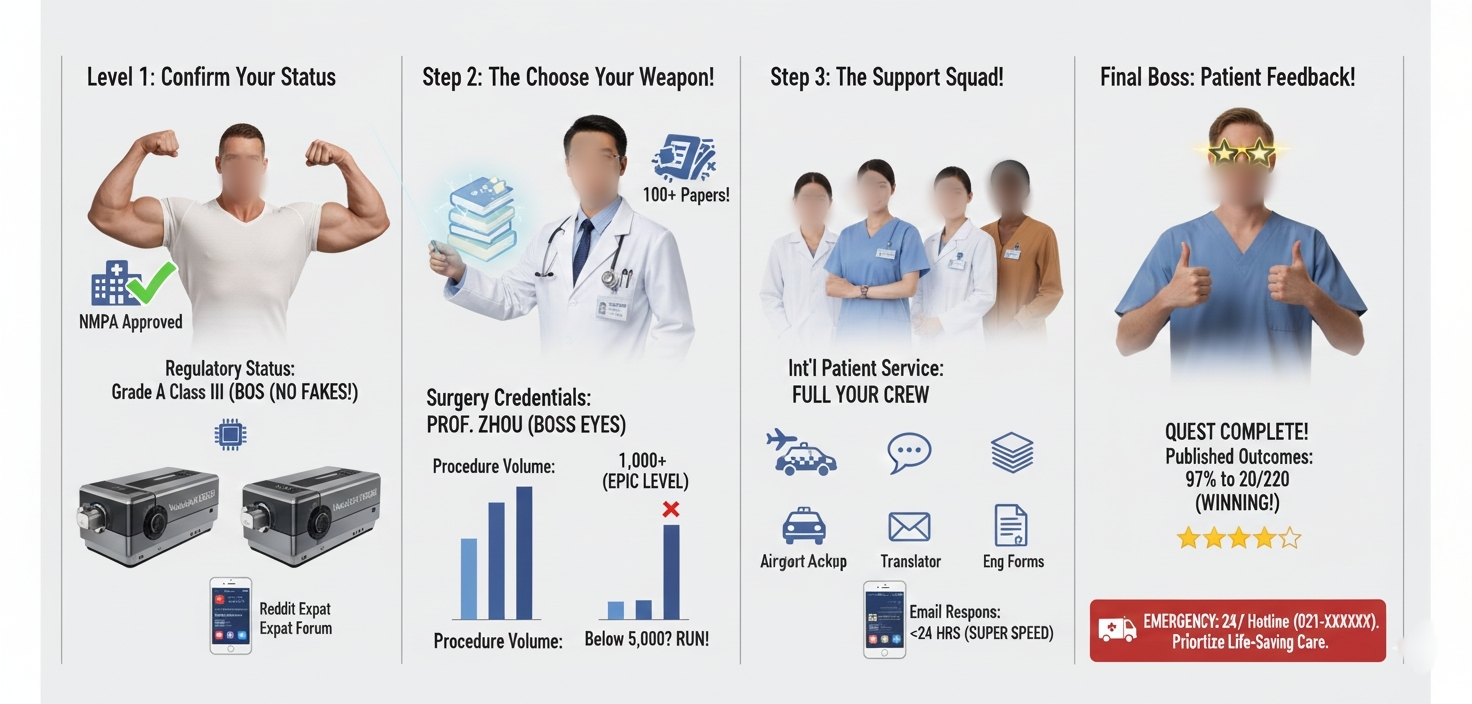
5 Steps to Verify Hospital Credentials
Confirming quality protects your investment in the cost of laser eye surgery in China. Follow this verification checklist before committing.
Step 1: Confirm regulatory status and hospital classification
China has a three-tier, three-class system of classifications for hospitals. Grade A, Class III is the highest level. Beijing Tongren and Shanghai Fudan are both rated as such hospitals. Private hospitals operate under different ranking systems but should at least be rated AA.
Check the level of registration with the National Health Commission. All medical devices in China must be approved by the National Medical Products Administration (NMPA). Ensure your chosen hospital uses NMPA-approved laser equipment. Aier Eye Hospital is listed on A shares with a stock code of 300015.
Step 2: Verify surgeon credentials and procedure volumes
Request your surgeon's specific statistics before booking. Prof. Zhou has published 100+ peer-reviewed papers and 8 Journal of Refractive Surgery covers. Prof. Wang holds WCRS Fellowship and established global refractive standards with Dr. Ronald Krueger. These credentials verify expertise independently.
Ask for procedure volumes: How many SMILE surgeries has this surgeon personally performed? How many this year? What is their enhancement rate? Surgeons at leading centers should have 10,000+ personal procedures. Anything below 5,000 warrants additional scrutiny.
Step 3: Confirm equipment certification and technology versions
The Carl Zeiss VisuMax is still the only femtosecond laser approved for lenticule extraction in China. Find out if your hospital uses the VisuMax 800 (newest) or VisuMax 500 (older but well-established). Both give great results, though with slightly different characteristics in terms of speed.
For LASIK, ensure there’s a WaveLight EX500 excimer laser available. The 500Hz pulse rate and the 1050Hz eye tracker represent standards from the industry. Find out if the diagnostic equipment includes an Alcon Sightmap, corneal tomography, and wavefront aberrometry. They all should be available.
Step 4: Evaluate international patient infrastructure
Contact the international department before arrival. Test their English responsiveness via email.
Confirm what services the international department provides:
- Airport pickup availability
- Appointment scheduling in English
- Translation during consultations
- English consent forms and post-operative instructions
- Assistance with hotel bookings near the hospital
Step 5: Review patient feedback and reported outcomes
Search for patient reviews on English-language platforms. Request the hospital's published outcomes data. Shanghai Fudan Eye Hospital reports 97% within ±1.0 diopter of target. Aier Eye Hospital achieved 100% to 20/20 vision at 3 months with WaveLight Plus. Be cautious of hospitals unwilling to share statistics.
What happens inside the operating room and during recovery
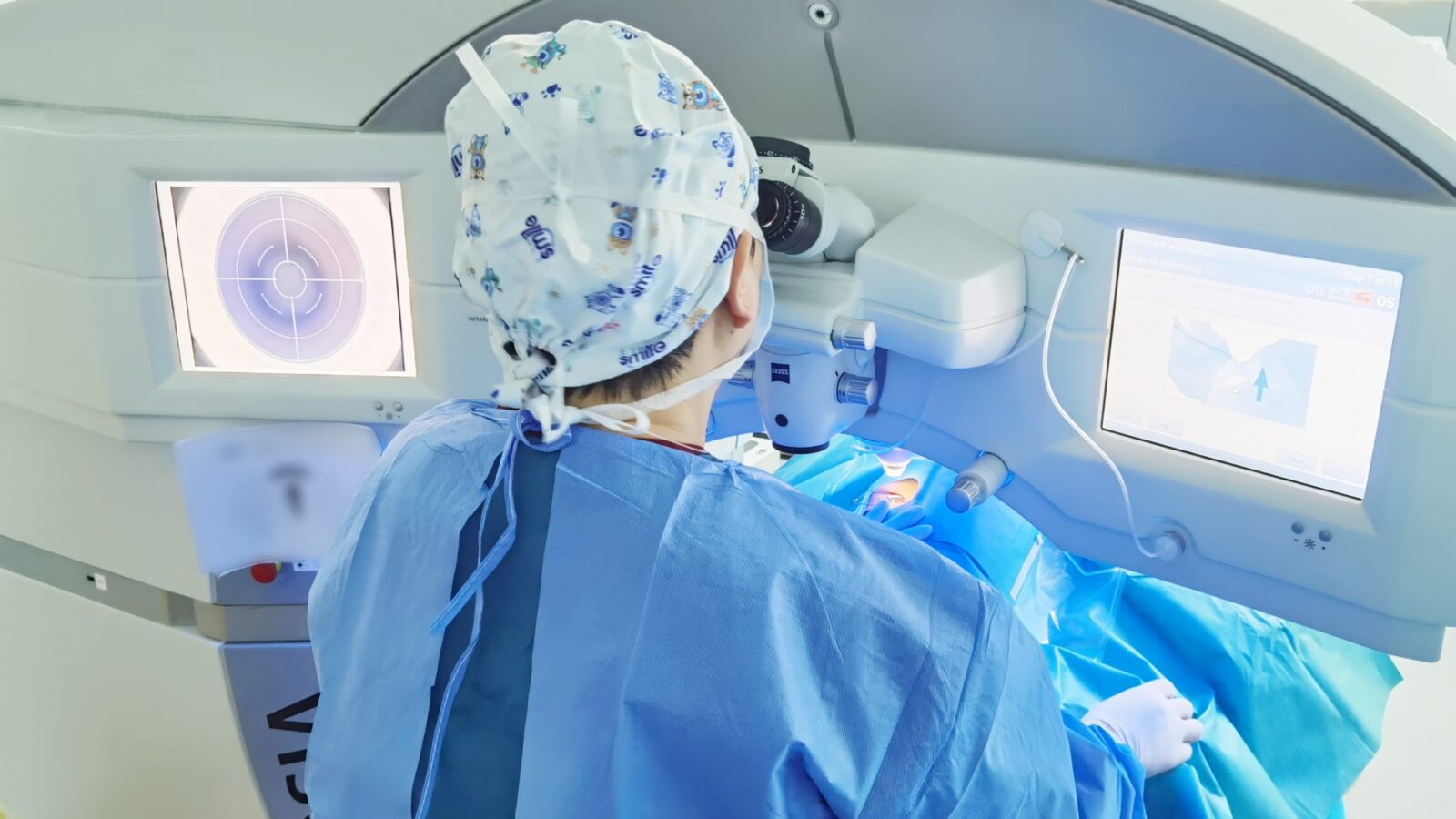
SMILE (Small Incision Lenticule Extraction)
Understanding the surgical experience prepares you mentally for laser eye surgery in China. Here's exactly what to expect throughout the process.
Pre-operative preparation takes 2-3 hours
Your surgery day begins with arrival 1-2 hours before your scheduled time. Nurses verify your identity and review your medical history. They may offer a mild sedative to reduce anxiety.
Eye drop administration starts the numbing process. Topical anesthesia eliminates pain completely—you feel only pressure sensations. Staff clean the eye area thoroughly. A speculum holds your eyelids open throughout the procedure.
Final equipment calibrations occur based on your measurements. The surgeon reviews your corneal map one final time. You receive clear instructions: 'Look at the green light. Do not move.'
The procedure itself lasts 5-30 minutes total
SMILE (8-10 seconds laser time with VisuMax 800): You stare at a fixation light while the femtosecond laser creates the lenticule. The clicking sound indicates laser pulses. Pressure sensation feels significant but painless. The surgeon then makes the small incision and extracts the lenticule manually. Total time: approximately 10 minutes per eye.
LASIK (15-20 minutes total): The femtosecond laser creates your corneal flap first. A brief suction sensation occurs during flap creation. The surgeon folds back the flap. The excimer laser then reshapes your cornea—you may smell a faint burning odor. This is normal and indicates tissue ablation. The flap returns to position and self-adheres.
Immediate post-procedure observation lasts 30+ minutes. Staff administer initial eye drops. Your vision appears foggy and may include halos. This resolves within hours for most patients.
Recovery milestones follow predictable patterns
| Timeframe | What to Expect |
|---|---|
| 0-2 hours | Foggy vision, burning/stinging sensation, light sensitivity |
| 2-6 hours | Discomfort peaks then subsides, rest with eyes closed |
| 24 hours | Significant vision improvement, first follow-up appointment |
| 48 hours | Most return to office work, avoid screens for extended periods |
| 1 week | Near-optimal vision, minor fluctuations normal |
| 1 month | Most side effects resolved, eye rubbing still restricted |
| 3 months | Enhancement eligibility assessment if needed |
| 6 months | Full stabilization complete |
Post-operative restrictions:
- No swimming: 2 weeks (pools), 4 weeks (natural water)
- No strenuous exercise: 1 week
- No eye makeup: 1-2 weeks
- No eye rubbing: 1 week minimum (critical for flap procedures)
- Wear sunglasses outdoors during initial recovery
Follow-up care protocols and managing potential complications

Follow-up Care
Proper aftercare ensures optimal outcomes from your laser eye surgery in China. Plan your follow-up schedule carefully to maximize the value of your investment in the cost of laser eye surgery in China.
The essential follow-up appointment schedule
24-48 hours post-surgery (Mandatory): Your surgeon examines corneal healing and flap position. Vision testing confirms initial results. Additional drops may be prescribed. Never skip this appointment.
One week (Highly recommended): Extended healing assessment identifies any concerns early. Vision stability measurement guides activity clearance. You receive updated restrictions based on your progress.
One month (If staying or returning): Refinement assessment determines whether enhancement might help. Most patients achieve target vision by this point. Activity restrictions lift for most patients.
Three to six months (Can be done at home): Final stabilization confirmation occurs. Enhancement procedures become possible if needed. Your home optometrist can perform this check with Chinese medical records.
What to do if complications arise during your stay
Dry eyes (Most common): Artificial tears every 1-2 hours initially. Preservative-free drops work best long-term. Symptoms typically peak at 1-3 months then resolve. Chinese pharmacies stock multiple brands.
Infection signs (Rare but serious): Increasing redness, pain, discharge, or worsening vision require immediate attention. Contact your hospital's 24-hour line immediately. Beijing Tongren emergency: (+8610) 58266699.
Vision fluctuations: Expect some variability during the first month. This does not indicate failure. Report consistent blurriness lasting more than 3 days.
Flap complications (LASIK only): Avoid all eye rubbing. Report any trauma immediately. Dislodged flaps require same-day repositioning.
Planning follow-up care after returning home
Request comprehensive English documentation before departure.
This should include:
- Pre-operative measurements and diagnostics
- Surgical report with procedure details
- Post-operative examination findings
- Eye drop prescriptions with generic names
- Recommended follow-up schedule
Contact your home optometrist before traveling. Many can perform follow-up examinations with Chinese records. Provide them with surgeon contact information for questions.
Enhancement procedures if needed can happen at home. Your Chinese surgeon's records enable any qualified ophthalmologist to perform touch-ups. Aier Eye Hospital and EuroEyes both coordinate international follow-up.
Emergency resources for international patients
| City | Hospital | Emergency Contact |
| Beijing | Beijing Tongren | (+8610) 58266699 (24/7) |
| Shanghai | United Family Hospital | (+8621) 22163999 (24/7) |
| Shenzhen | C-MER Dennis Lam | Via Hong Kong offices |
Register with your home country's embassy before traveling. Keep digital and printed copies of passport, visa entry stamp, and insurance documents. Save hospital contacts offline in case internet access fails.
💡 PRACTICAL TIP #5: Documentation Package
Request a 'medical tourism documentation package' from your hospital. This includes all records in English, surgeon's direct contact, and recommended follow-up protocol. EuroEyes and Aier International provide this standard.
Visa options, trip timing, and complete travel planning
Planning your laser eye surgery in China requires careful attention to entry requirements. Recent policy changes create excellent options for medical tourists looking to minimize the overall cost of laser eye surgery in China.
The 30-day visa-free policy covers most nationalities
Citizens from 48 countries can enter China visa-free for 30 days through December 31, 2026. This policy explicitly permits medical treatment. Eligible nationalities include major European countries, Australia, New Zealand, and selected others.
1.Eligible European countries: France, Germany, Italy, Netherlands, Spain, Switzerland, Ireland, Austria, Belgium, Poland, Portugal, Greece, Finland, Denmark, Sweden, Norway, and more.
2.Eligible Asia-Pacific: Japan, South Korea, Singapore, Brunei, Malaysia, Australia, New Zealand.</p>
3.Eligible Americas/Middle East: Brazil, Argentina, Chile, UAE, Sa
udi Arabia, and others.
Requirements remain simple: valid passport with 6+ months validity. No advance notification required. Multiple entries permitted within the policy period. Register with local police within 24 hours—hotels handle this automatically.
The 240-hour transit option works for quick procedures
If your nationality lacks visa-free status, consider the 240-hour (10-day) transit visa-free program. This covers 55 countries entering through 65 designated ports. Beijing, Shanghai, Guangzhou, Shenzhen, and Chengdu airports all qualify.
Key requirements include:
- Confirmed onward ticket to a third country (not your departure country)
- Transit through designated entry/exit ports
- Passport valid 3+ months
The 10-day window provides adequate time for consultation, surgery, and initial recovery. Plan your third-country destination strategically—Hong Kong, Singapore, or Japan work well.
Your recommended trip timeline runs 7-14 days minimum
| Day | Activities |
|---|---|
| Day 1 | Arrive in China, rest, adjust to time zone |
| Day 2 | Hospital registration, comprehensive eye examination (3+ hours) |
| Day 3 | Results review, surgical planning, possibly same-day surgery |
| Day 4 | Surgery day if not day 3 (procedure + 3 hours at clinic) |
| Day 5 | First mandatory post-operative check (24-48 hours after) |
| Days 6-7 | Recovery, light activity, one-week follow-up if extending |
| Days 8-14 | Optional: Extended recovery, tourism, additional follow-up |
Critical pre-surgery requirement: Stop wearing contact lenses 7-14 days before surgery. Soft contacts require 7 days minimum. Hard contacts need 14+ days. Your cornea must return to natural shape for accurate measurements.
Seasonal considerations affect both travel and recovery
Best periods: April-May and September-November offer comfortable weather and moderate hospital volumes. Shanghai's spring provides ideal recovery conditions. Autumn brings clear skies and lower humidity.
Avoid: Chinese New Year (late January-February) shuts down much of China for 1-2 weeks. National Day week (October 1-7) brings domestic travel surge and higher prices. Summer brings heat and humidity that may irritate recovering eyes.
Winter option: December-February offers lower prices and minimal wait times. Cold weather and indoor heating may increase post-operative dryness. Pack artificial tears generously.
💡 PRACTICAL TIP #6: Contact Lens Timing
Mark your calendar for contact lens removal 14 days before departure. This ensures adequate corneal recovery time. Bring your current glasses for the trip. Consider disposable contacts for arrival day if you must travel corrected.
Payment methods, language support, and daily logistics
Laser Eye Surgery in China
Navigating practical matters smoothly enhances your laser eye surgery experience and helps manage the cost of laser eye surgery in China effectively. Plan these elements before departure.
Payment options range from mobile apps to wire transfers
Alipay (Recommended): Download before departure and link your Visa, Mastercard, or Amex. Transaction limits reach $5,000 per transaction and $50,000 annually. Under ¥200 incurs no foreign fees. Above ¥200 adds approximately 3%. The app includes English interface with built-in translation.
WeChat Pay: Same international card linking capability with identical limits. Verification proves more complicated than Alipay. Many hospitals use WeChat mini-programs for registration. Having both apps ready prevents frustration.
International Cards: Major hospitals accept Visa and Mastercard at international departments. Tongren's international pharmacy specifically supports foreign cards. Expect some terminals to decline—always have mobile payment backup.
Wire Transfer: Available for larger amounts through hospital financial departments. Allow 3-5 business days for funds to clear. Some hospitals require pre-payment this way.
Cash (CNY): ATMs dispense Chinese yuan widely. Carry ¥2,000-5,000 for incidentals. Small vendors and taxis may not accept cards. Your bank may charge foreign ATM fees.
Language barriers require proactive planning
Hospitals with English service:
- EuroEyes: Full English staff guaranteed
- Aier International Division: Bilingual coordinators available
- C-MER Dennis Lam: Hong Kong-trained English-speaking doctors
Public hospital strategies:
- Request English-speaking surgeons when booking (Dr. Li Haiyan at Aier Shanghai)
- Book medical escort services ($100-200/day)
- Prepare medical vocabulary cards in Chinese
- Download offline translation apps before arrival
Essential apps to download:
- Alipay: Payment and translation features
- WeChat: Messaging and hospital mini-programs
- Baidu Maps or Amap: Navigation in China
- DeepL or Google Translate: Download Chinese offline pack
- VPN (ExpressVPN, NordVPN): Required for Western apps and email
Comparison of hospitals by language accessibility
| Hospital | English Level | Booking in English | English Consent Forms | Follow-up Support |
|---|---|---|---|---|
| EuroEyes | Excellent | Yes | Yes | Yes |
| Aier International | Good | Yes | Available | Yes |
| C-MER Dennis Lam | Good | Yes | Yes | Via HK clinics |
| Fudan Eye Hospital | Limited | Difficult | Limited | Limited |
| Beijing Tongren | Limited | Via international dept | Limited | Limited |
💡 PRACTICAL TIP #7: VPN Setup
Install your VPN before entering China. VPN app stores become inaccessible within China. ExpressVPN offers the most reliable connections during crackdowns. Alternative: Purchase a China eSIM that bypasses the firewall entirely.
Frequently asked questions about cost of laser eye surgery in China
Q: How much does laser eye surgery cost in China?
The cost of laser eye surgery in China ranges from $1,100-$3,500 depending on the procedure and hospital. SMILE costs $2,150-$3,000 at top facilities like Shanghai Fudan Eye Hospital, while standard LASIK starts at $1,100. ICL implants run $1,920-$3,500 per eye. These prices include pre-operative exams, surgery, and initial follow-up appointments.
Q: Which country is the cheapest for laser eye surgery?
When evaluating the cost of laser eye surgery in China versus other countries, China and South Korea offer the lowest prices globally. Thailand and India also provide budget options. However, China delivers the best value combining low prices with world-leading surgical volumes and cutting-edge technology. Shanghai Fudan's $2,150 SMILE represents exceptional quality-to-price ratio.
Q: Is LASIK in China cheaper than other countries?
Yes, the cost of laser eye surgery in China remains 50-70% lower than Western countries. US LASIK costs $4,000-$6,000 versus $1,100-$1,400 in China. Singapore charges $2,400-$4,500 compared to China's rates. Chinese hospitals use identical Carl Zeiss and Alcon equipment, so lower prices reflect operating costs, not quality compromises.
Q: What is the cost difference between SMILE and LASIK in China?
The cost of laser eye surgery in China shows minimal difference between procedures. SMILE costs $2,150-$3,000 versus $2,000-$3,200 for Femto LASIK at premium hospitals. This narrow gap differs from Western markets where SMILE typically costs $2,000 more. Budget clinics offer standard LASIK from $1,100, but SMILE remains unavailable at lower-tier facilities.
Q: Which Chinese city offers the best value for laser eye surgery?
Shanghai provides optimal value when considering the cost of laser eye surgery in China. Fudan Eye Hospital offers world-class SMILE at $2,150—China's lowest price for top-tier care. The city combines exceptional surgical expertise with convenient international access. Beijing and Shenzhen cost 20-40% more while offering comparable technology and outcomes.
Q: Does insurance cover laser eye surgery in China?
Most international insurance excludes the cost of laser eye surgery in China as it's considered elective. However, some global health plans or employer-sponsored international coverage may offer partial reimbursement. Purchase supplemental travel medical insurance before departure. Keep all receipts for potential FSA/HSA claims upon returning home for eligible tax benefits.
Q: Are there hidden costs for laser eye surgery in China?
Understanding the true cost of laser eye surgery in China requires considering extras beyond quoted prices. Budget $200-500 for extended eye drops, $100-300 per additional follow-up, and $100-200 daily for medical escort services at public hospitals. Transportation, accommodation, and meals add $1,000-2,500 depending on preferences. Total trip costs still undercut Western surgery prices.
Q: How much does laser eye surgery cost in Shanghai specifically?
The cost of laser eye surgery in China's Shanghai ranges from $2,150-$3,200 for SMILE and $1,250-$2,150 for LASIK. Fudan Eye Hospital charges ¥15,500 ($2,150) for SMILE—the city's lowest rate. Premium EuroEyes charges $3,200 with German doctors. Shanghai First People's Hospital offers mid-range pricing at $2,200-$2,650 for SMILE procedures.
Q: Can I negotiate prices for laser eye surgery in China?
Public hospitals maintain fixed pricing for the cost of laser eye surgery in China with no negotiation flexibility. Private chains like Aier occasionally offer package deals or seasonal promotions reducing costs 5-15%. International patient departments may bundle translation services at discounted rates. Group bookings rarely receive discounts. Focus on comparing hospital capabilities rather than negotiating prices.
Q: What payment methods do Chinese eye hospitals accept?
Managing the cost of laser eye surgery in China requires multiple payment options. Major hospitals accept Visa/Mastercard at international departments, though some terminals decline foreign cards. Alipay and WeChat Pay link to international cards with $5,000 transaction limits. Wire transfers work for large amounts but need 3-5 days processing. Carry ¥2,000-5,000 cash for incidentals.